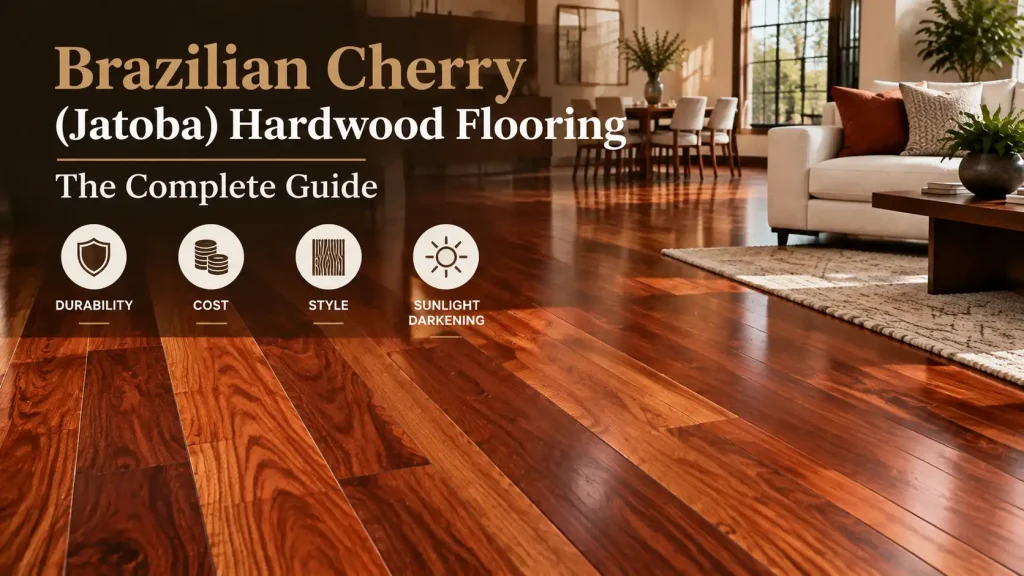
Brazilian cherry, known botanically as Jatoba, is one of the hardest and most striking hardwood floors you can install. With a Janka rating of roughly 2,350 to 3,500, it far outlasts oak and even hickory in dent resistance, and its rich red-brown color makes a bold statement. Its defining trait: Brazilian cherry is photosensitive, so it darkens noticeably with sunlight, often within weeks. It is a premium, imported wood best suited to larger, high-traffic rooms. Here is the complete, honest guide.
At National Hardwood Flooring & Moulding, we have supplied Brazilian cherry flooring to Southern California homes and projects since 1984. Browse our full hardwood flooring range, or read on for everything you need to know about Jatoba.
What Is Brazilian Cherry? (Jatoba, Not True Cherry)
First, a clarification that matters. “Brazilian cherry” is a trade name, not a botanical one. The wood is Jatoba (Hymenaea courbaril), a dense tropical hardwood from Central and South America. It is named for its warm, cherry-like red tones, but it is not related to true American cherry and is dramatically harder. If you love the reddish color of American cherry but want something far tougher, Jatoba is that wood.
How Hard Is Brazilian Cherry?
Extremely hard. This is Jatoba’s headline advantage.
| Species | Janka rating |
| American black walnut | ~1,010 |
| Red oak | 1,290 |
| White oak | 1,360 |
| Hard maple | ~1,450 |
| Hickory | 1,820 |
| Brazilian cherry (Jatoba) | ~2,350–3,500 |
At roughly 2,350 to 3,500 on the Janka scale (sources vary by sample), Brazilian cherry is far harder than red oak (1,290), white oak (1,360), and even hickory (1,820), the hardest common domestic species. That toughness makes it outstanding for hallways, stairs, dining rooms, and active homes. The trade-off is that its density makes it harder to cut, nail, sand, and refinish, so installation and refinishing take more labor.
Does Brazilian Cherry Darken Over Time?
Yes, and this is the single most important thing to understand before you buy. Brazilian cherry is photosensitive: UV light and normal oxidation deepen its color over time. A freshly installed floor often looks lighter, even slightly orange, and then mellows into a rich amber-red or deep mahogany-brown. The first change can appear within weeks, with more darkening over the following months.
This surprises a lot of homeowners, who look at the floor a few months later and feel it is not the one they chose. It is not a flaw — it is what this wood naturally does — but you should plan for it:
- Buy lighter than your target. Choose a shade slightly lighter than the final look you want, because it will deepen.
- Rotate rugs and furniture. Anything blocking light slows darkening underneath, so rugs and furniture can leave lighter patches. Move them periodically, especially in the first year, so the floor ages evenly.
- Manage strong light. Curtains, blinds, and window film in the brightest rooms even out the shift.
Brazilian Cherry and Southern California Sun
Because darkening is driven by light, Southern California’s strong, abundant sun accelerates it. Rooms with large windows, skylights, or all-day exposure will darken faster and are more prone to uneven patches where rugs and furniture sit. It is very manageable — rotate rugs, use window treatments in the sunniest rooms, and expect the richest color in high-light spaces — but it is worth planning for at the design stage. Ask us about UV-aware finishes that help even out the change.
Color, Grain, and Style — Are Brazilian Cherry Floors Outdated?
Brazilian cherry has a deep red-brown color and a wavy, interlocked grain with an open texture similar to oak. It reads as warm, rich, and dramatic — a statement floor rather than a quiet backdrop.
Is it outdated? Not exactly, but it is a strong design commitment. The very dark, red-toned look is less on-trend than the lighter, more neutral floors dominating current design, so it works best when you want a bold, traditional-to-transitional statement in a larger, well-lit room. In small or dim spaces it can feel heavy. Styled with lighter walls, furnishings, and plenty of light, it still looks intentional and premium. If you prefer a lighter, more current palette, compare with our maple or white oak options instead.
Staining and Refinishing
Two practical notes. First, Brazilian cherry does not take stain well — its swirly, interlocked grain absorbs unevenly, so stain tends to look blotchy. It is best enjoyed in its natural color or bought prefinished, not custom-stained on site. Second, its extreme hardness makes sanding a demanding job, though the result is beautifully smooth. Both are reasons most Brazilian cherry is sold prefinished. See our stains and finishes selection for finish options.
Where Brazilian Cherry Works (and Where It Doesn’t)
Match it to the right space and it performs for decades.
| Room | Fit | Why |
| Living / family rooms | Excellent | Statement color, handles traffic |
| Dining rooms | Excellent | Very hard — shrugs off chair scuffs |
| Hallways / stairs | Excellent | Extreme hardness suits high-wear zones |
| Larger bedrooms | Very good | Rich, warm; needs room to breathe |
| Small / dim rooms | Use caution | Dark color can feel closed-in |
| Bathrooms / laundry | Not recommended | Standing water and humidity risk |
Two cautions: like most dark floors, Brazilian cherry shows dust and pet hair more than a pale floor, so plan on regular light cleaning; and because wood absorbs moisture, it should not go in bathrooms, laundry rooms, or any area with standing water or unstable humidity.
Solid vs. Engineered Brazilian Cherry
Construction matters as much as species.
- Solid Brazilian cherry: milled from one piece; can be sanded and refinished multiple times. Best in climate-controlled rooms above grade with stable humidity.
- Engineered Brazilian cherry: a real Jatoba veneer over a stable plywood core. Much more stable against humidity the safer choice for concrete slabs, basements, and radiant heat. Usually comes prefinished.
We stock both solid and engineered Brazilian cherry, with samples in the showroom so you can compare in person.
Brazilian Cherry Flooring Cost
Brazilian cherry is a premium, imported hardwood. Material commonly runs from around $5.50 to $11 or more per square foot depending on grade, width, and construction often 20 to 40 percent above domestic oak. The premium reflects import status, its hardness, and that Jatoba is a slower-growing tropical species. If sustainable sourcing matters to you, ask us about the origin and certification of the products we carry.
For an accurate figure on your project, bring your square footage and grade preference to our Van Nuys showroom and we will price the material and finishing.
Brazilian Cherry Flooring FAQ
What are the disadvantages of Brazilian cherry?
It darkens noticeably with sunlight, does not take stain well, shows dust because of its dark color, is harder to install and refinish due to its density, and is more expensive than domestic hardwoods.
Is Brazilian cherry wood good for flooring?
Yes. It is one of the hardest, most durable flooring woods available and offers a rich, warm look, making it excellent for high-traffic, larger, well-lit rooms — as long as you plan for its color change.
Is Brazilian cherry hardwood expensive?
It is a premium wood, typically 20 to 40 percent more than oak, often around $5.50 to $11 or more per square foot for material before installation.
Where can I buy Brazilian cherry hardwood flooring?
National Hardwood Flooring & Moulding stocks Brazilian cherry in solid and engineered options at our Van Nuys showroom, serving homeowners, designers, and contractors across Southern California.
See Brazilian Cherry in Person
Because the color changes so much with light, it is worth seeing full-size samples in your own space before you commit. Visit our Van Nuys showroom to compare solid and engineered Brazilian cherry across grades and widths, or browse our hardwood flooring range online. Contractors and designers can ask about trade pricing and bulk sourcing.