When interior designers, architects, and high-end residential builders specify hardwood flooring, their deliverables go far beyond writing “7-inch white oak” on a floor plan. A vague wood specification creates jobsite confusion, leaves room for contractor value engineering substitutions, and risks costly structural failures down the line.
A professional architectural hardwood specification functions as a legally binding technical blueprint. It balances visual goals like plank width, color tone, and edge bevels against engineering demands like subfloor moisture barriers, wear layer thicknesses, acoustic isolation, and finish chemistries.
Below is the complete 8-point specification framework, technical checklist, and sampling protocol used by top interior architecture studios to translate a client’s design vision into a durable, code-compliant installation.
The 8-Point Architectural Specification Checklist
A comprehensive hardwood schedule in an architectural construction drawing set covers eight distinct technical variables:
THE DESIGNER'S HARDWOOD SPECIFICATION CHECKLIST:

1. Wood Species & Botanical Source  ──────> (e.g., Quercus alba / European White Oak)
2. Milling Cut & Grain Structure    ──────> (Plain Sawn, Rift & Quartered, Live Sawn)
3. Structural Construction          ──────> (Solid 3/4" vs. Multi-Ply Engineered)
4. Wear Layer Thickness             ──────> (Sawn Lamella: 4mm to 6mm)
5. Dimension & Length Distribution  ──────> (Width: 7", Lengths: 2' to 8' nested random)
6. Lumber Grade                     ──────> (Select/Prime, Character, Light Rustic)
7. Surface Texture & Edge Profile   ──────> (Wire-brushed, hand-scraped, micro-bevel)
8. Protective Finish Chemistry      ──────> (Two-component water-based poly vs. Hardwax oil)
1. Wood Species and Botanical Origin
The specification must state both the common trade name and the botanical origin of the timber. Different geographic variants of the same wood family perform distinctly:
European White Oak (Quercus robur): Sourced primarily from managed European forests, offering cold-climate dense growth rings, prominent medullary rays, and lower natural red undertones. It takes modern reactive stains and fuming treatments exceptionally well.
American White Oak (Quercus alba): Denser and slightly harder on the Janka hardness scale (1,360), with variable grain patterns and warmer wheat undertones.
American Walnut (Juglans nigra): Valued for its chocolate tones and rich figure; requires careful specification regarding sapwood allowances, as outlined in our review on whether walnut hardwood flooring is too soft for busy households.
Exotic Tropical Hardwoods: Species like Cumaru or Brazilian Cherry offer high density and rich color depth, but require specialized subfloor acclimation protocols to manage natural wood movement.
2. Milling Cut: Plain Sawn, Rift, Quartered, or Live Sawn
How the log is oriented against the sawmill blade defines both the visual grain lines and the dimensional stability of the lumber:
Plain Sawn (Flat Sawn)
Visual Characteristic: Displays traditional cathedral arch grain patterns across the board face.
Movement Profile: Expands and contracts tangentially (across board width).
Best For: Classic traditional estates and rustic transitional designs.
Quarter Sawn
Visual Characteristic: Straight, parallel vertical grain lines accented by shimmering, transverse medullary rays (frequently called ribbon or fleck figure).
Movement Profile: Expands vertically rather than horizontally, offering high dimensional stability.
Best For: Craftsman restorations, historic bungalows, and formal architectural spaces.
Rift Sawn
Visual Characteristic: Exceptionally straight, tight, linear grain patterns without medullary ray flecks. The sawmill cuts at a continuous 30- to 60-degree angle to the growth rings.
Movement Profile: The most dimensionally stable cut possible; minimal seasonal movement.
Best For: High-end contemporary, minimalist, and Scandinavian interiors.
Live Sawn (French Cut)
Visual Characteristic: Cuts straight through the entire diameter of the log without turning it. Combines plain-sawn cathedral grain in the center of the board with straight rift-and-quartered grain along the edges.
Best For: Wide-plank European styles like our french galerie collection, blending character with structural integrity.
3. Structural Construction: Solid vs. Engineered
Designers select between solid timber and engineered wood based on structural subfloor conditions and regional microclimates:
Solid Hardwood (Standard 3/4-inch)
Structural Base: One continuous piece of solid milled timber from face to base.
Subfloor Requirements: Must be mechanically nailed or stapled to an approved plywood or OSB wood subfloor. Cannot be installed directly over concrete slabs.
Ideal Locations: Above-grade residential spaces with crawlspaces, or historic homes where authentic solid wood is required.
High-Performance Engineered Hardwood
Structural Base: A genuine hardwood top layer permanently bonded over 9 to 11 cross-laminated layers of Baltic birch plywood.
Subfloor Requirements: Can be direct-glued over concrete slabs, floated over sound membranes, or nailed to wood framing.
Climate Resilience: Engineered cross-grain construction reduces seasonal expansion and contraction by 70 to 80 percent compared to solid timber. It is the primary standard for Southern California slab-on-grade homes and radiant heat installations.
4. Wear Layer Thickness: Ensuring Longevity
When specifying engineered wood, the thickness and cut of the top wear layer known as the lamella determines the life expectancy of the investment:
WEAR LAYER COMPARISON FOR SPECIFICATION:

[ 1.5mm to 2mm Rotary/Sliced Veneer ] ──> Entry builder-grade; CANNOT be sanded; 10-15 yr life
[ 3mm Sawn Lamella ]                 ──> Standard residential; allows 1 full sand; 25-30 yr life
[ 4mm to 6mm Dry-Sawn Lamella ]      ──> Architectural standard; allows 2 to 4 full sands; 50+ yr life
Rotary-Peeled Veneers: The log is turned against a lathe knife, creating unnatural wood grain with internal micro-fractures. Designers avoid rotary veneers for high-end projects.
Dry-Sawn Solid Lamella: Thick hardwood lumber is sawn using high-precision band saws, identical to solid wood milling. A 4mm to 6mm sawn wear layer provides the same sandable depth as a traditional 3/4-inch solid wood floor above its tongue-and-groove joint, ensuring multiple future refinishing cycles. Learn more about wear layer maintenance in our guide on how often should you refinish hardwood floors.
5. Dimensions and Length Distribution
A common flaw in weak specifications is stating the plank width while ignoring the board lengths.
Plank Width
Standard Strips: 2-1/4 to 3-1/4 inches.
Contemporary Wide-Plank: 7 to 9 inches wide. Wide planks visually expand living areas and reduce the number of seam lines across open-concept floor plans.
Length Distribution (Nested Bundles)
Budget flooring boxes often consist of short boards (12 to 36 inches), which creates a busy, cluttered look across a floor. Designers eliminate this issue by specifying strict length parameters:
“Random lengths from 2 feet to 8 feet, with an average board length of at least 5.5 feet.”
Specifying long average lengths ensures an elegant, calm visual rhythm across the room.
6. Lumber Grading: Defining Knot and Color Allowances
Wood grade dictates how much natural character appears across the installed floor:
Select / Prime Grade: Clean, uniform grain with minimal color variation. Free of knots, worm holes, or heartwood/sapwood color contrasts.
Character / Natural Grade: Embraces the organic life of the tree. Contains sound, tight knots (often up to 1.5 inches in diameter), natural color variations, and occasional mineral streaks.
Rustic Grade: Heavy, rustic aesthetic featuring large filled open knots, surface checks, and pronounced sapwood variations.
Designers specify knot fill parameters explicitly, noting whether knots should be filled with dark brown epoxy, black filler, or left unfilled for a weathered look.
7. Surface Texture and Edge Profile
The tactile feel of the timber and the way adjacent boards meet underfoot influence how light hits the floor:
EDGE PROFILES:

[ Square Edge ]        ──> Planks meet flush; seamless monolithic plane; site-finished only
[ Micro-Bevel / Eased ] ──> Tiny 45° chamfer (~0.5mm); hides minor subfloor variations
[ Pillowed / Hand-Rolled ] ──> Soft, rounded board edges mimicking centuries of foot traffic wear
Smooth / Sanded Flat: Contemporary, formal, and architectural.
Wire-Brushed: Steel wire wheels pull out soft summer growth rings, leaving hard winter grain raised. This tactile texture hides micro-scratches from pets and daily footpaths.
Hand-Scraped / Distressed: Milled by hand using traditional draw-knives to create subtle surface undulations that scatter ambient light.
8. Protective Finish Chemistry and Sheen Levels
The finish specification dictates ongoing maintenance routines, indoor air quality, and scratch resistance:
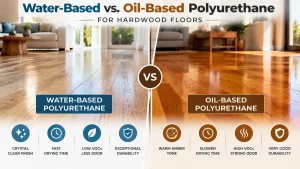
Commercial Two-Component Water-Based Polyurethane: Delivers crystal-clear optical clarity, zero ambering, low VOC emissions, and high scratch resistance against pets. See our comparison of water-based vs oil-based polyurethane for performance differences.
Natural Hardwax Oils: Vegetable-oil and carnauba wax systems (such as Rubio Monocoat or Osmo) bond molecularly with the wood fibers. They create a non-reflective, ultra-matte patina that allows individual scratches to be spot-repaired without sanding down the entire room. Read our trade review of hardwax oil vs polyurethane to match finishes to your client’s lifestyle.
Sheen Target: Specify gloss levels by percentage:
Ultra-Matte: 3% to 5% gloss (contemporary architectural standard)
Matte / Satin: 10% to 20% gloss (soft glow)
Semi-Gloss: 35% to 50% gloss (traditional formal finish)
Subfloor Preparation and Environmental Performance
A high-end floor will fail if the specification ignores what sits underneath:
Concrete Slab Moisture Mitigation
For installations over concrete slabs in Southern California:
Mandate ASTM F2170 relative humidity testing prior to install.
Specify an all-in-one silane-polymer elastomeric wood adhesive that provides a continuous vapor barrier and crack isolation membrane.
Review structural slab considerations in our guide on hardwood flooring issues on slab foundations.
Multi-Family Acoustic Compliance
For condominium and townhome projects, the specification must include an acoustic underlayment meeting local HOA criteria:
Specify high-density portuguese cork underlayment or acoustic rubber membranes.
Include lab test certificates showing compliance with HOA bylaws; see our guide on IIC and STC ratings explained for multi-family flooring to prevent acoustic compliance issues.
Sample Specification Clause: What an Architectural Schedule Looks Like
Below is an example of an architectural wood flooring specification schedule ready for a drawing set:
SECTION 09 64 00 - WOOD FLOORING SPECIFICATION
1. Species: European White Oak (Quercus robur)
2. Cut: Live Sawn / French Cut
3. Construction: Engineered multi-ply Baltic birch core (11-ply)
4. Overall Thickness: 5/8-inch (15mm)
5. Wear Layer: 4.0mm dry-sawn hardwood lamella
6. Plank Dimensions: 7-1/2" Width x Random Lengths (24" to 84", minimum 60% full length)
7. Grade: Character Grade with dark brown epoxy filled knots (max knot diameter 1-1/2")
8. Surface Texture: Light wire-brushed
9. Edge Detail: Four-sided micro-bevel (0.5mm depth)
10. Finish: Factory-applied oxidative hardwax oil; Ultra-matte sheen (3-5% gloss); Zero VOC
11. Adhesive: 100% solids, zero-VOC elastomeric silane adhesive with integrated vapor barrier
12. Overage Allowance: 10% waste factor for straight field layout (15% for stairs/closets)
Frequently Asked Questions
Why shouldn’t designers rely on small 4-inch sample swatches?
Small hand samples fail to show natural board-to-board color variation, grain changes, and knot frequency. A single small swatch might show completely clear grain, while the delivered boxes could feature wide cathedral arches and mineral streaks. Designers should always review large, multi-plank architectural boards (at least 24″ x 36″) or lay out multiple cartons on site before finalizing specifications.
How does waste factor factor into designer specifications?
Contractors must order extra square footage to account for perimeter cuts, starter boards, and pattern geometry. Designers specify standard straight-lay overages at 10%, while complex patterns like herringbone or chevron require 15% to 20% overage. Learn how contractors determine these numbers in our guide on flooring waste factor.
What is the difference between factory prefinished and site-finished flooring?
Prefinished flooring is stained and sealed in a controlled factory setting with high-durability UV-cured coats, allowing immediate foot traffic after installation. Site-finished flooring is delivered raw, installed flat, and then sanded, stained, and coated inside the home. Site-finishing creates a completely flush, monolithic floor plane with zero micro-bevels, but adds several days of jobsite labor and drying time.
How do designers balance baseboard height with specified wood floors?
When specifying wide-plank hardwood, designers ensure perimeter expansion gaps (typically 1/2-inch) are covered by appropriately scaled millwork. Sizing rules call for baseboard heights proportional to the ceiling elevation; explore room-by-room trim sizing in our architectural guide on how tall should baseboards be.
To review full-size architectural display boards, inspect custom sawn wear layers, and explore premium custom flooring and engineered hardwood flooring collections, visit the National Hardwood Flooring and Moulding showroom at 14959 Delano St, Van Nuys, CA 91411, or contact our trade concierge to request physical material samples for your client presentations.