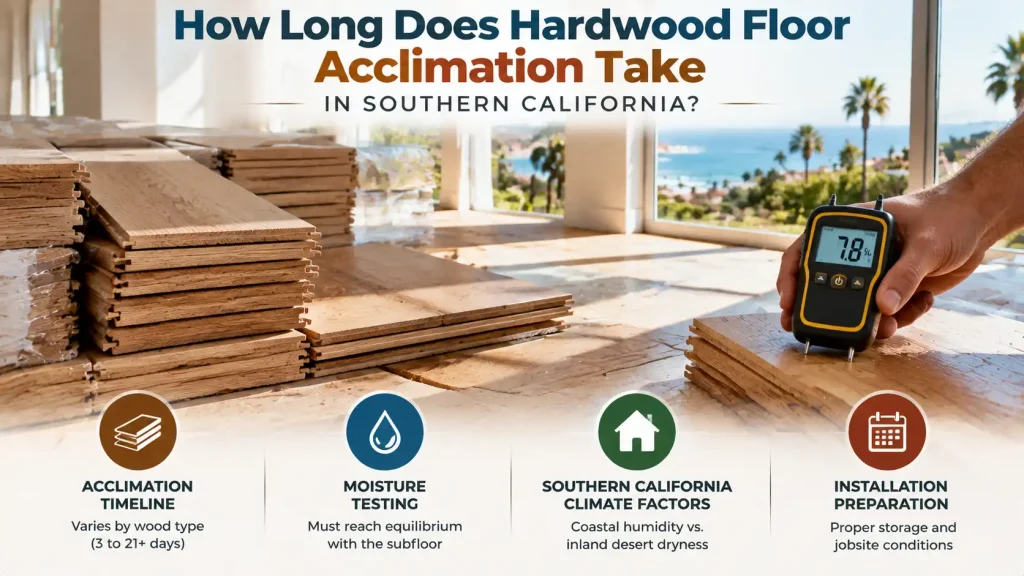
Hardwood flooring does not acclimate by a fixed calendar count. While many retail guidelines cite a generic rule of three to seven days, professional wood flooring installers in Southern California know that wood is ready for installation only when its moisture content reaches equilibrium with the subfloor and the home’s ambient living environment.
According to National Wood Flooring Association (NWFA) standards:
For strip flooring (planks narrower than 3 inches), the moisture content of the hardwood must be within 4 percentage points of the subfloor.
For wide-plank flooring (planks 3 inches or wider), the hardwood must be within 2 percentage points of the subfloor.
Southern California presents one of the most diverse microclimate zones in North America. A home situated near the marine layers of Santa Monica or Newport Beach behaves entirely differently from a property enduring dry 100-degree heat and seasonal Santa Ana winds in the San Fernando Valley, Pasadena, or the Inland Empire.
Relying on a static calendar instead of pin-calibrated moisture readings is the primary cause of floor failures, leading to post-installation cupping, crowning, squeaks, and unsightly winter board gaps.
Acclimation Timeline by Flooring Type and Region
While testing with a calibrated pin moisture meter is the only acceptable confirmation of jobsite readiness, typical timelines provide an operational baseline for scheduling your remodel:
Solid Hardwood (Standard Strip Planks under 3 Inches)
Typical Window: 3 to 7 days
Acclimation Target: Hardwood moisture content within 4 percent of wood subfloor
Jobsite Nuance: Stored flat inside fully conditioned living space; boxes opened and cross-stacked
Solid Hardwood (Wide-Plank 4 Inches and Wider)
Typical Window: 7 to 14+ days
Acclimation Target: Hardwood moisture content within 2 percent of wood subfloor
Jobsite Nuance: Wide planks expand with severe lateral leverage; require slower cellular moisture balancing
High-End Engineered Hardwood
Typical Window: 3 to 5 days (or per manufacturer warranty)
Acclimation Target: Must balance to ambient indoor relative humidity (35% to 55%)
Jobsite Nuance: Multi-ply cross-grain cores resist swelling, but planks must still adapt to indoor temperature and humidity before being nailed or glued
Exotic Tropical Hardwoods (e.g., Brazilian Cherry, Cumaru, Ipe)
Typical Window: 10 to 21+ days
Acclimation Target: Hardwood moisture content within 2 percent of subfloor
Jobsite Nuance: Extremely dense cellular structures absorb and release moisture at a very slow pace
Southern California Microclimates: Coastal Humidity vs. Inland Desert Dryness
Achieving the correct Equilibrium Moisture Content (EMC) in Southern California requires understanding how local geography dictates ambient indoor air:
1. Coastal Zones (Malibu, Santa Monica, South Bay, coastal Orange County)
Climate Profile: High relative humidity, persistent morning marine layer fog, and moist salt air.
Ambient Moisture Impact: Timber baseline moisture content runs higher, often resting between 9% and 11%.
The Risk: If wood is stored in a hot inland warehouse and brought straight to a coastal home, it absorbs maritime moisture rapidly. Installing too early can cause planks to expand, buckle, or push against drywall framing.
2. Inland Valleys and Desert Foot-Hills (San Fernando Valley, Pasadena, Inland Empire)
Climate Profile: Triple-digit summer heat, extremely low ambient humidity, and dry autumn Santa Ana wind gusts.
Ambient Moisture Impact: Indoor timber baseline moisture content frequently drops to 5% to 7%.
The Risk: Hardwood shipped from humid southeastern mills often arrives on the West Coast containing 9% to 10% moisture. If installed immediately, the wood will lose several percentage points of water to the dry valley air, resulting in severe board shrinking, wide edge gaps, and squeaky subfloor joints within months.
NWFA Testing Standards: Pin Meters vs. Calendar Days
The most critical rule in professional flooring installation is simple: measure, never guess.
[ NWFA MOISTURE GAP TOLERANCE ]

Planks narrower than 3 inches:
| Hardwood MC | minus | Subfloor MC | must be LESS THAN OR EQUAL TO 4%

Planks 3 inches or wider (Wide Plank):
| Hardwood MC | minus | Subfloor MC | must be LESS THAN OR EQUAL TO 2%
How Installers Test Moisture on Site:
Wood Subfloors (Plywood or OSB): A contractor uses a calibrated resistance pin-meter to take at least 20 to 30 test readings per 1,000 square feet of subfloor, focusing on exterior walls, plumbing walls, and areas above crawlspaces.
Hardwood Planks: Technicians open multiple boxes across different pallets, taking direct core moisture readings from at least 40 random planks.
Concrete Slab Foundations: Concrete slabs do not hold the same moisture metrics as wood. Because concrete is porous, it continuously emits vapor. Before any acclimation or installation begins, the slab must be tested using in-situ Relative Humidity probes (ASTM F2170) or Calcium Chloride tests (ASTM F1869).
For a complete breakdown of moisture barriers, leveling requirements, and direct-glue methods over concrete, review our guide on hardwood flooring issues on slab foundations.
4 Mandatory Jobsite Pre-Conditions for Acclimation
Acclimation cannot begin the day materials are dropped at the curb. The physical structure must be fully enclosed and climate-controlled before a single box of hardwood crosses the threshold.
1. Enclosed Building Envelope
All exterior doors, windows, skylights, and weatherstripping must be fully installed. Open-air conditions allow outdoor morning coastal fog or midday heat to fluctuate wildly across raw timber.
2. Wet Trades Must Be 100% Cured
Drywall taping, joint compound, interior plaster, concrete leveling underlayments, and interior painting introduce hundreds of gallons of evaporated water into the air.
Drywall and compound must cure for at least 5 to 7 days before bringing wood into the home.
Concrete slab pours must cure for a minimum of 30 to 60 days before baseline moisture testing can begin.
3. HVAC Running for 5 Days Prior
The permanent heating, ventilation, and air conditioning (HVAC) system must be turned on and operating at normal living conditions for at least 5 consecutive days before delivering the wood.
Temperature Target: 60 to 80 degrees Fahrenheit.
Relative Humidity Target: 35% to 55%.
Temporary propane or kerosene construction heaters must never be used; they produce extreme moisture byproducts that artificially elevate room humidity.
4. Storage Inside Living Areas
Wood flooring must be stored inside the exact living space where it will be installed. Never store wood flooring in an unconditioned garage, covered exterior patio, or unfinished basement. Garages have uninsulated concrete slabs that emit heavy ground moisture, ruining the moisture equilibrium of the wood.
Proper Stacking Techniques for Jobsite Acclimation
How you stack the wood inside the room directly impacts airflow and drying balance:
Elevate Off the Subfloor: Place wood pallets or 2×4 framing scrap across the floor to keep the stacked hardwood boxes elevated at least 3 to 4 inches off the subfloor.
Cross-Stack the Boxes: Stack boxes in a log-cabin or crisscross pattern (alternating box direction every layer) with open spacing between boxes. This allows ambient room air to circulate evenly around every carton.
Cut Open the Packaging: Slice open the ends of cardboard cartons and peel back any plastic protective wrap. Trapping wood inside sealed plastic prevents air exchange, defeating the purpose of acclimation entirely.
What Happens When You Rush the Acclimation Process?
Skipping or cutting short the acclimation timeline causes irreversible structural damage to the floor:
+---------------------------------------------------------------------------------------------------+
| THE COST OF RUSHING ACCLIMATION                                                                   |
+---------------------------------------------------------------------------------------------------+
| 1. BOARD CUPPING: Edges rise higher than centers when subfloor is wetter than wood planks         |
| 2. BOARD CROWNING: Center of plank arches upward if wet wood is sanded flat then dries out        |
| 3. PERIMETER BUCKLING: Planks expand with excessive force, lifting entirely off subfloors         |
| 4. CHRONIC SEAM GAPPING: Boards installed wet will shrink in winter, leaving wide dirt traps       |
+---------------------------------------------------------------------------------------------------+
Cupping
Cupping happens when the bottom face of the plank absorbs moisture from a damp subfloor while the top face dries out in conditioned room air. The bottom expands while the top shrinks, forcing the board edges to lift higher than the center.
Crowning
Crowning is the opposite of cupping and often occurs after an installer mistakenly sands down a cupped floor before the moisture has fully equalized. When the subfloor eventually dries out, the board edges sink, leaving the center of the board permanently arched.
Winter Gapping
If hardwood is installed while damp (for example, right after arriving from a humid coastal warehouse during June gloom), the dry inland autumn heat will pull moisture out of the planks. As the cells shrink, gaps the width of a coin can open between every single row of flooring.
Does Engineered Hardwood Need Acclimation?
Homeowners often ask if engineered wood flooring requires acclimation since it is structurally more stable than solid timber.
The answer is yes, engineered wood still requires acclimation, but for slightly different reasons. While the cross-laminated plywood core prevents engineered planks from cupping as easily as solid lumber, the top wear layer (the hardwood lamella) is genuine natural wood.
The solid wood lamella will expand and contract in response to relative humidity.
Engineered planks must sit inside the conditioned room for at least 3 to 5 days to reach the same temperature and humidity as the subfloor and adhesive.
If engineered wood is glued down cold straight out of a delivery truck, the adhesive can flash-dry, or the planks can contract after installation, breaking the adhesive bond. Explore our premium collections of french galerie to review manufacturer-specific acclimation warranties on luxury engineered profiles.
Frequently Asked Questions
Can I acclimate hardwood flooring in my garage?
No. Never acclimate or store hardwood flooring inside a garage. Garages lack permanent climate control and sit over raw concrete that draws moisture from the earth. Wood stored in a garage will absorb excess humidity, leading to severe shrinkage and gapping once installed inside the home.
How do I know when my hardwood is ready to install?
Your hardwood is ready only when testing with a calibrated pin moisture meter shows that the hardwood is within 2% to 4% moisture content of the subfloor (depending on board width), and the indoor room relative humidity has remained stable between 35% and 55% for several consecutive days.
Can wood floor acclimation take several weeks?
Yes. If dense exotic species (such as Brazilian Walnut or Teak) are shipped during humid seasons to an arid inland Southern California location, cellular moisture transfer can easily take two to three weeks to reach the necessary 2 percent tolerance.
What should the indoor relative humidity be during installation?
NWFA standards mandate that indoor relative humidity should remain between 35 percent and 55 percent, with ambient room temperatures held between 60 and 80 degrees Fahrenheit, both during installation and permanently thereafter.
To inspect precision moisture meters, explore climate-stable solid and engineered hardwood flooring collections, or review jobsite prep standards with seasoned trade specialists, visit the National Hardwood Flooring and Moulding showroom at 14959 Delano St, Van Nuys, CA 91411, or contact our architectural flooring team to plan your upcoming installation.