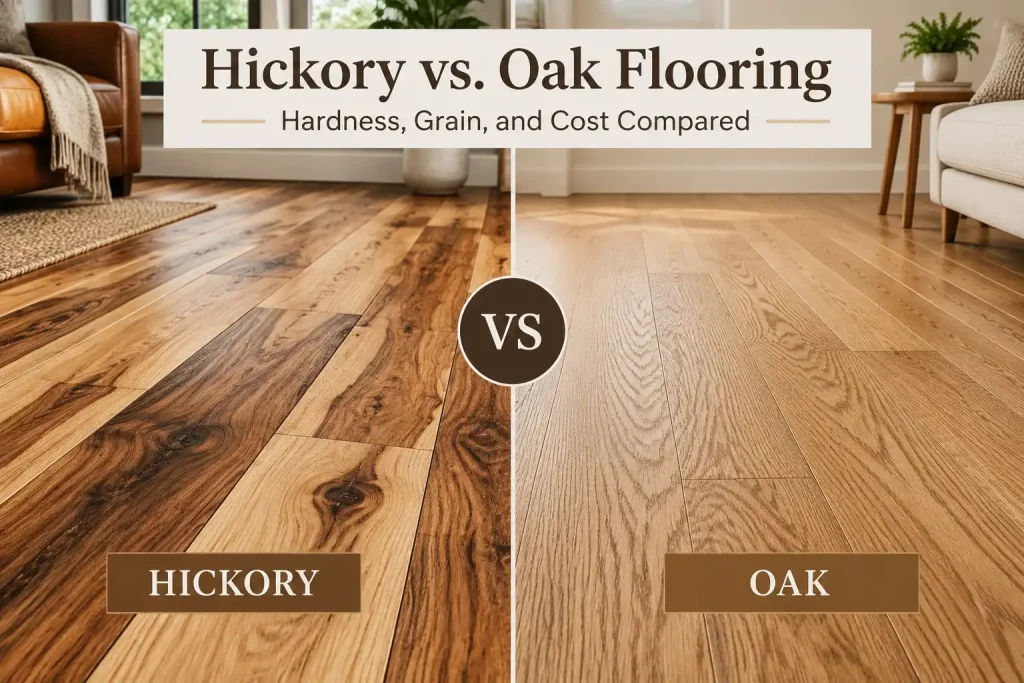
Choosing between hickory and oak flooring usually comes down to one question: do you want a bold, dramatic floor that hides everyday wear, or a uniform, classic floor that stains, refinishes, and resells cleanly? Hickory wins the hardness contest at 1,820 on the Janka scale, while oak wins on stability, staining, and long-term flexibility. Both are premium hardwoods, so the right answer depends on your room, your climate, and how you plan to live on the floor.
At National Hardwood Flooring & Moulding, we have helped homeowners, contractors, and designers across Southern California choose between these two species since 1984. Browse our full hardwood flooring range, or read on for the honest, side-by-side comparison, including the factors most guides leave out.
Hickory vs. Oak Flooring at a Glance
| Feature | Hickory | Oak (White / Red) |
| Janka hardness | 1,820 | White 1,360 / Red 1,290 |
| Grain & color | Bold, high plank-to-plank variation | Uniform; white golden-neutral, red pinkish |
| Dent resistance | Excellent | Good |
| Dimensional stability | Moves more with humidity | More stable (white oak best) |
| Staining | Resists even absorption | Takes stain predictably |
| Refinishing | Harder to sand; grain hides lap marks | Sands and refinishes cleaner |
| Relative cost | Slightly higher (material + labor) | Generally lower, more abundant |
| Best for | High-traffic homes, kids, pets | Refinish flexibility, stain-matching, resale |
Hardness: Is Hickory Harder Than Oak?
Yes. On the Janka hardness scale, which measures a wood’s resistance to dents and wear, hickory scores 1,820. White oak comes in at 1,360 and red oak at 1,290. That makes hickory roughly 34% harder than white oak and about 41% harder than red oak. For the full oak-on-oak comparison, see our red oak vs. white oak flooring guide.
In practice, hickory’s density makes it one of the hardest domestic hardwoods available, so it resists dents from furniture, pet claws, and heavy foot traffic better than oak. For an entryway, a busy kitchen, or a home with kids and large dogs, that extra hardness is a real advantage. Oak is still a durable, everyday-tough floor; it simply is not in the same hardness class. If you want a softer, warmer look instead, compare with our walnut hardwood flooring guide.
One caveat: harder is not automatically better. Hickory’s density makes it more difficult to cut, nail, and sand, which affects installation and refinishing (more on both below).
Grain and Color: Bold Character vs. Uniform Classic
This is where most people actually make up their minds.
Hickory
Hickory has dramatic, high-contrast grain and wide color variation, often within a single plank, ranging from creamy blondes to deep browns. No two boards look alike. It reads rustic, lively, and full of movement, which suits farmhouse, lodge, transitional, and modern-rustic interiors. For even more texture, ask about hand-scraped and distressed hickory. Some homeowners love that energy; others find it too busy for a calm, minimal space.
Oak
Oak is far more uniform. White oak has long, straight grain and neutral-to-golden tones; red oak shows a bit more grain and warmer, pinkish undertones. That consistency makes rooms feel calmer and larger, and it blends easily with both traditional and contemporary design. It is the safer choice when you want the floor to recede rather than dominate.
Stability in Southern California Homes
This is a factor almost no comparison guide addresses, and it matters here. Hickory moves more with changes in humidity than oak does, expanding and contracting more across seasons. White oak is one of the more dimensionally stable species.
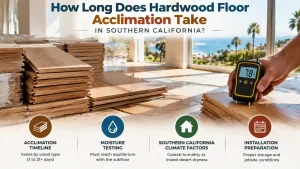
Southern California’s mix of dry inland heat and coastal humidity puts real stress on wood floors. For that reason, we typically recommend engineered hickory rather than solid hickory for most local installations, especially over concrete slabs, in the San Fernando Valley’s temperature swings, or near the coast. Engineered construction bonds a hickory wear layer to a stable plywood core, which greatly reduces movement. If you want solid hickory, it performs best in climate-controlled interiors above grade.
Both hickory and oak are also available in radiant-heat-compatible engineered formats. If you have or plan radiant heating, ask us for species and construction that are rated for it.
Staining and Refinishing
These two practical factors often decide the project, and they favor oak.
Staining: Oak, especially white oak, absorbs stain evenly and predictably, so it is easy to color-match to existing trim, cabinets, or furniture. Hickory’s dense, varied grain resists even stain absorption, which can produce a blotchy result and makes custom colors harder to nail. If you need a specific stain color, oak gives you far more control. See our stains and finishes selection for options.
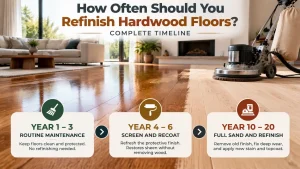
Refinishing: Both solid floors can be sanded and refinished multiple times. But hickory’s hardness makes sanding slower and more demanding, and its busy grain can hide lap marks and unevenness, so refinishing results are less forgiving. Oak sands smoothly and refinishes to a cleaner, more consistent surface, which is part of why oak tends to resell well.
Cost Compared: Material and Installation
Hickory generally costs slightly more than oak, and the gap shows up in two places.
Material: Oak is more abundant in North American forests, which keeps supply high and prices lower. Hickory is less common and its distinctive grade ranges can command a premium. Expect hickory to run modestly higher per square foot than comparable oak, though high-quality oak and hickory can overlap in price depending on grade and construction.
Installation: Hickory’s density makes it harder to work with. Solid hickory often requires carbon-tipped saw blades and pre-drilling before nailing, and it goes down more slowly, which can raise labor costs on solid installations. Oak is easier to cut, nail, and finish. When you compare total installed cost rather than material alone, oak is usually the more budget-friendly of the two.
For an accurate number on your project, bring your square footage and grade preference to our Van Nuys showroom and we will price the material and point you to the right installation approach.
Solid vs. Engineered for Each Species
Species is only half the decision; construction is the other half.
- Solid hickory or oak: Best for climate-controlled interiors above grade. Can be refinished the most times over its life. Solid hickory is the least stable option in humidity-variable spaces.
- Engineered hickory or oak: A real-wood wear layer over a stable core. Handles humidity, slabs, and radiant heat far better. The recommended choice for hickory in most Southern California homes. Can be refinished one to three times depending on wear-layer thickness.
We stock both solid and engineered hickory and oak, in a range of grades and plank widths, with over 5,000 oversized samples in the showroom so you can compare in person.
Which Should You Choose?
Choose hickory if
- You have high foot traffic, kids, or large pets and want maximum dent resistance.
- You want a bold, characterful floor with dramatic grain and color variation.
- You are installing engineered product (recommended locally for stability).
Choose oak if
- You want a uniform, timeless look that suits any design.
- You need a specific stain color or must match existing woodwork.
- Refinishing flexibility and resale value are priorities.
For builders and designers
On multi-unit and large-scale projects, oak’s abundant supply, predictable staining, and lower installed cost often make it the practical spec, while hickory is a strong upgrade option for premium units. We offer contractor and trade pricing and can source both species in the grades and volumes your project needs.
Hickory vs. Oak Flooring FAQ
What are the downsides of hickory flooring?
Hickory is less dimensionally stable than oak, resists even staining, is harder to sand and refinish, and typically costs a little more in both material and labor. Its busy grain is also not for everyone.
Which is more expensive, oak or hickory?
Hickory is usually slightly more expensive than oak, both because it is less abundant and because it is harder to install. High-grade oak can still overlap with hickory pricing.
Are hickory floors in style?
Yes. Hickory remains popular for farmhouse, rustic, and modern-rustic interiors, and warm, characterful woods are trending. Oak remains the more universally versatile choice.
Is hickory good for flooring?
Hickory is an excellent flooring wood, especially for durability in busy homes. Choose engineered hickory in humidity-variable climates for the best long-term performance.
See Hickory and Oak in Person
The best way to decide is to compare full-size samples under your own lighting. Visit our Van Nuys showroom to see hickory and oak in solid and engineered constructions, across grades and plank widths, or browse our hardwood flooring range online. Contractors and designers can ask about trade pricing and bulk sourcing.