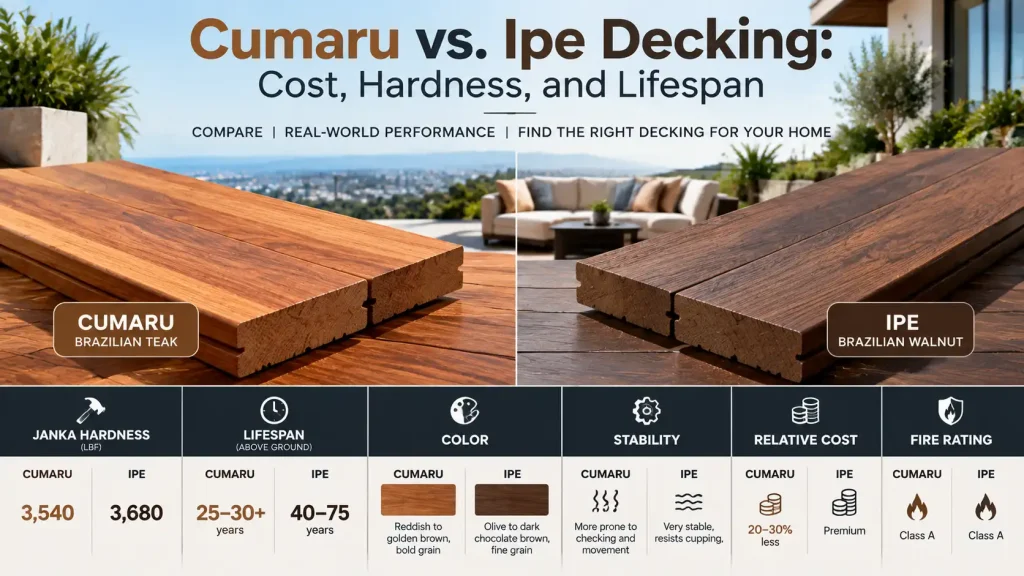
Cumaru and ipe are two of the hardest, longest-lasting decking woods on the market, and on paper they are close. Ipe is slightly harder, more dimensionally stable, and lasts longer, which is why it carries a premium price. Cumaru runs about 20 to 30 percent cheaper, brings warmer reddish-brown tones and a bolder grain, and performs almost as well, with a bit more movement and upkeep. For most residential decks the deciding factors are budget, color, and how much seasonal movement you are willing to manage.
National Hardwood Flooring and Moulding has supplied tropical hardwood decking to Southern California homeowners and contractors since 1984. This guide compares the two on hardness, lifespan, cost, workability, and upkeep in the local climate.
| Factor | Cumaru (Brazilian Teak) | Ipe (Brazilian Walnut) |
| Janka hardness | Around 3,540 lbf | Around 3,680 lbf |
| Lifespan (above ground) | 25 to 30 plus years | 40 to 75 years |
| Color | Reddish to golden brown, bold grain | Olive to dark chocolate brown, fine grain |
| Stability | More prone to checking and movement | Very stable, resists cupping |
| Relative cost | Roughly 20 to 30 percent less | Premium |
| Fire rating | Class A | Class A |
Hardness and Density
Both woods sit near the top of the Janka hardness scale, which measures resistance to denting and wear. Ipe scores around 3,680 lbf and cumaru around 3,540 lbf. That is roughly twice as hard as red or white oak, and the gap between the two species is small enough that it makes no practical difference on a deck. Both shrug off foot traffic, dragged furniture, and pet claws, and both are dense enough that they do not float in water, which is a reliable sign of natural decay resistance.
Durability and Lifespan
Both species are rated Class I for natural resistance to rot, decay, insects, and fungus, the highest classification, and neither needs chemical treatment to earn it. The natural oils and density do the work. Ipe holds the edge on raw longevity, commonly cited at 40 years and up and sometimes as long as 75 years with care, while cumaru typically runs 25 to 30 years and beyond above ground. Ipe pulls further ahead in ground-contact or constantly humid spots, but for a standard above-ground residential deck both will outlast most other materials.
Appearance and Color
This is where many people actually decide. Cumaru runs reddish-brown to golden-brown with a bolder, coarser grain and more visible variation board to board. Ipe is olive-brown to dark chocolate with a tighter, finer, more uniform grain. Left untreated, both weather to a silver-gray patina outdoors. If you want to hold the original color, plan on periodic oiling for either one.
Movement, Checking, and Stability
Stability is the most underrated part of this comparison. Ipe is exceptionally stable and resists cupping, twisting, and checking. Cumaru is more prone to checking, surface cracking, and seasonal movement, which means it needs careful kiln-drying, proper acclimation on site, and correct gap spacing at install. In a dry inland climate that swings between hot days and cool nights, that movement matters. It does not make cumaru a bad choice, but it does mean the install has to be done right.
Workability and Installation
Both woods are hard enough to be demanding to work with. Plan on carbide-tipped blades, pre-drilling every fastener hole, and more time per board than a softwood or composite. Cumaru has an interlocked, oily grain that can be a little tougher on tools. For a clean look, most tropical hardwood decks use hidden fasteners with a slotted edge system, though face-screwing into pre-drilled and plugged holes is also common. Either way, budget for the extra labor these dense woods require.
If you are weighing wood against a lower-maintenance alternative, our guide to composite vs wood decking walks through that tradeoff for Los Angeles homes.
Maintenance in Southern California
Southern California sun is hard on any wood deck. Strong UV fades the surface color faster here than in cloudier climates, so if you want to keep cumaru golden or ipe rich brown, expect to clean and re-oil with a UV-protective decking oil once or twice a year. If you are happy to let the deck weather to silver-gray, both species get there gracefully and still last for decades with only occasional cleaning.
For deck oils and finishing products, see our stains and finishes selection.
Cost, Upfront and Long Term
Cumaru is the more affordable of the two, generally running about 20 to 30 percent less than ipe per board foot. Ipe commands a premium for its stability, longevity, and reputation as the industry standard. Over a very long ownership horizon ipe can pencil out because it lasts longer with less fuss, but for many homeowners cumaru delivers most of the performance at a noticeably lower entry price. On larger or multi-unit projects, that upfront gap is significant, which is why cumaru is a popular value pick.
How They Handle SoCal Heat and Sun
Both species handle heat well because their density and oils resist the drying and cracking that damage softer woods. Ipe stays flatter through big temperature swings, while cumaru rewards careful install and spacing. For a broader look at how tropical hardwoods hold up to the local climate, see our guide to ipe vs teak decking in Southern California heat.
Which Should You Choose
Choose cumaru if you want tropical hardwood performance at a lower price, prefer warmer reddish-golden tones, and have an installer who will dry, acclimate, and space it correctly.
Choose ipe if you want the longest lifespan and the most stability, prefer a darker, more uniform look, and see the deck as a long-term investment where budget is secondary.
We stock ipe decking and can source cumaru and other tropical hardwoods to spec. See our ipe decking page, or the planned cumaru decking page, for product details.
Cumaru vs Ipe FAQ
Is cumaru as good as ipe?
For most residential decks, close. Cumaru is nearly as hard and durable and costs less, but ipe is more stable and lasts longer. The right pick depends on budget, color preference, and how carefully the wood will be installed.
Which lasts longer, cumaru or ipe?
Ipe. It commonly lasts 40 years or more above ground and up to 75 with care, while cumaru typically runs 25 to 30 years and beyond. Both far outlast softwood and most composites.
Is cumaru cheaper than ipe?
Yes, generally about 20 to 30 percent less per board foot. That upfront savings is a big reason cumaru is chosen as a value alternative to ipe.
Does cumaru or ipe need more maintenance?
Cumaru moves a bit more and can check, so it benefits from careful install and regular oiling. Both need periodic UV-protective oil to keep their color in strong sun, or they can be left to weather gray.
See Decking Samples in Person
The best way to choose between cumaru and ipe is to compare the color and grain in person. Visit our Van Nuys showroom to see tropical hardwood decking samples and talk through install and spacing for the local climate. Contractors and designers can ask about trade pricing and bulk sourcing.