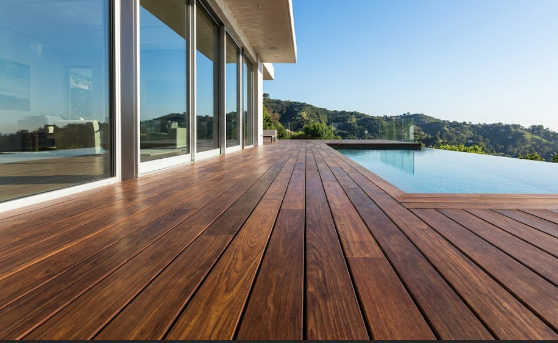
Stand on a composite deck in West Hollywood at 3pm in August. Then stand on an Ipe deck a block over. Same sun, same hour — entirely different surfaces. That one moment of contrast is, in fact, the whole conversation about composite vs. wood decking in Los Angeles compressed into a single sensation.
If you’re planning a deck for a Los Angeles home, the decision between composite and real wood is not a simple cost calculation. It’s a question of how the surface will live with you — through heat waves, marine layer, decades of foot traffic, and the slow accumulation of weather and use that makes a deck either a feature of the home or a regret. This guide is written from 50+ years of supplying both to LA’s homeowners, designers, and builders. We sell both. We have no incentive to push you one way.
The short answer
Composite wins on convenience and predictable cost. Real wood — specifically dense tropical hardwoods like Ipe, Cumaru, and Mangaris — wins on longevity, heat performance under LA sun, and the resale and aesthetic premium that comes with a genuine wood deck. If you’re optimizing for the lowest possible maintenance and you live somewhere fully shaded, composite is a defensible choice. If you’re building a deck you want to still love in 2046, hardwood is almost always the better long-term investment.
“Composite is sold on its maintenance story. Hardwood is bought on its 30-year story.”
1. The real cost picture
Composite decking ads love to talk about “lifetime value.” The math is more complicated than the marketing.
Upfront materials
Premium composite decking (Trex Transcend, TimberTech Azek) runs $9–$13 per square foot for materials. Mid-grade composites start around $5. Real hardwood decking spans a much wider range — pressure-treated pine sits at $3–$6, cedar around $7–$10, and the tropical hardwoods Los Angeles designers actually specify (Ipe, Cumaru, Mangaris, Teak) land between $12 and $25 per square foot.
Installation
Tropical hardwoods require pre-drilling and hidden fastener systems — typical install runs 15–25% higher than composite. Composite’s tongue-and-groove and clip systems install faster but require a specific substructure spacing.
Lifetime
This is where the numbers swing. Composite decking carries 25–50 year limited warranties but real-world replacement typically lands at 15–25 years (color fading, surface scratching, and board sagging are the most common end-of-life triggers). Premium tropical hardwoods, properly maintained, last 50–75 years. Ipe decks installed in the 1970s in Brazil are still in service today.
Run the per-year math: a $20/sq ft Ipe deck amortized over 50 years costs $0.40/year per square foot. A $10/sq ft composite deck replaced at year 20 costs $0.50/year per square foot — before considering teardown and disposal.
2. How they behave in LA’s climate
Los Angeles is not a generic climate. Long dry summers, intense direct sun (especially on west- and south-facing decks), occasional marine humidity in coastal neighborhoods, and almost no freeze-thaw cycle. This matters more than most decking buyers realize.
Surface heat
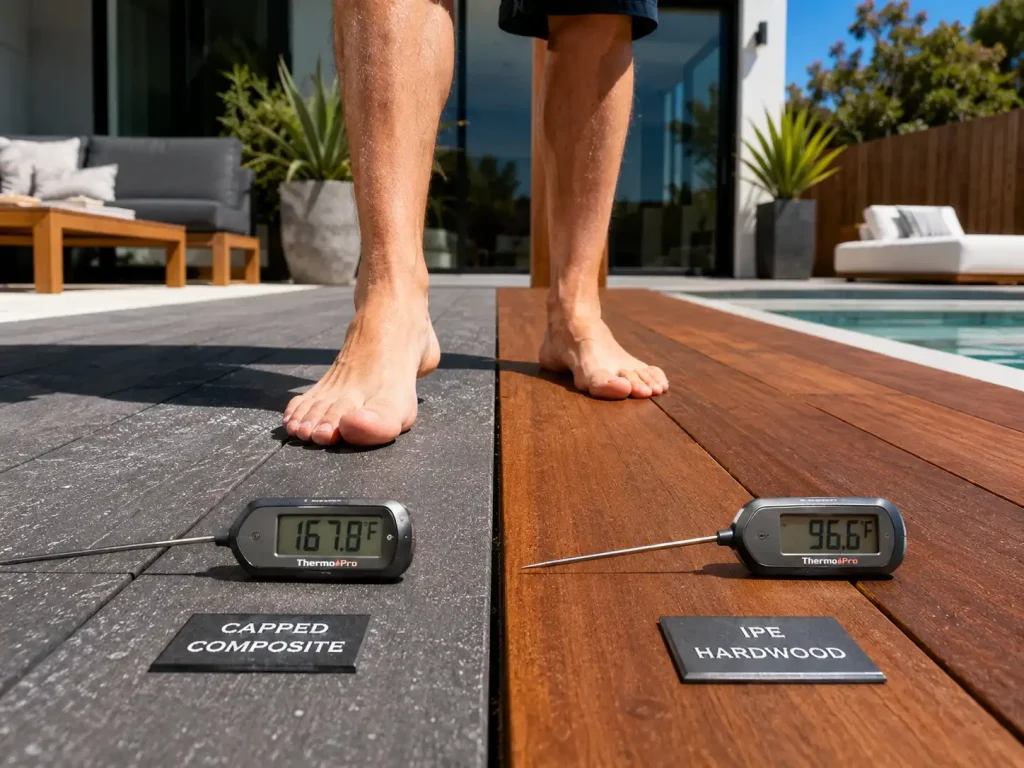
This is the under-discussed deal-breaker for composite in LA. Dark-colored composite decking can reach 145°F+ under direct sun — hot enough to burn bare feet and uncomfortable for pets. Lighter composites do better but still run 15–25°F hotter than wood under identical conditions. Tropical hardwoods like Ipe and Cumaru have natural density that radiates heat more slowly. They get warm; composite gets dangerous.
UV stability
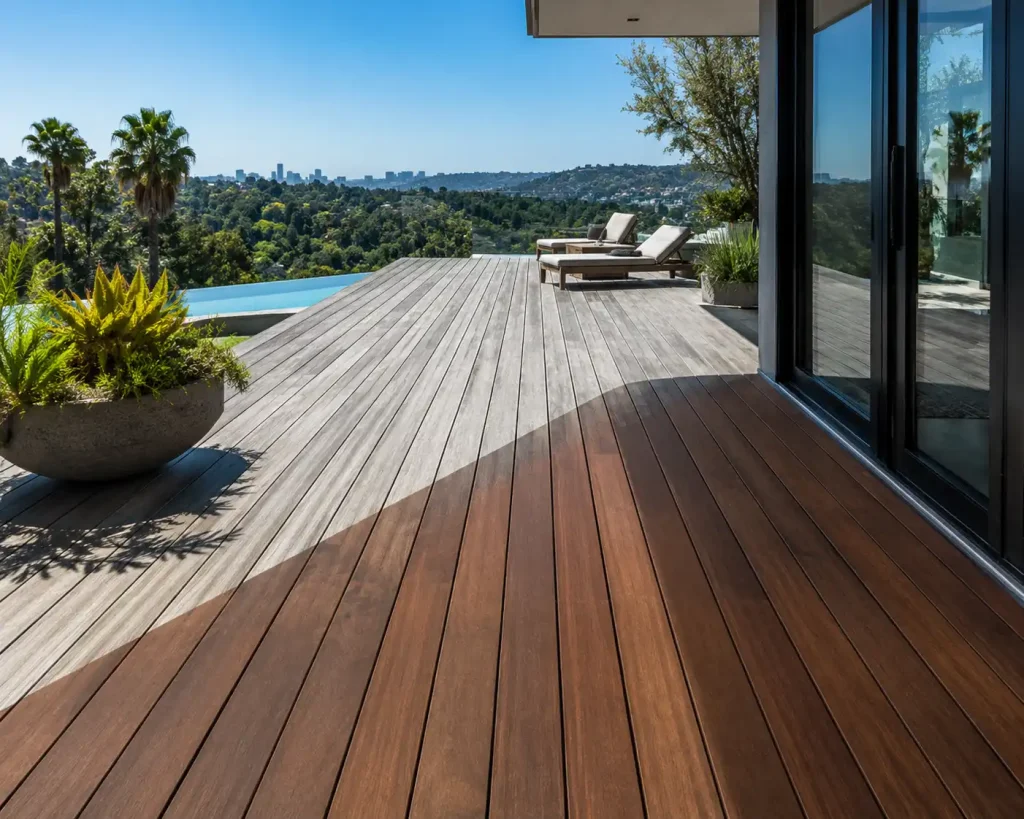
Both fade. Real wood fades to a silver-gray patina that many designers actively want — left untreated, Ipe and Teak develop a gorgeous weathered finish. Composite fading is less forgiving: it tends to look chalky and uneven, particularly where furniture has shielded portions of the deck.
Moisture and the marine layer
Coastal LA homes (Santa Monica, Venice, Manhattan Beach, Malibu) deal with morning moisture nine months of the year. Composites with a PVC cap shed water well. Untreated softwoods rot quickly in this environment. Tropical hardwoods are the only natural materials that genuinely thrive here Ipe in particular is rated Class A for both fire and decay resistance.
3. Aesthetics & design fit
Composite decking has improved dramatically. The latest generation (capped polymer, multi-tonal coloring) reads as wood from a distance and at a glance. Up close, on bare feet, in raking afternoon light, the difference remains obvious.
For modern LA homes — particularly the architectural builds in the Hollywood Hills, Bird Streets, Trousdale, and the new wave of indoor-outdoor remodels — designers consistently specify real wood. The reason isn’t snobbery. It’s that the rest of the home (limestone, plaster, steel, glass) reads better against material that has actual depth and grain variation. Composite can look flat against high-end finishes.
- Spanish Revival and Mediterranean homes: tropical hardwoods or cedar
- Modern minimalist new-builds: wide-board Ipe or Cumaru in rift-cut
- Craftsman and traditional: cedar, redwood, or character-grade Mangaris
- Rooftop decks and high-traffic commercial: Ipe (Class A fire-rated)
- Multifamily and STR portfolios: capped composite or pressure-treated cedar
4. The maintenance reality
This is composite’s marketing strength, and it’s largely earned. But “no maintenance” and “low maintenance” are different things.
Composite reality
Expect to wash composite decks twice a year with soap and water (or a deck-specific cleaner). Mildew on shaded composite sections is a known issue. Scratches from furniture, dog claws, and dropped items are permanent — there is no sanding-out. Color fading is permanent.
Real wood reality
Tropical hardwoods need an annual oil application (Penofin, Messmer’s, or equivalent) to retain their original color, or zero maintenance if you want the silver patina. Either is a valid path. Pressure washing is fine. Scratches sand out. The deck can be fully refinished decades into its life.
5. The environmental angle
This is genuinely contested, and the honest answer surprises some buyers.
FSC-certified tropical hardwood is one of the most carbon-efficient building materials available — the trees are grown, harvested, and processed with less embodied energy than almost any synthetic alternative. They also biodegrade at end of life. The key word is “FSC-certified.” National Hardwood sources our Ipe, Cumaru, and Mangaris exclusively from FSC-managed forests.
Composite decking typically uses 30–95% recycled content (a real positive) but is fundamentally a plastic-and-wood-flour composite that cannot be recycled at end of life. It ends in a landfill. The embodied energy in producing virgin PVC and HDPE caps is also significant.
Neither material is perfect. FSC-certified tropical hardwood is, by most lifecycle analyses, the lower-impact choice — but only if you specifically request FSC documentation.
6. Which wood decking species we recommend
If you’ve decided on real wood, here’s the short list our LA designers and contractors return to.
Ipe (Brazilian Walnut)
The benchmark. Janka hardness 3,510, Class A fire rating, 50–75 year lifespan, naturally rot-resistant. The premium choice. Costs more, lasts longer, looks unmistakable.
Cumaru (Brazilian Teak)
Often called “the poor man’s Ipe,” though that’s unfair — Cumaru is a beautiful, warmer-toned hardwood that runs 20–30% less than Ipe with most of the durability. Janka 3,540.
Red Mangaris (Red Balau)
Our most-specified mid-tier tropical. Rich red-brown tones, dense, naturally resistant, and value-priced. A favorite for LA hospitality projects.
Burmese Teak
The luxury option. Naturally oily, golden-brown, dimensionally perfect. Specified for yacht-like outdoor living, pool surrounds, and high-design rooftop decks.
Western Red Cedar
The softwood that earns its place — naturally rot-resistant, beautiful aroma, cooler under bare feet than any other option. Lower lifespan (20–30 years) but excellent for shaded decks and Pacific Northwest-inspired designs.
7. When each one makes sense
Choose composite if:
- Your deck is fully shaded (north-facing or under heavy tree cover)
- You want predictable, near-zero maintenance
- It’s a rental property, STR, or short-hold investment
- Your budget is fixed and won’t extend to tropical hardwood
Choose real wood if:
- The deck sees direct LA sun for more than 4 hours per day
- You’re planning to be in the home for 10+ years
- The deck is integral to the architectural design
- Resale value is a factor (real wood decks consistently appraise higher)
- You care about the look and feel of natural materials under bare feet
At a glance
| Real Wood | Composite | |
| Upfront cost (per sq ft) | $8 – $25 | $5 – $13 |
| Lifespan | 25 – 75 years | 15 – 25 years |
| Heat retention (LA sun) | Cool to warm | Hot — can scorch |
| Maintenance | Annual oil/seal | Wash 2× per year |
| Refinishable | Yes | No |
| Resale impact | Strong positive | Neutral |
| Environmental footprint | Low if FSC | Moderate (PVC/resin) |
| End of life | Biodegrades | Landfill |
Frequently asked questions
Is composite cheaper than wood decking?
Upfront, yes — for mid-grade composite vs. tropical hardwood. Over a 30-year horizon, no. Composite typically needs replacement before tropical hardwood does, and the cost-per-year of ownership flips.
Does composite decking get too hot in Los Angeles?
Dark-colored composite, yes — particularly on south- and west-facing decks. Lighter composite colors are more tolerable but still run hotter than wood. If you’ll walk barefoot, sample-test in summer sun before committing.
What’s the most durable wood for an LA deck?
Ipe (Brazilian Walnut). It’s the densest commercially available decking species, naturally resistant to rot, insects, and fire, and routinely lasts 50+ years with annual oiling — or weathers to a beautiful silver-gray if left untreated.
Will a wood deck increase my home’s resale value?
Real wood decking — especially Ipe, Cumaru, or Teak — is consistently called out positively in LA appraisals and listing comps. Composite is neutral; it doesn’t hurt, but rarely adds the premium that high-end natural wood does.
Is FSC-certified hardwood actually sustainable?
Yes, when sourced properly. FSC certification requires managed harvest cycles, biodiversity protection, and chain-of-custody documentation. National Hardwood provides FSC documentation for all tropical hardwood decking on request.
See and feel the difference
Sample boards on a computer screen are not the same as walking across a real Ipe plank at 3pm in July. Our Van Nuys showroom holds full samples of every wood decking species we sell, plus side-by-side composite comparisons. Bring your contractor. Bring your bare feet.