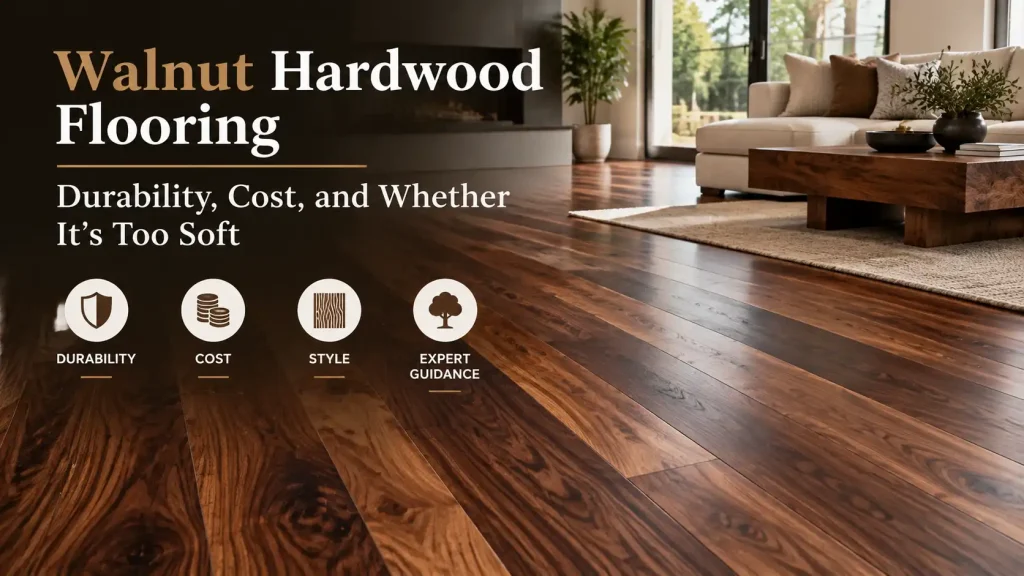
Walnut is one of the most beautiful hardwood floors you can install, with a rich, chocolate-brown color no other domestic species quite matches. It is a genuine hardwood, but it is softer than oak, maple, or hickory, with a Janka rating of about 1,010. That makes it a superb choice for design-focused, moderate-traffic rooms like bedrooms, offices, and formal living spaces, and a poor choice for mudrooms and busy entryways. Here is the honest breakdown, including the factors most guides skip.
At National Hardwood Flooring & Moulding, we have helped Southern California homeowners, designers, and contractors choose and source walnut flooring since 1984. You can browse our full hardwood flooring range or read on for the complete walnut guide.
Is Walnut Too Soft for Flooring?
This is the question people ask most, so let’s answer it directly. Walnut is softer than the most popular flooring hardwoods, but soft is relative it is still a hardwood and holds up well in the right rooms.
| Species | Janka rating |
| American black walnut | ~1,010 |
| Red oak | 1,290 |
| White oak | 1,360 |
| Hard maple | ~1,450 |
| Hickory | 1,820 |
| Brazilian walnut (Ipe) | 3,500+ |
American black walnut sits at roughly 1,010 on the Janka hardness scale, below red oak (1,290), white oak (1,360), maple (1,450), and well below hickory (1,820). In everyday terms, walnut dents and scratches more easily than those woods, so a dropped cast-iron pan or a rolling chair without a mat can leave a mark. If maximum dent resistance is your priority, compare walnut with our hickory flooring guide, since hickory sits at the hard end of the domestic scale.
The reassuring part: walnut’s deep, even color hides the dents and scratches it does get far better than a light wood like maple, where every mark stands out. Many owners find those small marks read as character rather than damage over time.
American Walnut vs. Brazilian Walnut (Ipe)
Here is a point of confusion worth clearing up before you shop. “Walnut” can mean two completely different woods:
- American (black) walnut: Janka ~1,010. The classic rich, chocolate-brown domestic hardwood most people picture. Softer, warm, refined.
- Brazilian walnut (Ipe): Janka 3,500+. Not a true walnut at all an extremely hard exotic, olive-to-deep-brown, most often used for decking. Very durable, harder to install.
They look related but perform on opposite ends of the hardness scale. If someone tells you “walnut is very hard,” they are almost certainly thinking of Ipe. For interior flooring with the warm, luxurious walnut look, American black walnut is what you want. If you are actually planning an outdoor project, see our decking options instead.
Grain, Color, and Style
Walnut’s signature is its color: deep chocolate-brown heartwood with occasional lighter streaks, in dark tones only. The grain runs from straight to gently wavy, smoother and more refined than hickory’s busy figure. It suits modern, transitional, and formal interiors, and it pairs beautifully with lighter walls and furnishings for contrast. For a more textured surface, ask about wire-brushed and hand-scraped walnut options.
Because walnut only comes in dark tones, it is not the pick if you want a light, airy floor, and dark flooring can make a small room feel more enclosed. In larger, well-lit spaces it looks rich and intentional. Warm, dark woods are also trending, which keeps walnut current.
Walnut and Sunlight: The UV-Fade Factor
This is a factor almost no guide mentions, and it matters in Southern California. Walnut lightens with exposure to UV light over time, direct sun mellows its dark heartwood toward a softer brown. In homes with large windows, skylights, or strong all-day sun, that fading can be noticeable and uneven where rugs or furniture block the light.
You can manage it. Ask us about UV-inhibiting options from our stains and finishes selection, rotate area rugs periodically so the floor ages evenly, and consider window treatments in the sunniest rooms. If a room gets intense, direct sun most of the day, we will tell you honestly and may steer you toward a species that holds its color better.
Durability in Real Homes: Where Walnut Works
Walnut’s softness is only a problem in the wrong room. Match it to the space and it performs for decades.
| Room | Walnut fit | Why |
| Bedrooms | Excellent | Low traffic, warmth, comfort underfoot |
| Home offices | Excellent | Low traffic, premium look |
| Formal living / dining | Very good | Design-focused, moderate traffic |
| Main living rooms | Good (engineered) | Manageable with rugs and care |
| Kitchens | Use caution | Spills, dropped pans; engineered only |
| Entryways / mudrooms | Not recommended | Grit and heavy traffic dent soft wood |
The pattern is simple: put walnut where people relax, not where they track in grit. Engineered walnut with a durable factory finish widens the range of rooms it can handle.
Solid vs. Engineered Walnut
Construction matters as much as species.
- Solid walnut: Solid walnut is milled from one piece; it can be sanded and refinished multiple times, so it can last a lifetime. Best in climate-controlled rooms above grade.
- Engineered walnut: Engineered walnut is a real walnut veneer over a stable plywood core. Far more stable against humidity, so it works over concrete slabs, in basements, and with radiant heat. A factory finish also adds scratch resistance. Often the smarter choice for walnut in variable climates.
We stock both solid and engineered walnut in a range of widths and grades, with samples in the showroom so you can compare in person.
Walnut Flooring Cost
Walnut is a premium hardwood and priced accordingly. Solid walnut material typically runs about $6 to $14 per square foot before installation, depending on grade, width, and whether it is domestic black walnut or a specialty cut. Engineered walnut varies with wear-layer thickness. The premium comes from walnut’s relative rarity and steady demand for its color.
For an accurate figure on your project, bring your square footage and grade preference to our Van Nuys showroom and we will price the material and walk you through installation options.
Walnut Flooring Pros and Cons
Pros
- Unmatched rich, dark color and a luxurious, high-end look.
- Dark tones hide dents and scratches better than light woods.
- Good dimensional stability and shock resistance for its weight class.
- Solid walnut can be refinished multiple times; engineered adds humidity stability.
- On-trend warm tone that adds resale appeal.
Cons
- Softer than oak, maple, and hickory — dents more easily in high-traffic rooms.
- Available in dark tones only; not for a light, airy look.
- Fades and lightens under UV over time without the right finish and care.
- More expensive than oak or maple.
Walnut Flooring FAQ
Is walnut a good choice for flooring?
Yes, in the right rooms. Walnut is an excellent choice for bedrooms, offices, and formal living and dining rooms where it delivers rich color without heavy wear. It is less suited to mudrooms and busy entryways.
Is walnut flooring expensive?
Walnut is a premium hardwood, typically more expensive than oak or maple, with solid material often around $6 to $14 per square foot before installation.
Are dark walnut floors in style?
Yes. Warm, dark woods are on-trend, and walnut’s deep color reads as timeless and high-end in modern and transitional interiors.
Does walnut scratch easily?
Walnut can show scratches and dents over time because it is softer than oak or maple, but its dark, even color hides marks better than lighter woods, and a durable finish helps.
See Walnut in Person
The best way to judge walnut is to see full-size samples under your own lighting, especially given how it responds to sun. Visit our Van Nuys showroom to compare solid and engineered walnut across grades and widths, or browse our full hardwood flooring range. Contractors and designers can ask about trade pricing and bulk sourcing for premium units.