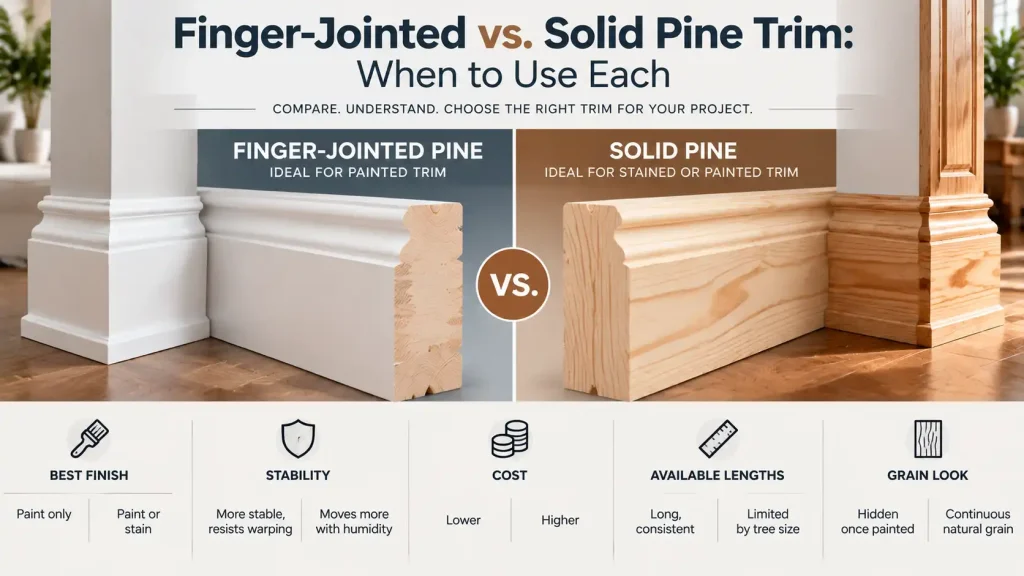
The choice between finger jointed and solid pine trim usually comes down to a single question: are you painting the trim or staining it? For painted work, finger jointed pine is the practical pick because it is straighter, more stable, and cheaper, and the joints vanish under paint. For stained or clear-finished work, solid wood wins, because the finger joints show through a transparent finish. Everything else, from cost to durability, follows from that first decision.
National Hardwood Flooring and Moulding stocks both, plus hardwood options, and runs an onsite mill for custom profiles. This guide covers when each material makes sense, how to spot good finger jointed stock, and where solid pine still earns its place. Browse our full moulding and trim range as you read.
What Finger Jointed Trim Is
Finger-jointed trim is made by gluing short pieces of clear pine end to end with interlocking finger shaped cuts, which is where the name comes from. The short pieces let the mill cut out knots and defects before assembly, so the finished board is straighter and freer of flaws than a comparable solid board, and it comes in long, consistent lengths. Because it is built from small pieces whose grain runs in different directions, it also moves less with humidity than solid wood, which matters for interior trim that has to stay flat against the wall. It is almost always sold factory primed and is meant to be painted.
What Solid Pine Trim Is
Solid pine trim is milled from a single continuous piece of wood. It shows real, uninterrupted grain, which is exactly what you want under a stain or clear finish. The tradeoff is that long, clear, knot-free solid stock requires larger trees and costs more, and a single piece is more prone to bowing, twisting, and cupping as it takes on and loses moisture. It holds nails well and takes a crisp profile.
| Factor | Finger jointed pine | Solid pine |
| Best finish | Paint only | Paint or stain |
| Stability | More stable, resists warping | Moves more with humidity |
| Cost | Lower | Higher |
| Available lengths | Long, consistent | Limited by tree size |
| Grain look | Hidden once painted | Continuous natural grain |
| Sold as | Usually primed | Primed or bare |
The One Question That Decides It: Paint or Stain
Before comparing cost or durability, settle the finish. If the trim will be painted, the finger joints disappear and you get a straighter, cheaper, more stable board with no visible downside. If the trim will be stained or clear coated, the glue lines and grain changes at each joint telegraph through the finish and look obvious, so solid wood is the only real option. Make this call first and the rest of the decision falls into place.
When to Use Finger Jointed Pine
Reach for finger jointed pine when:
- The trim is being painted, which is most interior base, casing, and crown in modern homes.
- You want long, straight runs with no bowing on a long wall.
- Budget matters, on a whole-house trim package or a multi-unit job.
- You want a real-wood board that holds nails better than MDF and resists dents better in high-contact spots.
When to Use Solid Pine or Hardwood
Use solid wood when the trim will be stained or clear finished so the grain stays visible and continuous. Solid pine works for a stained look on a budget, but for a harder, richer stained trim, a hardwood such as oak, poplar, or maple is the better base. See our stains and finishes selection for the finish side, and note that solid stock is also the choice when you need to match an existing solid-wood profile.
How to Spot Good Finger Jointed Trim
Not all finger jointed stock is equal, and a bad batch causes most of the complaints people have about it. When you pick through a bundle, watch for a few things:
- Tight, flush joints. Loose or slightly raised joints will need sanding and can telegraph through primer.
- Sharp, clean profiles. The best product holds a crisp edge that produces fine shadow lines once installed.
- Even priming. A good factory prime coat is often better than a hand-applied one and saves a step.
- Sight down the length of the board and set aside any piece with a bow or twist.
On very tall one-piece base, seven inches or more, look closely at long joints running the length of the board, which can be a weak point. For those heights, some carpenters prefer solid or a built-up base instead.
Will the Joints Show Through Paint Over Time
This is the most common worry, and with modern adhesives and proper priming it is rarely an issue indoors. Interior temperature and humidity are stable enough that quality finger jointed trim stays put. The cases where joints do telegraph are almost always exterior use, damp locations, or low-grade product with weak glue. Seal the trim with a latex or oil-based primer before topcoat, and because there are no knots, you do not need an expensive shellac-based primer.
Cost: Why Finger Jointed Is Cheaper
A single long length of clear, knot-free solid pine has to come from a tree large enough to yield that board in one piece, which is increasingly expensive and harder to source. Finger jointing flips that math by joining short offcuts and small pieces into boards of any length, cutting out defects along the way. On a whole-house or multi-unit trim package, that difference adds up quickly, which is why finger jointed pine is the standard choice for painted trim on midrange and upper-end jobs alike.
Interior, Exterior, and Damp Rooms
Most finger jointed trim is rated for interior use only because the adhesive is not waterproof. Check the label before using any finger jointed product outdoors or on a porch. Some products are made and rated for exterior use and will say so on the spec sheet. Inside the home, keep both finger jointed and solid pine out of consistently wet rooms; a PVC or moisture-rated base is the better call for bathrooms and laundry rooms.
A Note on MDF
MDF is the third common paint-grade option. It is smooth and economical but heavy, prone to following waves in a wall, and easily damaged at the edges, and it swells if it gets wet. For a fuller comparison of composite versus wood trim, see the material notes on our moulding and trim page.
Which Material by Application
Finger-jointed pine covers most painted baseboards, door and window casing, and door jambs. For painted crown moulding, both finger-jointed pine and MDF are common. Anywhere the trim is stained, switch to solid wood or hardwood. If you need a profile that is not stocked, an onsite mill can match it in the material you want, solid or otherwise; see custom moulding and profile matching.
Finger Jointed vs Solid Pine FAQ
Is finger jointed trim as good as solid wood?
For painted interior trim, yes. Quality finger jointed pine is straighter and more stable than solid, and the joints disappear under paint. For stained trim, solid wood is better because the joints show through a clear finish.
Can you stain finger jointed trim?
It is not recommended. The glue lines and grain changes at each joint telegraph through stain and look obvious. Use solid wood or hardwood for any stained or clear-finished trim.
Will finger joints show through paint?
Rarely, indoors, when the trim is properly primed and made with modern adhesive. Telegraphing is mostly an exterior, damp, or low-grade issue. Prime with a latex or oil-based primer before painting.
Is finger jointed trim cheaper than solid?
Yes. It is made from short pieces and offcuts joined into long boards, which uses wood more efficiently than milling a clear board from one large piece, so it costs less.
See Trim Options in Person
The best way to choose is to compare finger jointed, solid, and hardwood profiles side by side. Visit our Van Nuys showroom to see the options, check joint quality and profiles, and get help matching the right material to a painted or stained finish, or browse the full moulding and trim range. Contractors and designers can ask about trade pricing and bulk sourcing