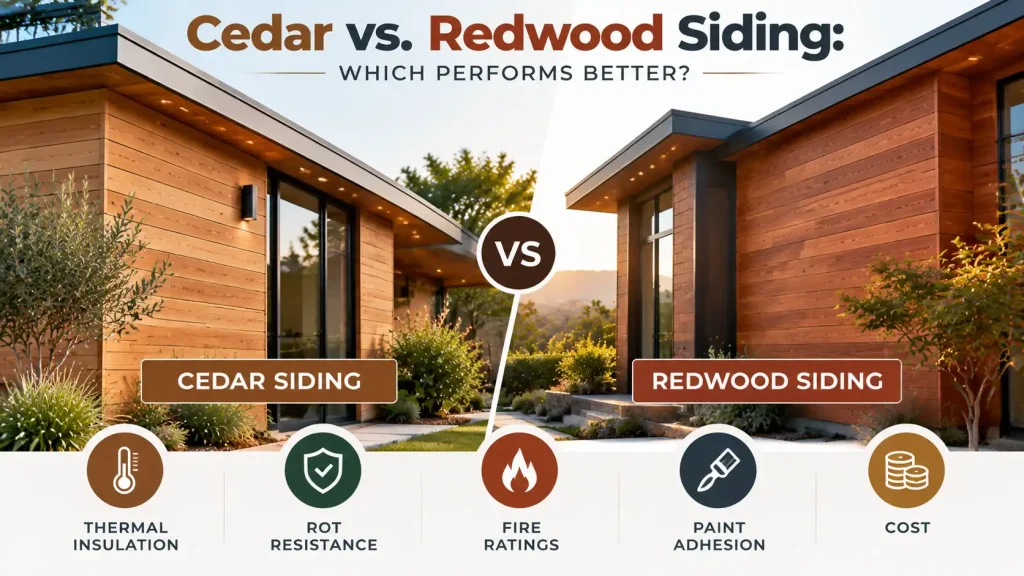
When specifying real architectural wood cladding for an exterior facade, Western Red Cedar and California Redwood remain the two premier species in North American home design. Both woods possess natural resistance to decay, straight grain patterns, and timeless curb appeal that synthetic vinyl and fiber-cement products attempt to mimic.
Choosing between them is not simply a matter of aesthetic preference. The two species diverge across key engineering metrics: Western Red Cedar provides superior thermal insulation (higher R-value) and holds paint or semi-transparent stain significantly longer. In contrast, California Redwood delivers higher fire-resistance performance, greater natural density, and richer reddish-amber color depth.
Below is a detailed technical comparison of Western Red Cedar and California Redwood siding, evaluating rot resistance, finish longevity, fire codes, profile performance, and overall project costs.
Technical Comparison: Cedar vs. Redwood Siding
Western Red Cedar Siding
Botanical Source: Thuja plicata (Pacific Northwest / Canada)
Density and Weight: Approximately 21 to 23 pounds per cubic foot (lightweight)
Janka Hardness Rating: 350 pounds of force
Thermal Insulation (R-Value): R-1.10 per inch of thickness (highest among softwoods)
Flame Spread Rating: Class B or Class C (typically 65 to 100 depending on milling)
Finish Adhesion: Exceptional; pitch-free cellular structure holds paint and stain up to 30 percent longer
Insect and Decay Resistance: Exceptional natural thujaplicin extractives in heartwood
Primary Siding Profiles: Bevel (lap), Tongue-and-Groove, Channel Rustic, Board-and-Batten, Shingle/Shake
California Redwood Siding
Botanical Source: Sequoia sempervirens (Northern California coast)
Density and Weight: Approximately 26 to 28 pounds per cubic foot (moderately dense)
Janka Hardness Rating: 420 to 480 pounds of force
Thermal Insulation (R-Value): R-0.85 per inch of thickness
Flame Spread Rating: Class B (typically 50 to 70; naturally denser ignition resistance)
Finish Adhesion: Very good, though rich water-soluble tannins require strict stain-blocking primers
Insect and Decay Resistance: Exceptional natural polyphenolic tannins in heartwood
Primary Siding Profiles: Tongue-and-Groove, Shiplap, Bevel, Board-and-Batten, Custom Architectural Planks
1. Natural Durability and Rot Resistance
Both species naturally survive wet and dry outdoor cycles without requiring chemical pressure treatment. Their resistance comes from natural extractives concentrated inside the heartwood.
Western Red Cedar contains thujaplicins and water-soluble phenolics that act as natural fungicides, preventing rot-producing wood decay fungi from colonizing the timber. Cedar also has low volumetric shrinkage, meaning boards resist cupping, warping, and seam splitting during seasonal rain bursts.
California Redwood contains dense concentrations of tannins that give the heartwood its deep reddish-cinnamon hue. These tannins make the wood naturally unpalatable to wood-boring insects and drywood termites.
The Critical Heartwood Rule
For both species, exterior durability is concentrated strictly in the heartwood (the dark center of the tree trunk). The pale, yellowish-white sapwood found along the outer edge of the log contains almost no natural extractives. If you specify siding with sapwood content (such as lower-tier Construction Common grades), those sections will rot and fall victim to insects in under a decade. Always specify Clear Heart, A-Grade, or Architectural Clear lumber for exterior siding runs.
2. Finish Longevity: Paint and Stain Performance
Siding is constantly exposed to direct sunlight, windblown rain, and ambient moisture. How a wood species interacts with finishes directly dictates how often you will have to repaint or re-stain your home.
Western Red Cedar: The Clear Winner for Paint and Stain
Western Red Cedar contains virtually zero pitch or natural resin. Its cellular structure is open, light, and porous, functioning like a sponge for liquid primers, penetrating oils, and 100 percent acrylic latex coatings.
Because cedar expands and contracts very little with humidity shifts, it exerts minimal shear stress on the underside of dried paint films.
Premium acrylic paint systems applied over properly back-primed cedar siding can last 10 to 15 years before needing a repaint. If you prefer natural finishes, review our guide on wood stain vs paint for cedar siding to select the right system for your property.
Redwood: Exceptional Color, Higher Risk of Tannin Bleed
Redwood holds paint and stains well, but its heavy concentration of water-soluble tannins requires meticulous prep.
If moisture penetrates behind the siding, these tannins dissolve and migrate through the paint film to the surface, creating dark brown or yellowish streaks known as tannin bleed.
To prevent this issue, Redwood siding must be completely sealed on all six sides—including the back and all fresh job-site end cuts—using a high-solids, exterior oil-based or alkyd stain-blocking primer before applying water-based topcoats. Read our detailed contractor instructions on how to fix tannin bleed on cedar siding and redwood cladding to resolve active surface discoloration.
3. Fire Resistance and California WUI Compliance
In wildfire-prone areas across the Western United States and Southern California—including designated Wildland-Urban Interface (WUI) zones in Los Angeles, Ventura, and San Diego counties—flame-spread characteristics are a major building code requirement.
Redwood has a natural physical advantage in fire performance. Because it is denser than cedar and has a tight, uniform cellular structure, Redwood typically earns a Class B flame-spread rating (with ratings often testing in the 50 to 70 range). It ignites more slowly and chars at a predictable, insulating pace under ember exposure.
Western Red Cedar is lighter and less dense, typically landing near the lower end of Class B or within Class C (flame-spread index around 65 to 100).
In strict WUI designated fire hazard zones, exterior wood cladding must either be factory-treated with certified fire-retardant chemistries or installed over non-combustible exterior gypsum sheathing assemblies to satisfy Chapter 7A building code requirements.
4. Thermal Insulation and Energy Efficiency
Wood provides far superior natural insulation compared to aluminum, vinyl, or concrete-based cladding products because its internal structure is filled with tiny, trapped air pockets.
Western Red Cedar is the most effective thermal insulator among all common softwoods. A standard bevel or tongue-and-groove cedar installation acts as a continuous thermal break over exterior wall framing studs, reducing thermal bridging and helping keep indoor living spaces cooler during hot summer days and warmer through chilly winter nights.
5. Popular Siding Profiles: How They Behave
The architectural profile you choose influences water drainage, shadow lines, and structural stability across both woods:
1. Bevel (Lap) Siding
Best Wood Match: Western Red Cedar
The classic American home profile. Thicker at the bottom butt-edge and tapered thin at the top, bevel siding sheds driving rain cleanly. Cedar’s lightweight boards make long 16-foot horizontal runs straightforward to align and nail without splitting.
2. Shiplap and Tongue-and-Groove
Best Wood Match: Redwood or Western Red Cedar
Shiplap and tongue-and-groove profiles create a flat, contemporary, modern surface with crisp architectural reveal gaps (such as 1/8-inch nickelslot lines). When choosing between these two interlocking systems, see our side-by-side comparison of shiplap vs tongue and groove wall paneling.
3. Board-and-Batten
Best Wood Match: California Redwood
Wide vertical boards covered at the joints by narrower vertical battens create rustic modern farmhouse and mid-century aesthetic lines. Redwood’s higher density and stiffness help long, wide vertical planks (such as 1×10 or 1×12 boards) hang straight without cupping away from framing studs.
6. Sourcing, Regional Availability, and Cost
Location plays a noticeable role in material pricing and availability:
Regional Availability: Redwood grows primarily along the coastal strip from central California up into southern Oregon. As a result, premium redwood is widely stocked and competitively priced across California lumber yards. Western Red Cedar originates mainly in the wet rainforests of the Pacific Northwest and British Columbia, making it more abundant and cost-effective across the Northern and Mountain West regions.
Pricing Realities: For architectural grades (Clear Heart, vertical grain), both species fall into the premium building tier, typically ranging from $6.50 to $14.00 per square foot for raw materials, depending on board width, profile complexity, and thickness.
Summary: Which Should You Choose?
Choose Western Red Cedar if:
You plan to paint the siding white, light gray, or another pale exterior color and want maximum protection against peeling.
Energy efficiency and thermal insulation across exterior walls are top priorities.
You want a lightweight board that is easy to handle on scaffolding and creates crisp, sharp bevel or lap lines.
You love the subtle, golden-brown honey tones and pleasant aroma of natural cedar.
Choose California Redwood if:
You want a clear or semi-transparent finish that showcases rich, deep natural cinnamon and ruby-brown wood grain.
Your home is located in an area with heightened wildfire or ember exposure where higher material density and Class B flame-spread resistance provide added peace of mind.
You are designing wide vertical board-and-batten cladding or flat, modern shiplap panels that benefit from stiffer timber density.
You want to match existing architectural millwork, exterior pergolas, or boundary fences built with local fencing materials.
Frequently Asked Questions
Which siding lasts longer, cedar or redwood?
When specified in 100 percent heartwood grades and maintained correctly, both species offer an exterior lifespan of 30 to 50+ years. Longevity depends far more on installation practices—such as using breathable rainscreens, stainless steel fasteners, and back-priming—than on raw species differences.
Does cedar siding need to be sealed?
Yes. While cedar naturally resists rot and fungal decay without chemical sealers, leaving it completely bare allows UV rays to break down surface wood fibers and turn the wood dark or silvery gray. Applying a high-grade penetrating exterior wood oil or water-repellent preservative prevents surface checking and moisture absorption.
Can you install wood siding directly against housewrap?
Modern building science strongly advises against installing wood siding tight against flat housewrap. Installing wood cladding over a rainscreen gap (using 3/8-inch or 3/4-inch furring strips) creates a ventilated air cavity behind the siding. This air gap allows trapped water to drain quickly and lets boards dry from both sides, doubling the life of exterior paint and stain coatings.
Why do fasteners cause black stains on redwood and cedar siding?
Both cedar and redwood contain high amounts of natural extractives and tannins that chemically react with plain steel or low-grade galvanized fasteners. This reaction creates permanent, inky black stains across the wood surface. Always specify Grade 304 or Grade 316 stainless steel ring-shank nails to eliminate fastener corrosion and wood staining.
To inspect full-scale siding profiles, explore premium siding patterns, and review exterior hardwoods alongside matching decking species, visit the National Hardwood Flooring and Moulding showroom at 14959 Delano St, Van Nuys, CA 91411, or contact our architectural lumber specialists to review material samples and project plans.