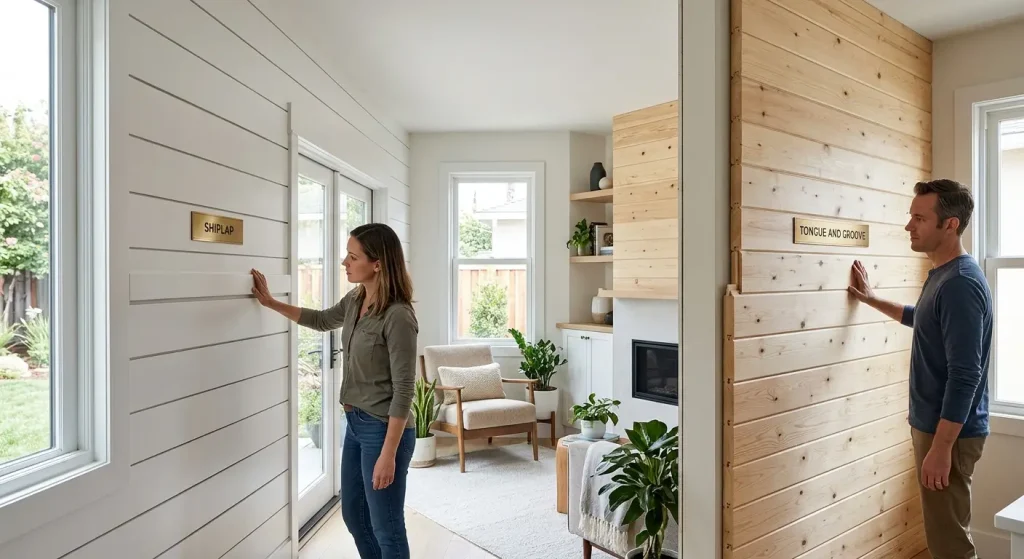
Both shiplap and tongue and groove show up constantly in home renovation conversations, and it is easy to see why they get conflated. They are both wood paneling systems, they both install in similar orientations, and they both create a finished wall that looks intentional and done. But they are built differently and they read differently on a wall, and those differences matter when you are trying to figure out which one belongs in your home.
How Each One Is Actually Built
Shiplap gets its name from the way the boards are cut. Each board has a rabbet, a step-cut on the top and bottom edge, that allows it to overlap with the board above and below it. When installed, those overlapping edges create a consistent shadow gap between each board. That gap is the defining visual feature of shiplap. It gives the wall a horizontal rhythm, and the shadow lines that develop as light hits the surface are part of the appeal.
Tongue and groove works differently. One edge of each board has a protruding tongue, and the opposite edge has a matching groove. The tongue of one board fits into the groove of the next, locking the boards together. When installed correctly, tongue and groove paneling creates a tight, even surface with no visible gap between boards. The boards meet flush, and the joint between them is either very subtle or, in some profiles, accented with a small bead detail.
The Visual Difference on a Wall
This is where homeowners need to think about the room they are working with before choosing a product.
Shiplap is more casual. The shadow gaps between boards give the wall some movement and texture, and the style has strong associations with farmhouse, coastal, and transitional interiors. It works well in living rooms, bedrooms, dining spaces, and anywhere the goal is to add character without making the space feel formal. Horizontal installation is the most common orientation, though vertical shiplap has a different feel that suits some architectural styles.
Tongue and groove is more formal, or at least more finished. Because the boards sit tight against each other, the wall surface reads as more continuous. In traditional and craftsman interiors, tongue and groove paneling on ceilings, wainscoting sections, or full walls is the standard choice. It also suits spaces where you want the texture and warmth of wood without the casual, gap-marked look of shiplap.
Ceiling Applications
On ceilings, tongue and groove tends to win. The tight joint between boards holds up better overhead because there is less visual distraction from gravity pulling the eye to shadow gaps. Tongue and groove porch ceilings, bedroom ceilings, and covered outdoor ceiling installations have a long history in both traditional and coastal architecture. Shiplap on a ceiling is not unheard of, but it is less common for good reason.
Species & Material Choices
Both shiplap and tongue and groove are available in multiple wood species, and the species you choose affects how the installation looks and how it handles over time.
Cedar is a common choice for both profiles in interior and exterior applications. It accepts stain and paint, handles moisture without deteriorating quickly, and is lighter than most hardwood options. Cedar shiplap on an exterior accent wall has become a standard in contemporary home design.
Pine is the most economical option for interior installations. It accepts paint well and is the default material for shiplap in most painted applications. The softness of pine means it picks up dents in high-traffic areas, but for wall applications where contact is minimal, it performs well.
Hardwood options like oak, poplar, and redwood step up the quality and durability of the installation. Poplar is particularly popular for painted tongue and groove ceiling applications because it mills to a clean profile and holds paint without significant grain show-through. Oak provides a natural finish that stands on its own without paint or stain.
Width & Profile Options
Shiplap typically runs in 6-inch and 8-inch widths, though wider boards are available. Narrower boards create more shadow lines per linear foot of wall, which increases the visual texture. Wider boards create a calmer surface with less shadow line frequency.
Tongue and groove profiles vary in width as well, and some profiles include a decorative bead at the joint. Beaded tongue and groove is common in traditional and craftsman interiors and gives the wall a more detailed finish than a plain butt joint.
Installation Considerations
Shiplap installs faster than tongue and groove in most cases because the overlapping joint does not require the same precision as fitting tongue into groove consistently across a long run. For DIY installations, shiplap is generally more forgiving. Tongue and groove requires careful alignment so the boards track straight and the joints stay consistent, which is easier to achieve with some experience.
Both systems work over wall framing and over existing drywall. For interior accent walls, installing directly over drywall is common and reduces the labor involved. For exterior applications, proper moisture barrier installation underneath is necessary regardless of which profile is used.
Which One to Choose
If the space is casual and the goal is texture and warmth without formality, shiplap is the straightforward answer. If the room calls for a tighter, more finished surface, particularly on ceilings or in rooms with traditional trim, tongue and groove is the right direction. For exterior accent walls and covered outdoor ceilings, tongue and groove in cedar or redwood has a track record that shiplap does not quite match.
Bringing samples of both profiles into the actual space and looking at them under the room’s lighting conditions is the best way to settle the decision before committing to material quantities.