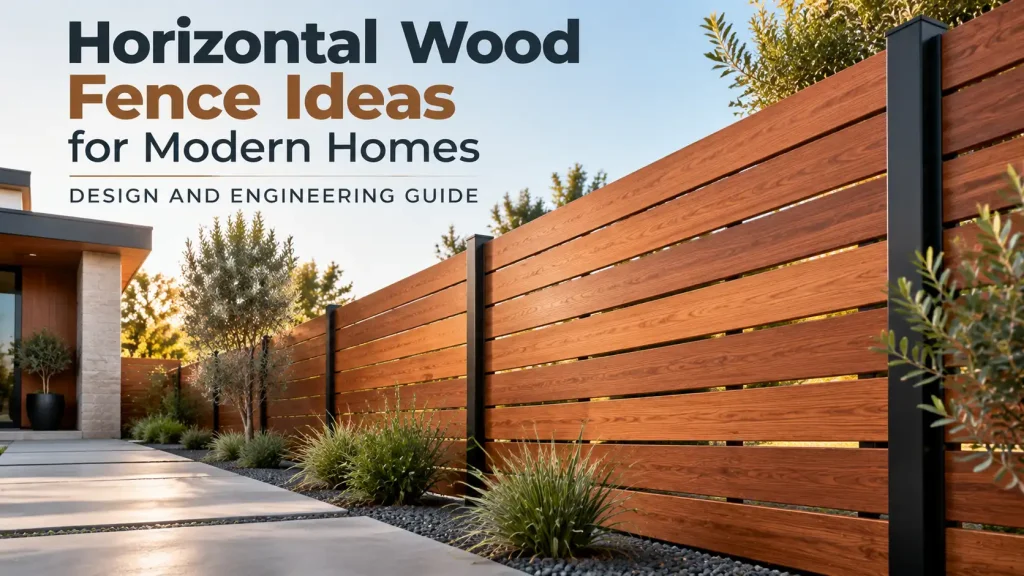
Horizontal wood fences have become the defining boundary feature for mid-century modern, contemporary, and transitional homes throughout Southern California and across the country. By orienting lumber parallel to the ground rather than vertically, a horizontal fence visually elongates property lines, emphasizes clean architectural planes, and complements flat-roof lines, low-pitch eaves, and minimalist landscaping.
However, building a horizontal fence is significantly more demanding than throwing up a traditional vertical dog-ear fence. Gravity works against horizontal boards across their entire flat face, making them inherently prone to mid-span sagging, cupping, and twisting if installed incorrectly.
Achieving a fence that retains its razor-sharp geometric lines requires balancing design creativity with proper engineering: selecting the right wood species, tightening post spacing, and incorporating concealed structural supports.
5 Inspiring Horizontal Fence Designs for Modern Homes
1. The Seamless Tongue-and-Groove Privacy Wall
For homeowners requiring complete backyard seclusion around swimming pools, outdoor spas, or ground-level patios, a continuous tongue-and-groove horizontal fence provides maximum privacy.
- Visual Style: Interlocking board edges fit together without gaps, creating a monolithic wood barrier that resembles fine architectural siding.
- Best Pairing: Looks striking behind architectural boxwood hedges, minimalist olive trees, or gravel walkways.
- Species Selection: Western Red Cedar or Clear Heart Redwood work best here because their low shrinkage rates keep interlocking joints from pulling apart during dry summer seasons.
2. The Open Shadowbox (Alternating Slat) Fence
An open shadowbox fence alternates horizontal boards across both sides of the support posts.
- Visual Style: It creates a dimensional, three-dimensional shadow profile that looks identical from both sides of the property line, making it ideal as a shared boundary with neighbors.
- Functional Advantage: The staggered gaps allow ocean breezes and heavy winds to pass through freely. This drastically reduces the wind-load pressure against fence posts during seasonal Santa Ana wind events, while still blocking direct lines of sight.
3. Thin-Slat Scandinavian Minimalist (Batten Style)
Rather than wide 1×6 boards, this profile utilizes narrow 1×2 or 2×2 clear-grade slats spaced 3/8-inch to 1/2-inch apart.
- Visual Style: The tight repetition of narrow horizontal lines creates a light, refined, furniture-grade screen. It is popular for courtyard enclosures, trash enclosure concealment, and front-yard low perimeter walls.
- Material Choice: Kiln-dried domestic clear cedar or ultra-dense woods like ipe wood decking boards ripped to narrow widths to ensure absolute straightness over time.
4. Mixed-Width Horizontal Pattern
Instead of using uniform boards from top to bottom, this design varies plank widths in a deliberate rhythm—such as alternating rows of 1×6, 1×4, and 1×2 lumber.
- Visual Style: Adds rhythmic texture and organic warmth to stark concrete or stucco facades, softening massive boundary runs.
- Construction Tip: Plan your repeating layout on paper beforehand to ensure that both ends of the fence panel terminate evenly against corner posts without leaving awkward 1-inch strips at the top or bottom.
5. Wood Slats with Black Powder-Coated Steel Posts
Combining natural warm wood with industrial black metal is a staple of California modern design.
- Visual Style: Instead of concealing wooden 4×4 posts behind the boards, structural steel posts (such as 2×2 or 3×3 square tubing) are left visible or embedded in custom metal channels.
- Structural Advantage: Steel posts never warp, rot at ground level, or twist under tension. The contrast between warm honey-brown wood and matte black metal creates an elevated, commercial-grade architectural boundary.
Choosing the Best Wood Species for Horizontal Fencing
Because horizontal boards do not hang from a top rail, their dimensional stability and fiber density determine how long the fence stands without curling:
1. Ipe (Brazilian Walnut)
- Hardness: Over 3,500 on the Janka scale.
- Performance: Ipe is one of the densest and most naturally durable hardwoods on earth. It is naturally resistant to termites, rot, and fungi, and carries a Class A fire rating.
- Lifespan: 40 to 50+ years.
- Best Use: High-end luxury properties where longevity and zero rot are mandatory. As explored in our comparison of ipe vs teak decking, dense hardwoods withstand punishing desert heat and intense sun without breaking down.
2. California Redwood (Clear Heart or Heart B)
- Performance: Redwood contains natural tannins that make its heartwood naturally insect- and decay-resistant. It is lightweight, remarkably easy to mill, and exhibits minimal movement across temperature swings.
- Lifespan: 20 to 25 years (using all-heartwood lumber).
- Best Use: Classic California architecture, hillside estates, and mid-century modern Eichler homes. Avoid cheap common redwood containing white sapwood, as sapwood rots within 5 to 7 years when exposed to moisture.
3. Western Red Cedar
- Performance: Cedar offers straight grain lines, lightweight fiber structure, and natural dimensional stability. It accepts semi-transparent stains and protective oils exceptionally well.
- Lifespan: 18 to 22 years.
- Best Use: Pacific Northwest and modern transitional styles where a warm, blonde-to-amber wood tone with prominent natural grain is desired.
4. Thermally Modified Wood
- Performance: Thermally modified lumber (such as modified Ash or Pine) undergoes high-temperature steam kilning that strips sugars and makes boards hydrophobic.
- Lifespan: 25 to 30 years.
- Best Use: Homeowners seeking tropical hardwood durability from sustainably harvested domestic trees. Read our detailed guide on thermally modified wood decking to see how this molecular heat-treating process stabilizes timber outdoors.
Critical Engineering Rules: How to Prevent Sagging and Warping
The number one failure point of horizontal fences is board sagging. A vertical board relies on its long grain axis to resist gravity. A horizontal board spans open air on its weaker flat axis, making it susceptible to gravity, sun cupping, and thermal sag.
To build a horizontal fence that stays straight for decades, contractors follow four essential construction rules:
1. Tighten Post Spacing to 6 Feet (Never 8 Feet)
Standard vertical privacy fences use 8-foot post spacing. Never use 8-foot spans for a horizontal fence. Over an 8-foot span, standard 1-inch lumber (which is actually 3/4-inch net thickness) will begin visibly bowing within its first summer.
- Rule: Space your support posts no more than 6 feet on-center (or 5 feet for thinner slats).
- Heavy dense woods like Ipe or Cumaru should strictly adhere to 4- to 6-foot spans due to their significant board weight.
2. Install Mid-Span Vertical Stiffeners
Even with 6-foot post spacing, boards can flex in opposite directions under intense afternoon sun. To lock all horizontal planks into a single rigid plane, install a vertical stiffener directly at the center of each span on the backside of the fence:
- Fasten a 2×2 or 2×4 vertical cleat on the hidden interior side of the fence panel at the 3-foot midpoint between posts.
- Screw every single horizontal board into this center stiffener from the back.
- This locks all 8 to 12 stacked boards together as an integrated monolithic panel, preventing individual boards from warping or cupping out of alignment.
3. Mind the Fastener Type: Use Stainless Steel Exclusively
Exotic hardwoods and tannin-rich species like Redwood and Cedar corrode standard steel, electro-galvanized nails, and yellow-zinc screws. This corrosion leaves dark, inky black stains running down the boards and eventually snaps screw shanks.
- Always use Grade 305 or Grade 316 stainless steel screws.
- Drive two fasteners per board at every post intersection.
- For hardware decisions, check our breakdown on hidden fasteners vs face screws for hardwood decks to evaluate the difference between surface fasteners and hidden clip channels.
4. Maintain a 2-Inch Ground Clearance
Never allow your lowest horizontal fence board to touch garden soil, mulch, or lawn turf. Direct ground contact traps dampness, wicking moisture up through the lower grain and rotting the bottom plank within a few seasons. Maintain a minimum 2-inch clearance above soil, or install a rot-resistant gravel drainage band beneath the fence line.
Finishing and Maintenance for Long-Term Beauty
Outdoor horizontal fences endure intense UV radiation on their top edges and faces. Maintaining their appearance depends on the finish strategy you select:
- Preserving Natural Tone: Apply a penetrating exterior wood oil with trans-oxide UV blockers immediately after installation. Dense hardwoods should be finished following the protocols in our guide on how to oil and maintain a hardwood deck. Reapply every 18 to 24 months.
- Allowing Natural Weathering: If you prefer a relaxed coastal look, you can leave high-grade woods like Ipe or Clear Redwood un-oiled. Over 12 to 18 months, the sun will oxidize surface fibers, naturally transforming the wood into a uniform, silvery-gray patina without sacrificing structural integrity.
- Avoiding Film-Forming Paints: Never use thick exterior latex paints or surface varnishes on horizontal fences. Direct sun and seasonal movement cause surface paints to blister and peel, creating a labor-intensive scraping and stripping project later.
Frequently Asked Questions
Which wood species is best for a modern horizontal fence?
Clear Heart Redwood and Western Red Cedar are the top domestic choices due to their natural decay resistance, lightweight stability, and rich grain. For luxury properties requiring maximum dent resistance, zero insect damage, and a 40+ year lifespan, Brazilian ipe wood decking boards installed horizontally provide the most durable boundary possible.
Why do horizontal fence boards warp faster than vertical ones?
Horizontal boards sit on their flat, flexible axis without top-down support, making them vulnerable to gravity and sun-induced heat bowing. To prevent warping, keep post spacing under 6 feet, screw boards into mid-span vertical stiffeners, and use kiln-dried lumber with uniform moisture content.
Can you build a horizontal fence with steel posts?
Yes, using steel posts (such as galvanized pipe or square black steel tubing) is one of the most effective ways to build a long-lasting horizontal fence. Steel posts do not warp, crack, or rot underground. Wood boards can be fastened to steel posts using specialized fence brackets or heavy-duty self-tapping stainless steel screws.
How much spacing should be left between horizontal fence boards?
For privacy, leave an intentional 1/8-inch to 1/4-inch expansion gap between boards. If you install wet or unseasoned lumber with zero gap, the boards will expand during winter rains, buckle against one another, and crack around the fasteners. For an open architectural screen, gaps of 3/8-inch to 1/2-inch are standard.
To inspect full-scale lumber samples, view premium fencing materials, or explore custom milled profiles, visit the National Hardwood Flooring and Moulding showroom at 14959 Delano St, Van Nuys, CA 91411, or contact our architectural lumber specialists to review board dimensions and framing hardware for your next project.