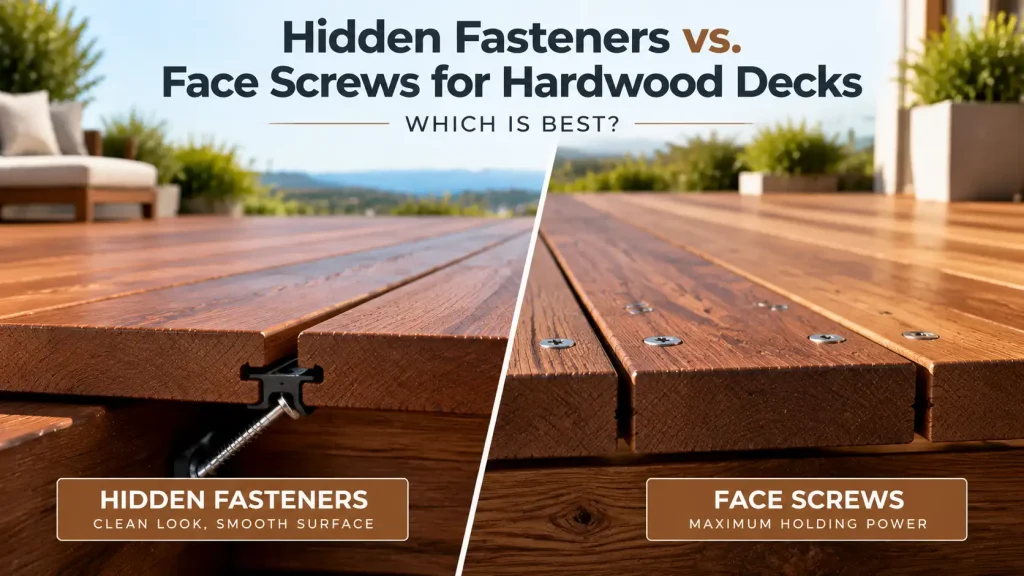
When installing an exotic hardwood deck, choosing between hidden fasteners and traditional face screwing is one of the most critical structural decisions you will make. While composite decking forgivingly adapts to almost any clip system, high-density exterior timbers such as ipe wood decking, Cumaru, and Garapa exert tremendous physical leverage as they expand and contract with changing weather.
Hidden fasteners deliver a sleek, modern, fastener-free walking surface that highlights uninterrupted grain lines. However, face screwing remains the gold standard among seasoned deck framing contractors for pure mechanical hold down power, structural longevity, and board stability.
Selecting the right installation method requires weighing visual appeal against subframe ventilation, board thickness, local climate swings, and long-term maintenance needs.
Comparison at a Glance: Hidden Fasteners vs. Face Screwing
Hidden Fasteners
Primary Visual Appeal: Completely unblemished walking surface with zero visible screw heads
Mechanical Restraint: Moderate, holds boards by their milled edge grooves
Vulnerability to Board Cupping: Higher risk if ground ventilation is limited
Pre-Drilling Time: Low to moderate (screws drive through clips at an angle)
Single Board Replacement: Difficult; often requires disassembling nearby rows
Best Suited For: High-clearance decks with excellent underside airflow and boards 4 inches or narrower
Face Screws (Exposed Head)
Primary Visual Appeal: Visible industrial hardware pattern aligned over every joist
Mechanical Restraint: Maximum; drives two top-down fasteners through every joist intersection
Vulnerability to Board Cupping: Very low; physically locks both edges of the board flat
Pre-Drilling Time: High; every single pilot hole must be drilled and countersunk
Single Board Replacement: Fast and straightforward; simply back out individual screws
Best Suited For: Decks of any clearance, wide 1×6 or 5/4×6 planks, and low-ventilation installations
Face Screws with Matching Wood Plugs
Primary Visual Appeal: Invisible metal fasteners covered with matching natural wood grain
Mechanical Restraint: Maximum structural hold down power identical to face screwing
Vulnerability to Board Cupping: Very low; eliminates edge lifting across wide boards
Pre-Drilling Time: Very high; requires drilling, countersinking, gluing plugs, and sanding flush
Single Board Replacement: Moderate; requires drilling out wood plugs to access screws
Best Suited For: Ultra-luxury architectural installations demanding maximum stability and clean aesthetics
How Hidden Fasteners Work on Dense Hardwood
Hidden fastener systems for hardwoods use specialized, injection-molded clips made from reinforced polypropylene or stainless steel (such as Ipe Clip, Camo, or DeckWise systems). The clip features a stainless steel reinforcing insert and a built-in spacing leg to ensure consistent 5/32-inch or 1/4-inch expansion gaps between boards.
       [ Deck Board ]                        [ Deck Board ]
      ┌───────────────┐                    ┌───────────────┐
      │               └──┐   [ Clip ]   ┌──┘               │
      │                  │   ┌──────┐   │                  │
      │                  └───┤  ██  ├───┘                  │
      └──────────────────────┴──┬───┴──────────────────────┘
                                │ (Screw driven at 45°)
                      ══════════╪═════════════════
                         [ Framing Joist ]
The clip inserts directly into pre-grooved side slots along the edges of the deck boards. A stainless steel screw is then driven through the clip at a 45-degree angle straight into the framing joist below.
Key Advantages of Hidden Fasteners
Clean Visual Lines: Without hundreds of exposed screw heads breaking up the floor, the natural figures, ribbon grain, and warm tones of the timber take center stage.
No Water Infiltration into Board Faces: Face-driven screws create small surface penetrations where standing water can pool. Hidden clips secure boards entirely through their side profiles, keeping the top face smooth and water-shedding.
Smooth Barefoot Surface: Fasteners never back out above the walking surface over years of foot traffic, eliminating the risk of snagging bare feet or socks.
Technical Limitations of Hidden Fasteners
Dense tropical hardwoods possess extreme shear strength and fiber density, rating well over 3,000 on the Janka hardness scale. When a dense board experiences moisture changes, it moves with substantial hydraulic force. Because hidden clips secure only a thin 5/32-inch groove along the lower edge of the board, the top half of the plank remains unrestrained. If the board cups, it can bend the clip, shear the screw, or snap the wood groove.
How Face Screwing Secures Hardwood Decks
Face screwing is the time-tested mechanical fastening method for heavy timber. Installers snap chalk lines across the deck to locate joist centers, pre-drill two holes per joist intersection across the board face, and drive heavy-gauge stainless steel deck screws straight down through the board into the joist.
Key Advantages of Face Screwing
Absolute Cupping Prevention: Driving two screws across the width of a board firmly secures both edges. Even when boards endure severe sun on top and damp soil underneath, top-down mechanical leverage prevents edges from curling upward.
Simple Board Repairs: If a plumbing line beneath the deck breaks, or if an individual board is damaged by patio furniture or hot barbecue grease, face screws can simply be backed out to lift that single board without disturbing the rest of the deck.
Works in Any Climate and Clearance: Face screwing does not rely on perfect ground airflow to prevent fastener failure, making it safe for low ground-clearance decks.
Drawbacks of Face Screwing
High Labor Requirements: Because hardwoods are so dense, installers cannot use self-tapping screws. Every hole must be cleanly pre-drilled and countersunk using specialized bits. Driving screws without pilot holes will immediately snap high-tensile stainless steel screws.
Visible Fastener Lines: Even when screws are laid out with laser lines, hundreds of visible screw heads remain across the deck floor.
Face Screws with Plugs: The Luxury Hybrid Method
For luxury residential projects where neither exposed screw heads nor the cupping risks of hidden clips are acceptable, architects specify countersunk face screws covered with matching wood plugs.
Installers pre-drill a pilot hole with an integrated 3/8-inch counterbore bit.
The stainless steel screw is driven home, seating its head roughly 1/4-inch below the surface of the timber.
A drop of waterproof exterior wood glue (such as exterior polyurethane adhesive or epoxy) is placed into the hole.
A tapered wood plug cut from the identical hardwood species is tapped into the hole, carefully aligning its grain direction with the board face.
Once cured, the protruding plug is trimmed flush with a flexible Japanese pull saw and belt-sanded smooth.
This approach provides the maximum structural hold down force of face screws while concealing all metal fasteners beneath genuine timber grain. The primary trade-off is labor cost; plugging an entire deck adds significant carpentry time to the project.
The Ventilation Rule: When Hidden Fasteners Fail
The biggest factor dictating whether hidden fasteners will succeed or fail is underside deck ventilation.
HIGH-RISK SCENARIO FOR HIDDEN FASTENERS:
  Direct Sun / Intense Heat (Dries out board face rapidly)
              ↓↓↓↓↓↓↓↓↓↓↓↓
      ┌──────────────────────────┐  <-- Top face shrinks and cups
      │        Deck Board        │
      └──────────────────────────┘
              ↑↑↑↑↑↑↑↑↑↑↑↑
  Damp Soil / Low Ground Clearance (Board bottom stays wet and swollen)
Wood changes dimension in response to moisture. When a deck is built close to the ground (under 18 to 24 inches of clearance over dirt or concrete):
The bottom of the deck boards absorbs moisture rising from the ground.
The top of the deck boards dries out rapidly under hot sun and wind.
This imbalance forces the bottom of the board to expand while the top shrinks, creating extreme upward cupping leverage.
If you install 1×6 or 5/4×6 wide boards over a low-clearance subframe using hidden clips, the clips will often fail under this pressure.
Rules for Choosing Fasteners Based on Site Conditions:
Less than 18 inches above ground: Mandatory Face Screwing (exposed screws or plugged). The moisture differential is too severe for hidden clips.
Over 24 inches above open, well-drained ground: Hidden Fasteners or Face Screws. Ample airflow keeps moisture equal on the top and bottom of the boards.
Board Width of 1×6 (5.5-inch face): Strong preference for Face Screwing. Wide planks exert far more cupping leverage than narrow boards.
Board Width of 1×4 (3.5-inch face): Excellent candidate for Hidden Fasteners. Narrow boards exert significantly less cupping pressure, allowing hidden clips to hold them reliably even through seasonal humidity changes.
Fastener Hardware: Stainless Steel Is Non-Negotiable
Whether you choose hidden clips or face screws, you must use high-quality stainless steel fasteners.
Dense exotic woods contain natural tannins and organic extractives that aggressively corrode standard carbon steel, galvanized screws, and yellow-zinc fasteners. Corroded screws will snap under structural tension and cause permanent black, inky chemical stains across the timber.
Grade 305 Stainless Steel: The minimum standard for general inland residential decking. Provides solid tensile strength and long-term corrosion resistance.
Grade 316 Marine-Grade Stainless Steel: Mandatory for properties located within 15 miles of the ocean or installed directly adjacent to saltwater swimming pools and hot tubs. Grade 316 contains added molybdenum to withstand atmospheric chloride attack and prevent salt-air pitting.
Maintenance and Long-Term Performance
Both fastening systems require periodic care to maintain the look and structural health of the wood. Regardless of how the boards are secured, dense hardwoods must be cleaned and treated to prevent surface checking and weathering:
Follow a regular schedule to clean and apply penetrating finishes, as detailed in our guide on how to oil and maintain a hardwood deck.
If you plan to compare alternative species that balance stability and fastening requirements, explore how domestic materials behave in our guide on thermally modified wood decking.
For builders evaluating alternative exotic species, review our technical breakdown of ipe vs teak decking to see how movement ratings differ across tropical woods.
Frequently Asked Questions
Can you use hidden fasteners on any hardwood deck?
Hidden fasteners work best on narrow boards (such as 1×4 or 5/4×4 profiles) installed on decks that sit at least 18 to 24 inches above the ground with open cross-ventilation. For wide 1×6 boards or low-clearance decks built over damp ground, face screwing is strongly recommended to prevent severe cupping.
Do hidden fasteners snap under seasonal movement?
High-quality modern clips feature stainless steel cores that resist snapping, but the screws securing them can shear if the wood cups with extreme force. Snapping issues almost always trace back to poor underside ventilation, inadequate spacing gaps, or using hidden clips on boards that are too wide.
What screw gauge should be used when face screwing hardwood?
Use minimum Number 8 or Number 10 gauge stainless steel deck screws with a trim-head or flat-head profile. Always pre-drill with a countersink bit designed for hardwood to ensure screw heads sit flush without splitting the board ends.
How much expansion gap is required between boards?
Most hardwood decks require an edge gap of 5/32-inch to 1/4-inch. Because dense hardwoods expand primarily across their width during wet seasons, leaving adequate space prevents boards from binding against each other and lifting off the joists.
To inspect grooved hardwood profiles, hidden clip systems, and premium deck fasteners in person, visit the National Hardwood Flooring and Moulding showroom at 14959 Delano St, Van Nuys, CA 91411, or contact our lumber specialists to review project plans, structural hardware, and material choices for your upcoming decking installation.