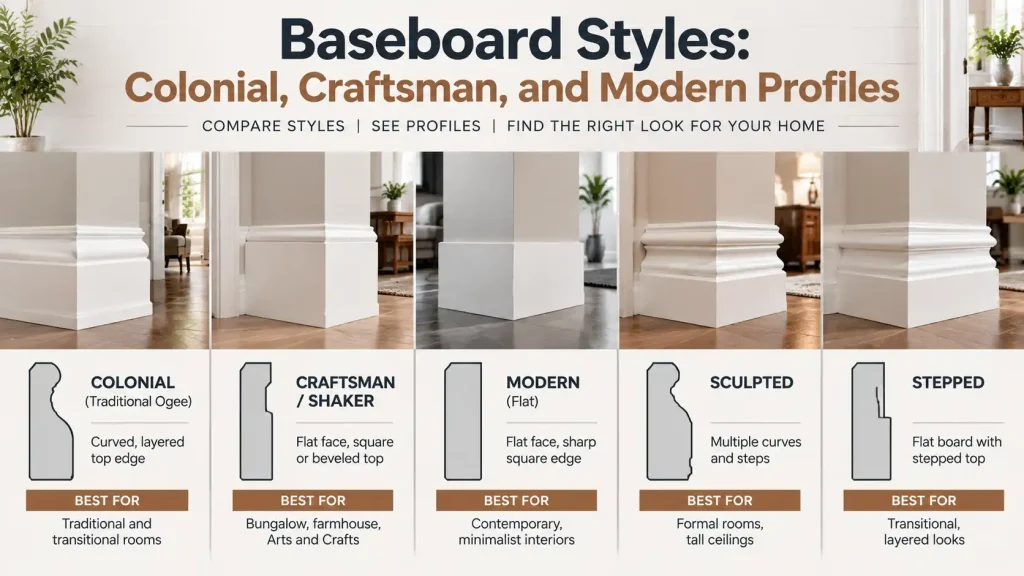
A baseboard does more than cover the joint where the wall meets the floor. Its profile, the shape of its face and top edge, sets the tone of a room and ties it to the age and style of the house. Most baseboards fall into three families: colonial with a curved top, craftsman with a flat square face, and modern flat stock with a clean edge. The right style is the one that agrees with your doors, casing, and the architecture of the home.
National Hardwood Flooring and Moulding has supplied and custom milled moulding and trim for Southern California homes since 1984. This guide breaks down each baseboard style, how to match it to the rest of your trim, and how to reproduce an older profile that is no longer stocked.
| Style | Best for | Key feature |
| Colonial (ogee) | Traditional and transitional rooms | Curved, layered top edge |
| Craftsman / Shaker | Bungalow, farmhouse, Arts and Crafts | Flat face, square or beveled top |
| Modern / flat | Contemporary, minimalist interiors | Flat face, sharp square edge |
| Sculpted | Formal rooms, tall ceilings | Multiple curves and steps |
| Stepped | Transitional, layered looks | Flat board with stepped top |
The Main Baseboard Styles
Colonial (Traditional Ogee)
A colonial base, often called traditional, is a flat board with a curved or stepped top edge, most commonly an ogee, which is a soft S shape. It is the profile in the widest use in American homes built from the 1970s forward. The curve at the top catches light and gives a soft, classic line that suits traditional and transitional rooms. In stock form it usually runs 3.25 to 5.25 inches tall, and taller in custom work.
Craftsman and Shaker
A craftsman base is flat stock with a simple square or lightly chamfered top edge and little to no ornament. It grew out of the early twentieth century Arts and Crafts movement, which valued clean lines and visible craft over decoration, and Shaker trim follows the same idea. The flat, substantial face reads honest and handmade, and it fits bungalows, farmhouse, prairie, and Arts and Crafts homes. Craftsman base often runs a bit taller, in the 5 to 7 inch range, to hold its weight against plain casing.
Modern and Flat Square
A modern base is completely flat with a sharp ninety degree top edge and no profile at all. It is designed to recede, giving a clean line where the wall meets the floor rather than a decorative one. It suits contemporary and minimalist interiors and pairs naturally with square edged casing and plain drywall reveals. Some modern designs push this further with a recessed reveal base set into the wall, which needs a specialized install.
Sculpted and Mid-Height
Sculpted base carries multiple curves, steps, or decorative elements for a more formal look. It reads richest in Victorian, formal colonial, and high ceiling rooms. The tradeoff is that detailed profiles catch dust and cost more than plain stock, so they suit rooms where the extra formality earns its keep.
Stepped
A stepped base is a flat board with small stepped grooves near the top. It reads clean and current but adds a little more interest than a plain flat board, which makes it a strong transitional choice for a home that is neither strictly traditional nor strictly modern.
Bullnose and Rounded
A bullnose base has a rounded top edge that tapers softly into the wall. The look is gentle and often used in shorter profiles. It shows up in mid century and some historic homes, though it can look dated in a strict modern room.
Build Your Own Profile with Cap and Shoe Molding
You are not limited to a single stock profile. A common approach is to start with a tall flat board, add a small cap molding along the top, and finish with shoe molding at the bottom. This builds a taller, more detailed base at a lower cost than a single ornate piece, and it lets you tune the exact look. It is also how many older homes achieved their tall, layered base in the first place. Cap and shoe are an easy way to lift a plain builder base without tearing it out.
Match Your Baseboard Style to the Rest of Your Trim
Baseboards share every room with door casing, window casing, and often crown, so the profiles need to agree. A craftsman home with flat casing wants flat craftsman base. Put a curved colonial base under flat casing and you get a conflict that is easy to feel and hard to name.
Keep the base and casing in the same family. See our guide to door casing styles to pair them. If the room has crown, hold the same style there too, and check our guide to types of crown molding or the crown moulding page for matching profiles.
Match the Style to Your Home
The surest guide to a baseboard style is the architecture of the house. A Spanish revival, a Craftsman bungalow, and a mid century ranch each have a period correct base, and matching it keeps the room honest. Across Los Angeles and the San Fernando Valley you see all three, often with original trim worth preserving.
If your home has original base that is no longer made, it can be reproduced. Bring in a short offcut and an onsite mill can match the profile, or run a custom one to a designer or architect spec. See custom moulding and profile matching for how that works.
Material by Style
Style sets the shape; material sets how it finishes and where it can go.
- Paint grade base, in MDF, poplar, or finger jointed pine, suits painted colonial, craftsman, and modern profiles.
- Hardwood base is the pick when you want a stained, natural look that shows grain.
- PVC or moisture rated base belongs in bathrooms, laundry rooms, and other damp spaces.
For the finish side of a stained base, see our stains and finishes selection, and browse the full lineup on the baseboards page.
A Quick Word on Height
Style and height are separate decisions, and both affect how the base reads. Once you have picked a profile, size it to the room and ceiling. Our guide to how tall baseboards should be covers the ceiling height ranges and a room by room breakdown.
Baseboard Styles FAQ
What is the most popular baseboard style?
The colonial ogee profile is the most widely used in American homes, especially those built since the 1970s. Flat, modern square base is the fastest growing style in contemporary builds.
What baseboard style suits a Craftsman home?
A flat stock craftsman or shaker base with a square or lightly chamfered top edge. Keep the door and window casing flat as well so the whole room reads as one style.
What is the difference between colonial and craftsman baseboard?
Colonial base has a curved, usually ogee, top edge, while craftsman base is flat stock with a square or slightly beveled edge and no curve. Colonial reads traditional, craftsman reads clean and handmade.
Can I mix baseboard styles in one home?
Keep one style through the main connected areas so open doorways read cleanly. You can vary the profile in a self contained room, but abrupt changes across an open floor tend to look accidental.
See Baseboard Profiles in Person
The easiest way to choose a style is to see the profiles at full size and hold them next to your casing. Visit our Van Nuys showroom to compare baseboard styles and materials, ask about custom milling and profile matching, or explore the full moulding and trim range. Contractors and designers can ask about trade pricing and bulk sourcing.