Wood floors handle a lot of foot traffic, but the thing that keeps them looking good for years is how you clean them, not how often you refinish them. Most of the damage people deal with later comes from cleaning habits that seemed fine at the time. The good news is that learning how to clean hardwood floors takes about ten minutes, and once you have a routine, it sticks.
Start by Knowing What Finish You Have
Before you grab any product, figure out what is sitting on top of your wood. The finish is the layer doing the protecting, and the way you clean depends on it.
Most floors made in the last few decades have a surface finish like polyurethane. This sits on top of the wood and acts like a shield. Older floors, or ones with an oil or wax treatment, soak the protection into the wood itself. The two types react to water and cleaners in opposite ways, so treating them the same is how people get into trouble.
How to test it
Put a single drop of water in an out-of-the-way spot. If it beads up and sits there, you have a surface finish and water is not soaking in. If it sinks in and leaves a dark mark within a few minutes, you have an oiled or waxed floor that needs gentler care and a lot less moisture.
The Daily and Weekly Routine
Cleaning hardwood floors works best as two separate jobs. One handles grit, the other handles grime. Mixing them up is where finishes start to wear down early.
Dry cleaning comes first
Sand and dirt act like sandpaper under your shoes. Every step grinds those particles into the finish. A few times a week, run a microfiber dust mop or a vacuum with the hard-floor setting across the surface. Skip the spinning brush bar on a vacuum, since it can scratch. This step alone does more for the life of your floor than any mop ever will.
Damp mopping, not wet mopping
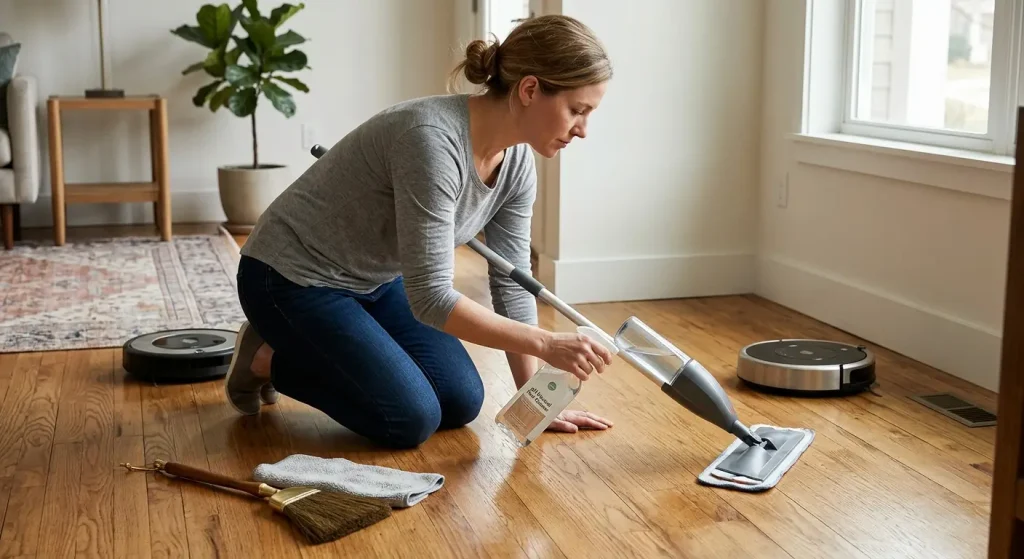
Once the loose stuff is gone, you can clean the surface. The word to remember is damp. Wood and standing water do not get along. Water that pools in the seams can swell the boards, lift the finish, and leave white haze behind. Use a microfiber mop that is barely wet, wring it until almost no water comes out, and go with the grain. If you can see streaks of water sitting on the floor, your mop has too much on it.
What to Use and What to Skip
The cleaner matters as much as the method. A lot of common household products were never meant for sealed wood, and they leave behind problems you only notice months later.
Cleaners that work
Stick with a pH-neutral cleaner made for wood floors. These lift dirt without stripping the finish or leaving residue. If you want to keep it simple, a small amount of that cleaner mixed into water is plenty. You are wiping away dirt, not scrubbing a pan.
Products that cause damage
Skip vinegar and anything acidic. People swear by it, but over time the acid dulls and eats into the finish. Stay away from ammonia, bleach, oil soaps, and steam mops too. Steam forces hot moisture straight into the wood and the seams, which is one of the fastest ways to ruin a floor. Wax-based or oil-based cleaners on a polyurethane floor just build up a cloudy film that traps dirt.
Dealing with Spills & Spots
Spills are going to happen, and they are fine as long as you get to them fast. Wipe liquid up the moment you see it rather than letting it sit. The longer water or juice stays on the surface, the more chance it has to work into a seam.
For sticky spots, a cloth dampened with your wood cleaner lifts most of it. For scuffs from shoes, a clean cloth with a little cleaner and some gentle rubbing usually takes care of it. Resist the urge to scrub with anything rough. A scrubbing pad will leave marks that are worse than the scuff you started with.
Habits That Keep Floors Looking Good Longer
Most of the work of keeping wood floors clean happens before dirt ever reaches them. A mat at every entrance catches grit and water at the door. A no-shoes rule cuts down on the sand and salt that get tracked in. Felt pads under chair and table legs stop the slow scratching that builds up under furniture.
Trim pet nails so they do not click and dig in. Keep the room from getting too dry or too humid, since wood moves with the seasons and big swings can open gaps or cup the boards. None of this takes effort once it becomes routine, and it adds years to how long your floors look new.
Cleaning hardwood floors is less about doing more and more about doing the right things in the right order. Sweep up the grit, mop with a damp cloth and the right cleaner, wipe spills fast, and keep dirt at the door. Do that, and the finish you paid for stays where it belongs, on the floor and not in the trash.