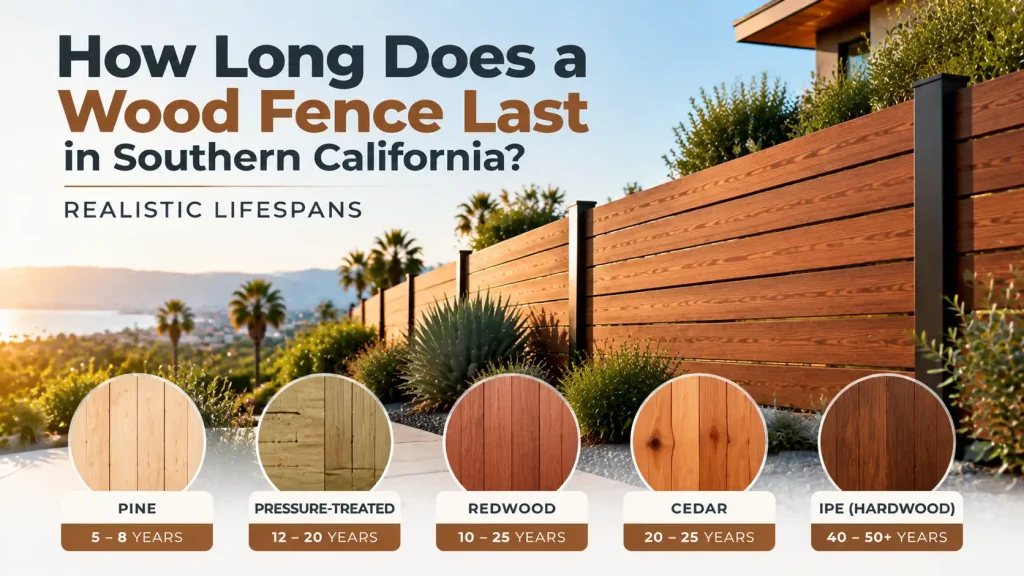
In Southern California, a standard residential wood fence lasts between 10 and 25 years, while premium architectural hardwoods can easily exceed 40 to 50 years. However, achieving the upper end of that range depends heavily on wood species selection, timber grade, ground contact protection, and seasonal maintenance.
Southern California presents a unique climate challenge for exterior woodwork. Homeowners contend with long stretches of intense ultraviolet radiation, baking inland summer heat exceeding 100 degrees Fahrenheit, dry seasonal Santa Ana winds, moist coastal marine fog, and active subterranean termite colonies.
Understanding the actual service life of different timber options—and the environmental factors that degrade them—is essential before investing in your perimeter boundary.
Lifespan by Wood Species: What to Expect in SoCal
Not all exterior woods perform equally when exposed to regional conditions. The difference between builder-grade lumber and architectural-grade heartwood or exotic timber translates directly into decades of extra service life.
1. Untreated or Builder-Grade Pine: 5 to 8 Years
Untreated softwood pickets and rails have virtually zero natural resistance to wood decay or native insect infestation. Under direct Southern California sun and winter rains, pine pickets cup, split, and attract drywood termites rapidly. It is rarely recommended for permanent perimeter installations.
2. Pressure-Treated Pine or Douglas Fir (Posts and Framing): 12 to 20 Years
Pressure treatment forces chemical biocides deep into the cellular structure of softwood lumber to stave off fungal decay and ground-contact rot. When used as structural posts embedded in concrete footings or as horizontal framing rails, pressure-treated timber provides dependable structural support for 15 or more years. However, the surface often shrinks, warps, and develops deep seasoning checks over time.
3. Construction-Grade Redwood (Con Heart vs. Con Common): 10 to 18 Years
Redwood is the regional classic across California. However, budget-friendly Construction Common grades contain significant amounts of blonde sapwood (the outer growth layer of the tree), which lacks protective tannins and rots quickly if wet. If specifying redwood on a budget, stepping up to Construction Heart ensures all boards are taken from the tannin-rich center of the log, yielding a reliable 15- to 18-year lifespan.
4. Architectural Clear Heart Redwood or Western Red Cedar: 20 to 25 Years
Premium Clear Heart Redwood and Western Red Cedar offer dense grain patterns, high natural oil concentrations, and minimal knot defects. These timbers naturally resist insects and handle ambient humidity shifts with minimal twisting. When paired with durable framing and elevated off the ground, a cedar or clear heart redwood fence delivers up to a quarter-century of reliable service.
5. Exotic Hardwoods (Ipe, Cumaru, Garapa): 40 to 50+ Years
Tropical hardwoods represent the pinnacle of fence longevity. Boasting extreme fiber density and ratings above 3,000 on the Janka hardness scale, species like Ipe are virtually impenetrable to drywood and subterranean termites, immune to fungal rot, and carry a Class A fire-resistance rating. As detailed in our head-to-head review of ipe vs redwood fencing, an Ipe fence will easily outlast the homeowner’s residency with minimal structural breakdown.
Quick Reference: Wood Fence Lifespans in Southern California
Untreated Softwood (Pine / White Wood): 5 to 8 years (Vulnerable to termites and severe sun cracking)
Construction Common Redwood: 10 to 14 years (Higher risk of premature sapwood decay)
Construction Heart Redwood: 15 to 18 years (Decent natural tannin protection; minor surface checking)
Western Red Cedar: 18 to 22 years (Low shrinkage; stable; handles coastal marine layer well)
Architectural Clear Heart Redwood: 20 to 25 years (Dense heartwood; minimal knots; high rot resistance)
Exotic Tropical Hardwood (Ipe / Cumaru): 40 to 50+ years (Termite proof; Class A fire rating; zero rot)
The 4 Regional Climate Factors That Destroy Wood Fences
Wood fences in Southern California face very different environmental wear than fences in humid southern states or freezing northern climates. Four specific local conditions drive fence decay:
1. Intense UV Radiation and Inland Heat
From the San Fernando Valley to Riverside and the Inland Empire, summer surface temperatures on wood can exceed 130 degrees Fahrenheit. Intense ultraviolet rays break down lignin, the natural glue binding wood fibers together. This causes the wood face to turn gray, dry out, become brittle, and form deep longitudinal cracks (checking) that allow winter rain to seep straight into the board core.
2. Coastal Marine Layer and Salt Air
In coastal communities like Santa Monica, Newport Beach, and Carlsbad, daily morning marine layers bring persistent humidity, dew, and salt mist, followed by hot afternoon sun. This daily wet-to-dry cycle forces softwood fibers to expand and contract repeatedly. Cheap steel fasteners corrode rapidly in this environment, causing fastener staining and loose, rattling boards.
3. Subterranean and Drywood Termites
Southern California is one of the most active termite regions in the United States. Subterranean termites attack from moist soil directly through the bottom of fence posts, hollowing them out from within. Meanwhile, drywood termites fly into fence rails and top caps during warm late-summer swarms, infesting untreated or non-heartwood softwoods without needing any ground contact.
4. Santa Ana Winds and Structural Load
Hot, dry, high-velocity Santa Ana wind gusts frequently top 50 to 60 miles per hour during the fall and early winter. Fences that have suffered concealed rot at the soil line or that lack proper structural engineering are vulnerable to blowing over. Wind failure is especially common on horizontal designs that catch maximum wind resistance; following proper layout guidelines from our collection of horizontal wood fence ideas for modern homes helps ensure posts can resist strong crosswinds.
Why Wood Fences Fail: The Post-to-Soil Failure Point
Over 85 percent of all wood fences fail at a single structural location: the ground line where the wooden post meets the concrete footing.
PROPER POST FOOTING (20+ YEAR LIFE):
       │               │
  ═════╪═══════════════╪═════ [Ground Level]
       │   ┌───────┐   │  <-- Sloped concrete collar sheds surface water
       │   │Concrete│   │
       │   │       │   │
       │   │       │   │
       └───┴───────┴───┘
       ▒▒▒▒▒▒▒▒▒▒▒▒▒▒▒▒▒  <-- 4 to 6 inches of crushed gravel for drainage
The Concrete Basin Mistake
A frequent contractor error is setting a wooden post into a flat or concave concrete footing, or sealing the post bottom entirely in concrete without gravel underneath. Water runs down the post and collects inside the concrete collar. Because the water cannot drain away, the wood sits permanently damp, and fungal rot destroys the post base within 7 to 10 years, even while the upper fence pickets look brand new.
How to Build Posts That Last:
Dig Post Holes Deep: Dig post holes to a depth of at least one-third the total above-ground fence height (e.g., 24 to 30 inches deep for a 6-foot fence).
Add a Gravel Base: Pour 4 to 6 inches of crushed angular gravel into the bottom of the open hole before inserting the post, allowing groundwater to escape downward.
Crown the Concrete Collar: Trowel the top of the wet concrete footing so it slopes smoothly away from the post, shedding rainwater and landscape runoff away from the timber.
Upgrade to Steel Posts: For the ultimate longevity, attach wooden pickets to galvanized, black powder-coated steel posts. Steel posts never rot, never split, and are completely impervious to subterranean termites.
4 Practical Steps to Extend Your Fence Lifespan by 10+ Years
A wood fence is an exterior investment that requires simple, proactive care to achieve its maximum service life.
1. Keep Pickets 2 Inches Above the Soil
Never allow the bottom edge of wooden pickets or horizontal boards to make direct contact with mulch, landscaping soil, or lawn turf. Soil retains irrigation moisture that wicks upward through the wood end-grain, accelerating decay and inviting termites. Always maintain a clear 2-inch air gap between the soil and the bottom of your fence boards.
2. Redirect Lawn Sprinklers
Sprinkler heads that spray directly against a wooden fence daily will quickly wash away protective finishes, promote algae, and cause the wood to rot from continuous water exposure. Audit your sprinkler coverage twice a year to ensure spray arcs hit only grass and garden beds.
3. Apply Penetrating Finishes on a Regular Schedule
Avoid using cheap acrylic exterior house paints on natural wood fences. Paint traps interior moisture, causing the film to blister, crack, and peel. Instead, use a high-quality penetrating exterior oil stain featuring trans-oxide UV blockers. In high-sun Southern California areas:
Softwoods (Redwood / Cedar): Re-apply penetrating stain every 2 to 3 years.
Dense Tropical Hardwoods: Follow the proper application technique outlined in our guide on how to oil and maintain a hardwood deck every 12 to 24 months, or let the wood naturally oxidize into a maintenance-free silver patina.
4. Insist on Stainless Steel Fasteners
Standard zinc or cheap electro-galvanized exterior screws quickly react with natural wood tannins and coastal salt air, forming dark streaks and snapping under seasonal wood movement. Always specify Grade 304 or Grade 316 stainless steel screws and nails for exterior builds.
Frequently Asked Questions
Which wood fence lasts the longest in Southern California?
Exotic tropical hardwoods like Ipe and Cumaru last the longest, often exceeding 40 to 50 years without rotting or succumbing to termites. Among domestic lumber options, Architectural Clear Heart Redwood and Western Red Cedar are the top performers, routinely lasting 20 to 25 years when kept off bare soil.
Why do fence posts rot before the fence boards?
Fence posts rot first because the base of the post sits near or beneath the ground line, where trapped soil moisture, sprinkler runoff, and soil bacteria concentrate. Fence boards, by contrast, stay dry and benefit from continuous ambient air circulation on both sides.
Does painting a wood fence make it last longer?
Generally, no. Standard paint creates a rigid surface film. When seasonal weather shifts cause the wood to expand and contract, the paint cracks. Water then seeps behind the paint layer and cannot evaporate, accelerating hidden wood decay. High-quality penetrating exterior wood stains are far better for long-term timber health.
How do I know if my fence has termite damage?
Check for hollow-sounding wood when tapped with a screwdriver handle, fine mud tubes running up the concrete foundation, or tiny pinholes surrounded by fine wood powder (frass). If the wood crumbles easily under firm finger pressure, active colonies may have compromised the structural integrity of the boards or framing.
To inspect full-scale wood profiles, explore long-lasting fencing options, and review premium decking species, visit the National Hardwood Flooring and Moulding showroom at 14959 Delano St, Van Nuys, CA 91411, or contact our architectural lumber specialists to plan your next residential build.