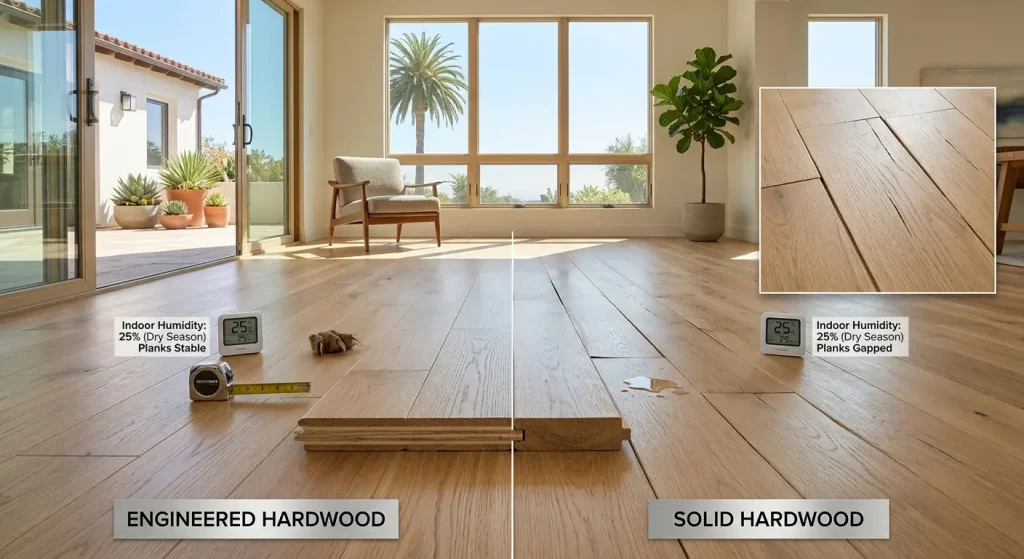
This question comes up constantly in flooring showrooms, and the honest answer is that it depends on where in the house you are installing and what the conditions of that space look like. Southern California has its own set of climate factors that influence this decision more than most people expect when they first start shopping for hardwood floors.
The idea that solid hardwood is always the better product is outdated. So is the idea that engineered hardwood is a budget compromise. Both are real wood products, both can last decades, and both have conditions where they outperform the other. The key is knowing which is which.
What Each Product Actually Is
Solid hardwood is exactly what the name says. Each plank is milled from a single piece of wood, typically 3/4 inch thick. It can be sanded and refinished multiple times over its life, which is one of the reasons it has a reputation for longevity. The tradeoff is that solid wood moves with humidity and temperature changes. It expands when moisture is present and contracts when the air dries out. That movement is manageable in stable environments, but it becomes a problem when conditions fluctuate significantly.
Engineered hardwood is built with a real hardwood veneer on top and multiple layers of plywood or high-density fiberboard underneath. The layered construction works against wood movement because the grain directions of each layer run counter to each other. The result is a plank that stays more stable across humidity and temperature changes than solid wood.
The Southern California Factor
Southern California is generally dry. Humidity levels in the San Fernando Valley, Los Angeles, and the surrounding areas tend to stay low for most of the year, with some fluctuation in winter. That low-humidity environment is actually favorable for hardwood flooring in general, but it does create a specific risk, solid hardwood in a very dry interior can shrink and develop gaps between planks over time.
Homes with central air conditioning running constantly during hot months tend to have even lower indoor humidity. Solid hardwood in those conditions can show more seasonal movement than homeowners expect. Engineered hardwood handles those fluctuations without the same degree of dimensional change, which makes it a practical choice for a lot of Southern California installations.
Slab Foundations Are Common Here
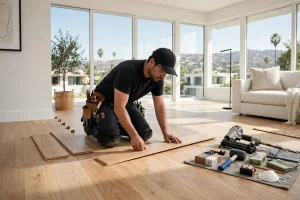
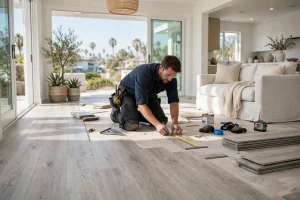
A significant portion of homes in the Los Angeles area are built on concrete slab foundations. Solid hardwood cannot be glued directly to a concrete slab because of moisture transfer from the concrete. Engineered hardwood can be, and it can also be floated or nailed down over an appropriate underlayment on concrete substrates. If the installation is going over a slab, engineered hardwood is the straightforward answer.
Radiant Heat Systems
Some homeowners in Southern California have radiant heat systems installed, particularly in newer construction. Solid hardwood does not work well over radiant heat because the heat source below the floor drives out moisture and causes excessive shrinkage and gapping. Engineered hardwood is the recommended product for radiant heat installations.
Where Solid Hardwood Still Makes Sense
If the home has a raised wood subfloor, the installation space has controlled humidity, and the homeowner wants the option to refinish the floor multiple times over 40 or 50 years, solid hardwood is a good fit. The refinishing advantage is real. A 3/4-inch solid plank can typically be sanded and refinished four to six times over its life. The veneer layer on engineered hardwood limits how many times it can be refinished, though higher-end engineered products with thicker veneers can handle two or three refinishing cycles.
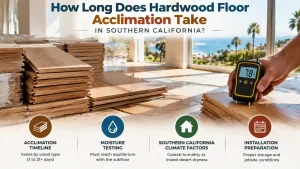
For formal living rooms, dining rooms, and bedrooms on raised subfloors, solid hardwood in an oak or maple species is still a solid long-term investment. The key is making sure the subfloor moisture content is within the acceptable range before installation and that the acclimation period for the wood is followed before installation begins.
Solid Hardwood Species Options
Solid hardwood is available in a wide range of domestic and imported species. Red oak and white oak are the most requested for residential installations. Maple offers a harder surface and a tighter grain. Walnut brings a darker, richer tone. Hickory has the highest hardness among domestic species and significant color variation within each board. Exotic species like Brazilian cherry and cumaru are also available in solid form, though they require more careful installation due to their density.
Engineered Hardwood Species & Construction
Engineered hardwood comes in many of the same species as solid, with white oak being particularly dominant in current production. The veneer thickness on engineered products varies, and thicker veneers, sometimes called thick-sawn engineered, allow for more refinishing cycles and provide a surface that looks and feels closer to solid hardwood.
Collections like French Galerie, Country French, and French Villa in engineered hardwood give homeowners access to character-forward finishes, wire-brushed textures, and longer plank formats that have become popular in open-plan living spaces. Wide-plank engineered flooring in 6-inch to 9-inch widths has grown in demand because the larger format works well in modern and transitional interiors.
Making the Call
For most Southern California homes, engineered hardwood covers more situations well. It handles the climate, works on slab foundations, performs over radiant heat, and comes in the same species and finishes as solid hardwood. The visual difference between a quality engineered product and solid hardwood is not apparent once the floor is installed.
Solid hardwood makes sense in specific situations where the subfloor, humidity control, and long-term refinishing expectations all line up. Talking through the specifics of the installation space with someone who knows both products well is the most reliable way to make the right call before any material is ordered.