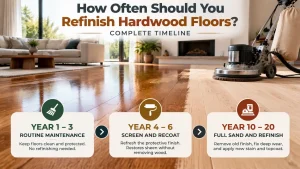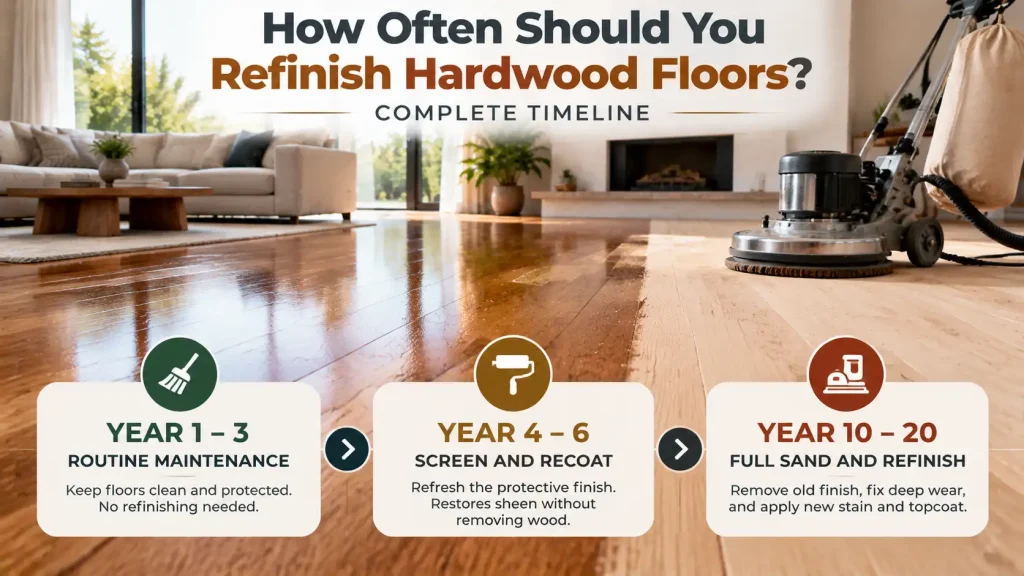
Solid hardwood floors typically require a full sand and refinish every 10 to 20 years, while high-traffic homes or spaces with active pets may need service closer to the 7- to 10-year mark. However, complete drum sanding down to bare timber is rarely necessary if you perform a routine maintenance procedure known as a screen and recoat every 4 to 6 years.
Understanding when your floors need a minor protective refresh versus an intensive full restoration depends on three factors: whether your flooring is solid or engineered, the depth of visible surface damage, and the remaining thickness of your timber wear layer.
Below is the trade timeline, diagnostic checks, and maintenance schedule used by professional wood flooring contractors to preserve hardwood investments for generations.
Refinishing Timeline: What to Do and When
Wood floors do not wear out overnight; the protective topcoat breaks down gradually under the friction of daily foot traffic, airborne dust, and grit tracked in from outside.
Year 1 to 3: Routine Maintenance
Surface Status: Factory or site-applied topcoat remains intact.
Required Action: Basic preventative care only. Sweep or vacuum weekly using a soft-bristled floor brush attachment, clean with a pH-neutral hardwood spray cleaner, and place felt protector pads beneath all furniture legs. Avoid wet-mopping, steam cleaners, or wax-based polishes.
Year 4 to 6: The Screen and Recoat Window
Surface Status: The clear protective finish begins to show surface dullness, micro-scuffs in high-traffic pathways (such as hallways, kitchen work triangles, and entryways), and loss of uniform sheen. However, the wood stain and bare timber underneath remain fully protected.
Required Action: Screen and Recoat (Buff and Coat). A contractor lightly abrades the top layer of polyurethane using a rotary floor buffer fitted with a fine mesh screen (120- to 150-grit), then applies a fresh coat of polyurethane over the top. This restores a clean, uniform sheen and adds a brand-new protective wear layer without removing any actual wood fiber.
Year 10 to 20: The Full Sand and Refinish Window
Surface Status: The polyurethane topcoat has worn through completely in high-traffic areas, exposing bare timber to oxidation, spills, and foot traffic. Scratches have cut through the stain into raw wood, boards show gray water stains, or boards exhibit seasonal cupping.
Required Action: Full Sand and Refinish. Heavy drum and rotary sanders strip the floor down to raw timber, leveling board edges, removing deep gouges, and flattening uneven seams. Installers apply new stain (if desired) followed by three complete coats of commercial-grade protective finish.
Screen and Recoat vs. Full Sand: Key Differences
Homeowners often assume that any scratched floor requires complete, dust-heavy drum sanding. In reality, addressing wear early saves thousands of dollars and preserves the structural wood for decades.
Screen and Recoat (Maintenance Refresh)
Wood Removal: Zero wood removed; only abrades the top micro-layer of existing clear finish
Equipment: Low-speed buffer with abrasive sanding screens
Project Timeline: Completed in 1 day; walkable in socks within 24 hours
Repair Capability: Erases surface scuffs, light pet claw hazing, and restores dull sheen
Limitations: Cannot fix deep gouges that cut into bare wood, cannot change stain color, cannot fix water stains
Average Cost: Roughly one-third to one-half the cost of a full sanding
Full Sand and Refinish (Complete Restoration)
Wood Removal: Removes approximately 1/32-inch (about 0.75mm to 1mm) of wood per pass
Equipment: Heavy 220V drum sander, edger, planetary multi-head sander, and vacuum containment
Project Timeline: 3 to 5 days of labor plus finish curing time
Repair Capability: Removes deep gouges, pet urine burns, heavy sunlight discoloration, and minor board cupping
Limitations: Can only be performed a finite number of times based on board thickness
Average Cost: Full labor and material commitment ($4.00 to $8.00+ per square foot)
4 Clear Signs Your Floor Needs a Full Sanding Immediately
If you are unsure whether your floor can get away with a simple screen and recoat, check for these four physical indicators:
+---------------------------------------------------------------------------------------------------+
| THE BARE TIMBER DIAGNOSTIC CHECKLIST                                                              |
+---------------------------------------------------------------------------------------------------+
| 1. THE WATER DROP TEST: Drops soak in immediately and turn wood black = Topcoat is dead           |
| 2. GRAY TRAFFIC RUNS: Heavy footpaths look dull gray = Bare wood is oxidizing                     |
| 3. PET URINE / CHEMICAL STAINS: Black rings deep in grain = Tannins have reacted; must sand deep  |
| 4. CUPPED OR CROWNED BOARDS: Moisture has distorted board flatness = Requires drum leveling        |
+---------------------------------------------------------------------------------------------------+
1. The Water Drop Test
Place three to four drops of water onto a high-traffic area of your floor and observe what happens:
If the water beads up into tight droplets: Your polyurethane finish is healthy. A simple clean or light screen and recoat is all you need.
If the water slowly flattens out after several minutes: The finish is thinning. You should schedule a screen and recoat soon.
If the water immediately soaks into the timber and turns the wood dark: The protective polyurethane barrier is gone. Moisture is penetrating the raw cellular structure of the wood, and the floor requires a full sand and refinish to prevent permanent rot.
2. Gray, Ashy Wood Fibers
When polyurethane wears away completely, bare wood is exposed to ambient oxygen, indoor humidity, and tracked-in moisture. In species like white oak and red oak, exposed wood oxidizes, turning a distinct dingy gray. A screen and recoat cannot fix gray patches because the wood fibers themselves are discolored; the oxidized layer must be sanded away until clean, bright timber is revealed.
3. Deep Scratches Through the Stain Layer
Minor micro-scratches that only affect the clear topcoat look like fine white lines; these disappear during a screen and recoat. However, if a scratch exposes pale, unstained wood underneath a dark stain, a topcoat cannot hide the gouge. The entire floor must be sanded down, re-stained uniformly, and resealed.
4. Severe Board Cupping or Warping
If a plumbing leak, elevated crawlspace moisture, or foundation humidity causes solid planks to cup (edges rise higher than board centers), the surface cannot be smoothed with a buffer. Once the moisture source is resolved and the wood stabilizes, a heavy commercial drum sander must flatten the boards across the room. Review our technical guide on hardwood flooring issues on slab foundations to diagnose moisture imbalances before performing sand work.
How Many Times Can Hardwood Floors Be Refinished?
Every time a floor undergoes a full sand and refinish, drum sanders remove a small fraction of the wood profile. How many times a floor can endure this process depends entirely on its construction.
SOLID HARDWOOD (3/4" THICK):
┌──────────────────────────────────────────────┐
│ WEAR LAYER: ~1/4" (6.35mm) above tongue      │  <-- Can be sanded 4 to 7 times
├──────────────────────┬───────────────────────┤
│ Tongue & Groove Line │                       │
├──────────────────────┴───────────────────────┤
│ CORE / BASE: Structural timber (~1/2")       │  <-- Structural support; cannot be sanded
└──────────────────────────────────────────────┘

HIGH-END ENGINEERED HARDWOOD:
┌──────────────────────────────────────────────┐
│ SAWN WEAR LAYER: 4mm to 6mm hardwood lamella │  <-- Can be sanded 2 to 4 times
├──────────────────────────────────────────────┤
│ MULTI-PLY BIRCH CORE: 9 to 11 cross-layers   │  <-- Cannot be touched by sander
└──────────────────────────────────────────────┘
Solid 3/4-Inch Hardwood Floors
Solid hardwood planks (such as traditional 3/4-inch oak, maple, or hickory) can typically be sanded down 4 to 7 times over their lifetime.
Sanding is limited by the location of the tongue-and-groove joint.
There is roughly 1/4-inch (about 6mm) of sandable wood above the tongue. Once sanding reaches within 1/16-inch of the tongue, the upper wood lip becomes too thin and will crack under foot traffic, exposing the metal flooring cleats. At that stage, the floor has reached the end of its structural life and must be replaced.
Engineered Hardwood Flooring
How often you can refinish engineered hardwood depends entirely on the thickness of its top hardwood layer, known as the lamella:
1mm to 2mm Wear Layer: Cannot be fully sanded. The veneer is too thin; a heavy drum sander will burn through into the plywood core within seconds. These floors can only accept a very light screen and recoat.
3mm Wear Layer: Can safely accept 1 full sand and refinish performed by an experienced professional using a multi-head orbital sander.
4mm to 6mm Wear Layer: Premium engineered floors (such as our french galerie collection) feature thick sawn lamellas that can be safely sanded and refinished 2 to 4 times, delivering a total service lifespan that rivals solid timber.
4 Factors That Accelerate the Refinishing Clock
Not every home follows an exact 10- or 15-year refinishing schedule. Several day-to-day lifestyle factors accelerate wear:
1. Active Pets and Claws
Large dogs running across hardwood floors act like coarse sandpaper over time. Untrimmed claws exert heavy point pressure, causing finish fractures and indentations. For homes with pets, choosing a denser wood species from the Janka hardness scale helps resist physical denting between finish cycles.
2. Outdoor Dirt and Sand
Properties near sandy coastal environments or rural areas track fine quartz particles indoors on shoes. Walking on gritty soil acts as a continuous abrasive agent that grinds away the polyurethane wear layer in front of exterior entryways.
3. Finish Chemistry Selection
The chemical type of topcoat you apply dictates how fast the floor wears down:
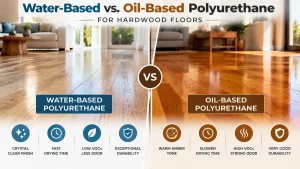
High-grade commercial waterborne finishes with external catalysts (such as Bona Traffic HD) outlast standard builder-grade finishes by years. Compare chemistry durability in our review of water-based vs oil-based polyurethane.
Penetrating plant finishes behave completely differently; explore how hardwax oil vs polyurethane finishes never require complete sanding because they can be spot-rejuvenated indefinitely.
4. Direct Ultraviolet Sunlight Exposure
Unfiltered sunlight streaming through large picture windows or sliding patio doors breaks down polyurethane molecular bonds while bleaching or ambering raw timber pigments. Using low-E window glass, sheer drapery, or UV-blocking coatings extends the life of the surface finish.
Practical Habits to Extend the Life of Your Hardwood Floors
To push your next full refinishing project out past the 15- to 20-year horizon, follow these contractor-proven habits:
Maintain High-Quality Felt Floor Protectors: Stick heavy-duty felt pads under all chairs, sofas, tables, and barstools. Inspect and replace felt pads twice a year, as trapped grit turns old pads into abrasives.
Place Walk-Off Entry Mats: Keep large dirt-trapping mats both outside and inside every exterior door to catch sand and grit before it reaches your wood floor. Avoid rubber-backed mats that trap moisture against the wood finish.
Keep Pet Claws Trimmed: Regular nail trimming and filing dramatically reduces finish scratching and board gouging.
Clean with the Correct Chemistry: Never use vinegar, ammonia, steam mops, or oil-soaps (like Murphy’s Oil Soap) on polyurethane floors. Oil-soaps leave a sticky residue that prevents future screen-and-recoat topcoats from adhering, forcing you into an expensive full sand prematurely.
Control Indoor Humidity: Keep indoor relative humidity between 35% and 55% using HVAC systems or humidifiers to minimize seasonal board expansion, shrinking, and seam gaps.
Frequently Asked Questions
Can you change the color of your hardwood floor when you refinish it?
Yes. During a full sand and refinish, the sanders strip away all existing stain and clear coat down to bare timber. You can then apply any new stain color from natural blonde and warm honey tones to deep walnut or dark espresso before applying the final protective topcoats.
How long does a floor refinishing project take?
A standard residential room or open floor plan typically takes 3 to 5 days of on-site labor: one to two days for sanding and staining, followed by two days to apply and dry multiple coats of polyurethane. Catalyzed water-based polyurethanes allow light foot traffic in socks within 24 hours, while oil-based finishes require several days of drying.
Can you refinish hardwood floors without sanding?
Yes, provided the wood is not discolored or scratched through to bare timber. A “screen and recoat” buffs the existing clear topcoat without cutting into raw wood, allowing a fresh coat of polyurethane to bond securely. However, if the floor has bare gray spots or deep gouges, sanding is mandatory.
Does refinishing remove significant thickness from the floor?
A standard professional sanding pass removes roughly 1/32 of an inch (about 0.75mm to 1mm) of wood. When performed by a certified technician using balanced commercial equipment, the floor loses very little wood, preserving its structural stability for future sanding cycles.
To evaluate wear layer thicknesses, inspect durable factory finishes in person, and explore solid or engineered hardwood flooring collections, visit the National Hardwood Flooring and Moulding showroom at 14959 Delano St, Van Nuys, CA 91411, or contact our wood flooring specialists to schedule an expert material consultation.