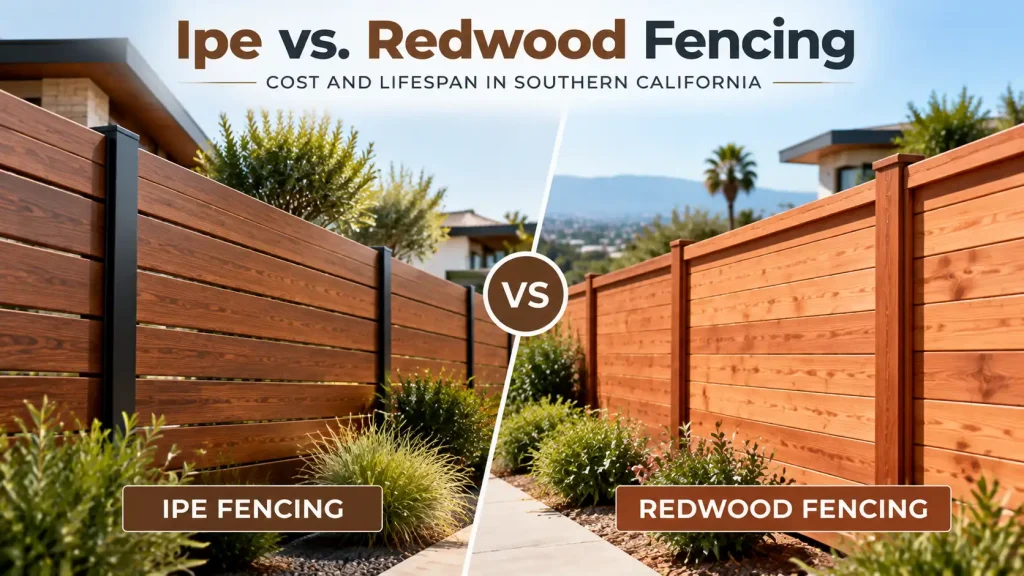
Selecting the right boundary material for a Southern California home requires balancing architectural style against the harsh local environment. The regional climate swings between intense UV sun exposure, dry Santa Ana desert winds, coastal marine layers, and persistent subterranean termite activity. For homeowners choosing between luxury and traditional wood perimeter designs, the decision almost always comes down to two standout species: Ipe (Brazilian Walnut) and California Redwood.
Redwood is the quintessential West Coast building material, offering classic warmth, natural workability, and moderate project costs. Ipe, on the other hand, is an ultra-dense South American hardwood that delivers near-indestructible durability, commercial-grade rot resistance, and a modern architectural presence.
Below is an engineering and financial comparison of Ipe and Redwood fencing, detailing material pricing, labor differences, lifespan expectations, and long-term performance across Los Angeles, Orange County, and San Diego properties.
Head-to-Head Comparison: Ipe vs. Redwood Fencing
Ipe (Brazilian Walnut) Fence
Botanical Origin: Central and South America
Janka Hardness Rating: 3,510 pounds of force
Average Lifespan in Southern California: 40 to 50+ years
Termite and Insect Resistance: Immune to native termites; too dense to penetrate
Fire Resistance Rating: Class A (shares the same flame spread rating as concrete and steel)
Average Material Cost: High ($18 to $28 per linear foot of 1×6 board)
Labor and Installation Complexity: High (requires carbide tooling and 100% pre-drilling)
Post System Requirements: Heavy-duty 4×4 or 6×6 posts, or powder-coated steel posts on maximum 6-foot spans
California Redwood (Clear Heart / Con Heart) Fence
Botanical Origin: Northern California and Pacific Northwest
Janka Hardness Rating: 420 to 480 pounds of force
Average Lifespan in Southern California: 15 to 25 years (dependent on grade)
Termite and Insect Resistance: High natural resistance in heartwood; poor in sapwood
Fire Resistance Rating: Class B
Average Material Cost: Moderate ($4 to $11 per linear foot depending on grade)
Labor and Installation Complexity: Moderate (easy to cut, nail, and screw on site)
Post System Requirements: Standard 4×4 pressure-treated pine or heartwood redwood on 6- or 8-foot spans
The Durability and Lifespan Factor
The lifespan of an exterior wood fence in Southern California depends on how well the timber stands up to intense sun, dry soil cycles, and local pests.
Why Ipe Lasts 40 to 50+ Years
Ipe rates at an extraordinary 3,510 on the Janka hardness scale, making it roughly eight times harder than Redwood. Because of its tight, interlocking cell structure and high concentration of natural oils and mineral deposits, Ipe naturally resists rot, fungal decay, and water absorption.
Termite Immunity: Subterranean and drywood termites are widespread across the San Fernando Valley and coastal Southern California. Ipe is simply too hard and chemically complex for termites to bore into or digest.
Fire Performance: With the constant threat of seasonal wildfires in hillside areas like Malibu, Calabasas, and Pasadena, Ipe offers a Class A flame-spread rating. It resists ember ignition far better than conventional softwoods.
UV Resistance: The wood does not splinter, check, or soften under continuous UV radiation. While sunlight will slowly oxidize the surface to a modern silver patina, the core structural integrity remains unaffected for decades.
How Redwood Performs Over 15 to 25 Years
Redwood has built generations of California fences because its heartwood naturally contains bitter chemical extractives called tannins, which ward off insects and decay fungi. However, Redwood is a relatively soft wood (Janka 420 to 480), making it prone to mechanical surface wear, weed-trimmer gouges, and deep moisture movement over time.
The Critical Grade Distinction: Redwood longevity depends entirely on timber selection. Clear Heart or Construction Heart lumber taken from the center of mature trees can easily survive 20 to 25 years above ground. Lower-tier construction grades that contain white sapwood (the outer living layer of the tree) contain no natural tannins and can rot or fall victim to termites in as little as 5 to 7 years.
Sun Bleaching and Fiber Breakdown: Without protective UV sealers, the hot Southern California summer sun breaks down the lignin in Redwood fibers faster than in hardwoods, leading to surface checking, raised grain, and perimeter warping over a 15-year window.
Upfront Material and Installation Costs
Cost is usually the primary factor that dictates whether a homeowner chooses Redwood or upgrades to an exotic hardwood installation.
1. Material Costs
Redwood Pickets and Rails: Construction Heart Redwood typically costs between $4 and $7 per linear foot for standard 1×6 boards. High-end Architectural Clear or Clear All Heart Redwood ranges from $8 to $11 per linear foot.
Ipe Planks: High-density 1×6 Ipe boards generally cost between $18 and $28 per linear foot, depending on current international shipping rates and lumber availability.
2. Labor and Tooling Costs
Labor costs to build an Ipe fence are typically 40% to 70% higher than building a traditional Redwood fence.
Tool Wear: Cutting Ipe dulls standard steel saw blades within minutes. Professional installers must use specialized carbide-tipped saw blades and replace them frequently.
Mandatory Pre-Drilling: You cannot drive a nail or self-tapping screw into Ipe without pre-drilling and countersinking every single hole. Forcing a fastener without a pilot hole will instantly snap high-grade screws or crack the board end.
Weight: Ipe is extremely heavy (weighing more than 6 pounds per board foot), which increases crew fatigue and requires deeper post footings.
Redwood Workability: Redwood is soft, lightweight, and forgiving. Crews can cut, adjust, and fasten boards using pneumatic nail guns or standard framing tools, significantly reducing labor hours on site.
Total Built Cost per Foot (Materials + Labor in SoCal):
Standard Construction Heart Redwood: $65 to $100 per linear foot installed.
High-End Clear Heart Redwood: $95 to $140 per linear foot installed.
Architectural Ipe (with Steel or Reinforced Posts): $180 to $275+ per linear foot installed.
Structural Framing and Engineering Realities
A high-performance fence relies on its underlying frame. Because of the vast weight and density differences between the two woods, the substructure design must match the material.
Post Foundations for Ipe
Ipe fences are heavy. If you build a modern horizontal fence using 1×6 Ipe boards, the sheer mass of the wood can cause standard wood posts to lean over time.
Post Spans: Posts should never exceed 6-foot intervals on center (compared to the standard 8-foot spacing used on basic vertical fences).
Post Material: Many designers and builders opt for heavy-gauge, black powder-coated steel posts set at least 30 to 36 inches deep in high-strength concrete.
Hardware: As highlighted in our analysis of hidden fasteners vs. face screws for hardwood decks, high-tannin woods react chemically with cheap fasteners. You must use Grade 305 or Grade 316 marine-grade stainless steel screws to prevent structural snapping and unsightly black corrosion streaks.
Post Foundations for Redwood
Redwood fences weigh roughly one-third as much as an equivalent Ipe structure.
Posts can be spaced at standard 8-foot centers for vertical pickets, though horizontal layouts still perform best on 6-foot spans to prevent mid-span sagging.
Ground Contact Warning: Never bury untreated Redwood sapwood in the ground. Posts set directly into soil should either be pressure-treated ground-contact lumber (such as Douglas Fir) or high-grade Con Heart Redwood with gravel bases to facilitate rapid drainage.
Maintenance Cycles: Preserving Color vs. Natural Aging
Both species will naturally oxidize and change color under the Southern California sun, but their maintenance demands differ significantly if you want to keep their original wood tones.
Maintaining Color
Redwood Staining: Redwood takes penetrating stains and semi-transparent sealers easily because of its open pores. Applying a high-quality oil-based or water-based exterior stain every 2 to 3 years protects against moisture intrusion and maintains a rich, red-amber glow.
Ipe Oiling: As detailed in our guide on how to oil and maintain a hardwood deck, Ipe cannot absorb thick paints or surface stains. It requires specialized, low-viscosity penetrating oils with trans-oxide UV blockers (such as Ipe Oil or Penofin). The oil must be applied in a thin coat, and all excess must be completely wiped away after 15 to 20 minutes. In full-sun environments, expect to re-oil the fence every 12 to 18 months.
Natural Silver Patina (Zero-Coating Route)
If left un-oiled, both woods will gradually turn an architectural, driftwood-gray color within 9 to 18 months.
The difference lies in the surface condition: un-oiled Redwood will slowly develop fine surface checks, cracks, and weathered grain. Un-oiled Ipe maintains an exceptionally smooth, hard surface that stays flat and structurally sound even after decades without finish.
Which Material Is Right for Your Project?
Choose California Redwood if:
You want the best balance of cost and classic West Coast aesthetics.
You prefer an authentic craftsman, ranch, or classic board-and-batten fence style.
You want the flexibility to easily stain the fence different tones or match existing garden pergolas.
You are planning a project with an overall budget under $120 per linear foot installed.
Choose Ipe Hardwood if:
You are designing a high-end modern, mid-century, or contemporary home (such as a horizontal slat boundary).
Your property is located in a high-fire hazard zone where a Class A flame-spread rating is a major safety asset.
Subterranean termites or heavy moisture exposure (such as coastal ocean spray or pool splash) are primary concerns.
You want a 40- to 50-year fence that will never rot, warp, or require full structural replacement in your lifetime.
Frequently Asked Questions
Can an Ipe fence be built horizontally?
Yes. Ipe is one of the most popular choices for modern horizontal fencing because the planks stay straight and will not twist over time. To ensure optimal stability, keep post spacing to 6 feet or less and install a hidden vertical support batten along the center back of the panels.
Will termites eat Redwood?
Termites will not eat the heartwood of Redwood because of the natural tannins. However, they will readily consume the light-colored sapwood found in lower-grade Redwood lumber. If you use Redwood, always insist on Construction Heart or Clear Heart grades to prevent termite infestation.
Does an Ipe fence get too heavy for standard soil?
Ipe is very heavy, so post holes must be dug properly. In typical Southern California clay or sandy soils, fence post footings should be dug at least 24 to 36 inches deep and filled with high-strength concrete to keep the fence straight and upright under heavy seasonal wind loads.
Can you pair Redwood framing with Ipe boards?
While possible to save money, it is generally not recommended. Pairing a 40-year surface board (Ipe) with a 15-year post (Redwood) means the underlying frame will rot and fail while the expensive Ipe boards are still in prime condition. Use steel posts or pressure-treated structural framing instead.
To compare real-world grain samples of ipe wood decking and exterior hardwoods alongside premium fencing options, visit the National Hardwood Flooring and Moulding showroom at 14959 Delano St, Van Nuys, CA 91411, or contact our lumber specialists to discuss material takeoffs and structural hardware for your upcoming boundary build.