Thermally modified wood decking is natural timber that has undergone a specialized, high-heat thermal process. The boards are baked at temperatures between 360 and 415 degrees Fahrenheit (180 to 215 degrees Celsius) inside an oxygen-depleted, steam-pressurized or vacuum kiln. This clean cooking process permanently alters the cellular structure of the wood, burning off its natural sugars and collapsing its moisture-absorbing cellular groups.
The outcome is a modified board that resists fungal rot, repels insects, exhibits 50 to 60 percent less expansion and contraction, and cures to a deep brown hue. For homeowners seeking a high-performance alternative to tropical woods like ipe wood decking or composite plastics, thermal modification delivers real architectural wood using sustainably harvested domestic species.
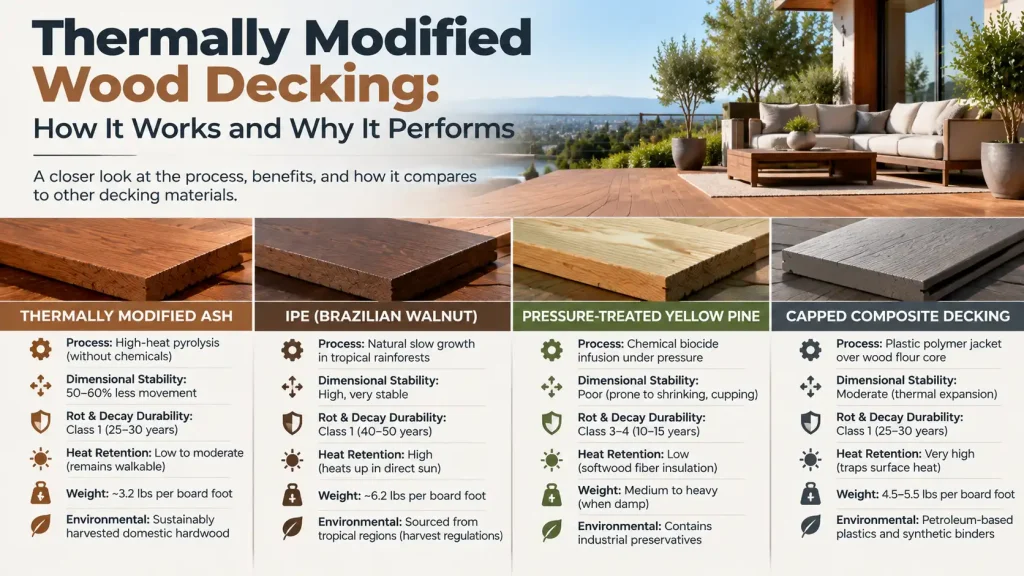
Comparison: Thermally Modified Decking vs. Traditional Materials
Thermally Modified Ash
Primary Process: High-heat pyrolysis without chemicals
Dimensional Stability: Exceptional with 50 to 60 percent less movement
Rot and Decay Durability: Class 1 rating lasting 25 to 30 years
Barefoot Heat Retention: Low to moderate, remains walkable in direct sun
Weight per Linear Foot: Approximately 3.2 pounds per board foot
Environmental Profile: Sustainably harvested domestic hardwood
Ipe (Brazilian Walnut)
Primary Process: Natural slow growth in tropical rainforests
Dimensional Stability: High, though very dense
Rot and Decay Durability: Class 1 rating lasting 40 to 50 years
Barefoot Heat Retention: High, heats up significantly in afternoon sun
Weight per Linear Foot: Heavy at roughly 6.2 pounds per board foot
Environmental Profile: Sourced from tropical regions under harvest regulations
Pressure-Treated Yellow Pine
Primary Process: Chemical biocide infusion under pressure
Dimensional Stability: Poor, prone to shrinkage, twisting, and cupping
Rot and Decay Durability: Class 3 to 4 rating lasting 10 to 15 years
Barefoot Heat Retention: Low due to softwood fiber insulation
Weight per Linear Foot: Medium to heavy when damp from treatment chemicals
Environmental Profile: Contains industrial preservatives
Capped Composite Decking
Primary Process: Plastic polymer jacket co-extruded over wood flour core
Dimensional Stability: Moderate, subject to linear thermal expansion
Rot and Decay Durability: Class 1 rating lasting 25 to 30 years
Barefoot Heat Retention: Very high, traps and holds severe surface heat
Weight per Linear Foot: Heavy at 4.5 to 5.5 pounds per board foot
Environmental Profile: Relies on petroleum-derived plastics and synthetic binders
The Science of Pyrolysis: What Happens Inside the Kiln
Thermal modification is much more advanced than standard kiln drying. Ordinary kiln drying only removes free moisture from the wood until it reaches an 8 to 12 percent baseline. Thermal modification permanently changes the chemistry of the wood through a three-stage heating process called pyrolysis.
Stage 1: High-Temperature Drying
The lumber is brought to 212 degrees Fahrenheit (100 degrees Celsius). This step drives all free moisture out of the wood until the moisture level drops near zero.
Stage 2: Pyrolysis and Modification
The kiln temperature is raised to between 360 and 415 degrees Fahrenheit. Superheated steam or an airtight vacuum prevents the lumber from catching fire. Under this heat, the hemicellulose decomposes and the internal cell structure is permanently altered.
Stage 3: Conditioning and Stabilization
Steam cools the lumber in a controlled environment. The moisture content is re-balanced to a stable 4 to 7 percent before the boards leave the chamber.
The Molecular Changes: Why the Wood Survives Outdoors
1. Removing the Food Source for Rot
Wood contains cellulose, lignin, and hemicellulose. Fungi, bacteria, and wood-destroying insects feed on hemicellulose, which consists of soft sugar chains. Thermal modification breaks down and caramelizes these sugars into inert compounds. Because there are no digestible nutrients left in the wood, fungi cannot survive on it. The board becomes naturally decay-resistant without requiring chemical preservatives.
2. Collapsing Water Binding Sites
Natural timber moves because its cell walls contain open hydroxyl groups that bond with moisture in humid air. High heat collapses these cellular pathways. The wood becomes hydrophobic, meaning it absorbs up to half as much moisture as untreated lumber.
3. Lower Equilibrium Moisture Content
Untreated outdoor lumber normally fluctuates between 12 and 19 percent moisture across wet and dry seasons. Thermally modified boards stabilize at an equilibrium moisture content of 4 to 7 percent. This balance virtually eliminates the cupping, splitting, and board expansion caused by seasonal weather changes.
Why Timber Species Matters: Modified Ash vs. Softwoods
The performance of thermally modified decking depends directly on the wood species chosen at the start.
Thermally Modified American White Ash
American White Ash is the top choice for residential and commercial deck surfaces. Ash is a dense domestic hardwood that rates at 1,320 on the Janka hardness scale. After modification, it maintains its surface strength against heavy foot traffic, patio chairs, and dog claws. It earns a European Class 1 durability rating, which indicates an exterior lifespan of 25 years or more.
Thermally Modified Pine and Softwoods
Softwoods like Scots Pine and Radiata Pine can also be modified. The process protects them from rot, but it does not add physical density to soft wood fibers. Modified pine remains soft and can dent under heavy concentrated loads. Because of this, modified softwoods are best suited for exterior wall cladding, porch ceilings, and architectural soffits rather than high-traffic deck floors.
The Main Advantages of Thermally Modified Decking
1. Exceptional Dimensional Stability
In climates that swing between coastal humidity and hot, dry winds, standard wood boards move constantly. Thermally modified boards remain flat. Butt joints stay tight, deck lines remain straight, and fasteners do not pull loose over time.
2. Completely Free of Chemicals
Unlike pressure-treated lumber that uses copper compounds to fight rot, thermally modified wood contains zero synthetic additives. It does not leach chemicals into garden soil, lawns, or swimming pool water, making it safe for kids and pets.
3. Stays Cooler Under Bare Feet
Solid composite boards and dense exotic hardwoods absorb solar heat and can become hot during sunny summer days. Because thermal modification reduces lumber density and clears internal cavities, the boards act as natural insulators. They release heat quickly and stay comfortable to walk on with bare feet.
4. Rich Color Throughout the Entire Board
The cooking process darkens the wood all the way through to its center. When you cut or profile an edge on site, the exposed core shows the same deep brown tone as the face. You do not need to apply stain just to hide fresh cuts.
Installation Rules and Structural Limits
While thermal modification prevents rot, the heat process introduces physical changes that installers must handle correctly.
1. Never Use for Structural Framing
Thermal modification reduces the bending strength (Modulus of Rupture) of the wood by 15 to 25 percent. The timber becomes stiffer and more brittle. As a strict rule, thermally modified lumber must never be used for structural posts, beams, or deck joists. It is designed strictly for deck surface boards, top rails, and siding. Framing joists should be spaced at standard intervals of 16 inches on-center, or 12 inches on-center for diagonal layouts.
2. Pre-Drilling is Mandatory for Face Screws
Because the wood fibers are less flexible, driving screws straight into the surface without pilot holes will split the wood. Always pre-drill holes with a countersinking drill bit. Use high-grade stainless steel screws (Grade 305 or Grade 316) to avoid rust stains.
3. Hidden Fastener Systems Work Best
The cleanest way to install thermally modified decking is using edge-grooved boards paired with hidden deck clips. These clips hold the boards securely while allowing for slight lateral expansion, leaving the board face free of screw holes.
4. Seal Every Cut End
Whenever a board is cut to length on the job site, apply an end-grain wax sealer immediately. Unsealed end grain can absorb moisture faster than the board face, which can lead to hairline end checking over time.
Long-Term Maintenance and UV Protection
Thermal modification protects wood from rot, but it does not block the sun. Ultraviolet light will naturally break down the top layer of lignin, turning the deep brown color into a soft silver-gray patina over 6 to 18 months.
Option 1: Keeping the Deep Brown Wood Color
To maintain the original dark color, apply a high-quality penetrating exterior wood oil with ultraviolet-blocking pigments within a few weeks of installation.
Avoid film-forming varnishes, polyurethanes, or paints that sit on the surface, as they will crack and peel.
Choose deep-penetrating oil formulas such as Cutek Extreme, Penofin, or Messmers UV Plus.
Reapply a light maintenance coat every 12 to 24 months, depending on how much direct sunlight the deck receives.
Option 2: Allowing the Deck to Turn Silver
If you prefer a natural, weathered gray appearance, you can leave the deck un-oiled. Unlike untreated softwoods that cup and rot when left unprotected, thermally modified hardwood retains its structural soundness and stays flat as it grays. Maintenance simply involves washing the surface once a year with a mild deck cleaner and a soft brush to remove dirt and pollen.
Frequently Asked Questions
How long does thermally modified wood decking last?
Thermally modified hardwood decking such as Ash lasts 25 to 30 years or more when installed with proper joist ventilation and drainage. It carries the same Class 1 durability rating against rot as high-end tropical hardwoods.
Is thermally modified wood environmentally friendly?
Yes. It uses fast-growing domestic hardwoods sourced from sustainably managed forests. By turning common woods into rot-resistant decking through heat and steam alone, it provides an eco-friendly option that avoids rainforest logging and plastic composite waste.
Does thermally modified decking splinter?
Thermally modified hardwoods splinter far less than softwoods or treated lumber because the surface cells do not swell and lift with water. However, the cut ends can be brittle, so freshly cut edges should always be eased with fine sandpaper on site.
Can thermally modified wood be installed around swimming pools?
Yes. It works well around pools and spas. It handles water exposure without rotting, stays cooler under bare feet than composite decking, and has no chemicals that could wash into the pool water.
To see thermally modified wood decking samples alongside ipe wood decking and custom decking displays, visit the National Hardwood Flooring and Moulding showroom at 14959 Delano St, Van Nuys, CA 91411, or contact our lumber specialists to discuss project plans, hidden fasteners, and material options.