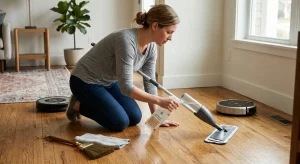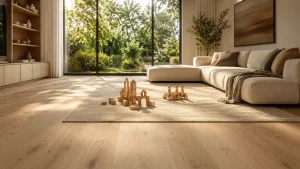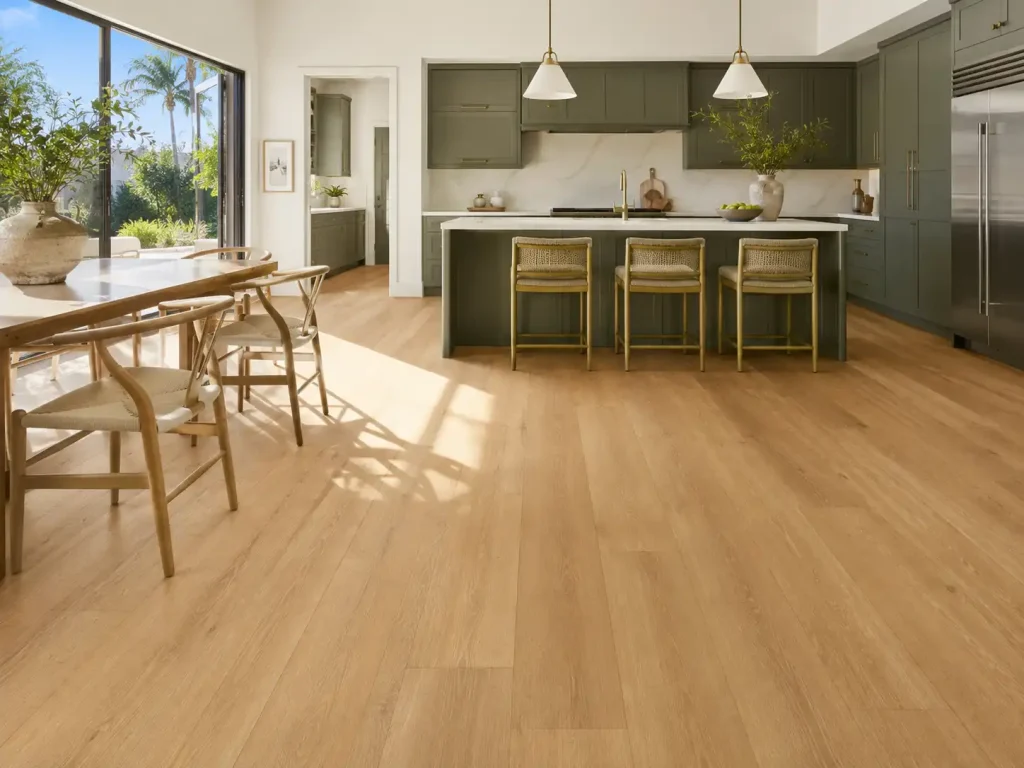
Walk into any big-box flooring aisle in Southern California and you will find laminate flooring marketed as waterproof. The displays show planks submerged in water. The box says 100% waterproof core. Contractors sell it for bathrooms. Homeowners install it in laundry rooms. And then, six months later, the floor buckling begins.
This is not a product failure story. It is a marketing language story. Waterproof laminate is real. The improvements over standard laminate are genuine and meaningful. But waterproof laminate is not the same as truly waterproof flooring, and the difference matters enormously for certain rooms and certain Southern California homes.
After 50 years of supplying flooring to Southern California homeowners, contractors, and designers, we have seen this confusion play out on countless projects. This guide exists to end it. We stock both waterproof laminate and laminate, vinyl, and SPC options (nationalhardwood.com/laminate-vinyl-spc-flooring) because the right choice depends on your room, your subfloor, and your specific situation. This is how to tell the difference.
What Does Waterproof Laminate Actually Mean?
Standard laminate flooring has a high-density fiberboard (HDF) core made from compressed wood fibers. Wood fiber absorbs moisture. When water reaches the HDF core, the boards swell, cup, and buckle. Even a slow drip under a dishwasher, left for a few days, will destroy a standard laminate floor.
Waterproof laminate addresses this problem through several technologies applied to the standard laminate construction:
- Sealed tongue-and-groove joints coated with wax or silicone to slow water infiltration at the seams
- Hydrophobic core treatment that reduces the rate at which the HDF core absorbs moisture if water does reach it
- Wax-coated board edges that protect cut surfaces from immediate moisture absorption
- Enhanced surface wear layer that provides better surface water resistance
These improvements are real. Waterproof laminate handles spills left for hours rather than minutes. It buys significant time before damage begins. In a kitchen or dining room where spills happen but standing water does not accumulate, it performs very well.
What it does not do: It does not make laminate equivalent to luxury vinyl plank (LVP), which has a 100% synthetic PVC or SPC core that genuinely cannot absorb water under any circumstance. Even the best waterproof laminate will fail if submerged, if water gets under the floor through perimeter gaps, or if sustained moisture vapor comes up through a California concrete slab.
The honest summary: Waterproof laminate handles spills and splashes. It does not handle sustained standing water, flooding, bathroom steam, laundry room leaks, or below-grade moisture. For those situations, the correct material is LVP.
Waterproof vs Water Resistant Laminate: What the Terms Mean
The flooring industry uses these terms inconsistently. Here is what they actually mean in practice:
| Term | What It Means | What It Does Not Mean | Real-World Performance |
| Water-resistant laminate | Surface layer resists water for 20 to 30 minutes. Basic joint protection. | Does not protect HDF core if water gets under planks or into joints. | Good for kitchen spill situations if wiped within 30 minutes. Not for wet areas. |
| Waterproof laminate (enhanced) | Sealed joints, hydrophobic core treatment, wax edges. Significantly improved over standard. | Core can still swell with sustained moisture, flooding, or slab vapor. | Handles spills up to several hours. Not suitable for bathrooms, laundry rooms, or below-grade. |
| Truly waterproof (LVP or SPC) | 100% synthetic PVC or SPC core. Water cannot absorb under any circumstance. | Does not protect subfloor below if water gets through perimeter gaps at walls. | Suitable for bathrooms, kitchens, laundry rooms, basements. Genuinely impervious. |
The joint is always the weak point. Even waterproof laminate with sealed joints allows water to penetrate at wall perimeter gaps, at transitions, and at any joint that was not perfectly sealed during installation. Once water reaches the HDF core, swelling begins within hours.
Waterproof Laminate vs LVP: Which Should You Choose?
This is the decision most Southern California buyers get wrong. Both products look similar, install similarly, and are priced similarly. But they are fundamentally different materials. See our complete guide on is hardwood flooring actually waterproof (nationalhardwood.com/is-hardwood-flooring-waterproof-complete-expert-guide-real-testing-insights) for broader context on water and wood-based flooring.
| Factor | Waterproof Laminate | LVP or SPC |
| True waterproofing | Resistant – not truly waterproof. HDF core can swell. | 100% waterproof. PVC or SPC core cannot absorb water. |
| Bathroom suitability | Not recommended. | Fully suitable. |
| Scratch resistance | Better – harder aluminum oxide surface. | Lower – softer urethane wear layer. |
| Realistic wood look | More realistic – deeper embossing, sharper texture. | Good but typically less depth than laminate. |
| Underfoot feel | Harder and more hollow-sounding without underlayment. | Softer and quieter underfoot. |
| Cost per sq ft material | $1.50 to $5.00 | $3.00 to $7.00 |
| Below-grade installation | Not suitable. | Fully suitable. |
| California slab CARB | Must verify – HDF core formaldehyde concern. | No issue – PVC or SPC core. |
| Large open areas | Needs expansion gaps and breaks over 30 feet. | More stable in large areas. |
| Refinishable | No – replace when worn. | No – replace when worn. |
Room-by-Room Guide: Where Waterproof Laminate Works and Where It Does Not
Kitchen
Verdict: Suitable with caution. Waterproof laminate handles kitchen spills well if cleaned up promptly. Avoid installation directly under or near dishwashers and sinks where sustained dripping is possible. LVP is the safer choice for full kitchen coverage. If you choose laminate for the kitchen, select AC3 or AC4 wear rating and ensure all perimeter edges are sealed at baseboards.
Living Room and Dining Room
Verdict: Excellent choice. Low sustained moisture exposure and high foot traffic play to laminate’s strengths. The scratch resistance of laminate’s aluminum oxide wear layer outperforms most LVP products in furniture scratch and chair leg wear. This is the ideal application for waterproof laminate. Pair with a quality cork underlayment such as our Portuguese cork underlayment (nationalhardwood.com/portuguese-cork-underlayment) for better sound absorption and underfoot comfort.
Bedroom
Verdict: Excellent choice. Minimal moisture exposure makes bedrooms the easiest application for any laminate product. Good scratch resistance underfoot and realistic wood visuals are laminate’s strengths. Budget-conscious buyers who want the look of hardwood flooring (nationalhardwood.com/hardwood-flooring) without the cost will find waterproof laminate performs very well in dry bedroom environments.
Bathroom
Verdict: Not recommended – use LVP instead. Do not install any laminate product in a bathroom. Daily shower steam, water on the floor, and toilet overflow risk create conditions that laminate cannot survive long term. Even the best waterproof laminate will fail within a few years in a full bathroom. Use LVP, SPC, or tile.
Laundry Room
Verdict: Not recommended – use LVP instead. Washing machine overflow is one of the most common causes of significant water damage in Southern California homes. Any laminate product – regardless of waterproof claims – will be destroyed by a single washer overflow event. LVP with glue-down installation and proper adhesive from our adhesives and abrasives section (nationalhardwood.com/adhesives-abrasives) is the correct specification for laundry rooms.
Basement or Below-Grade Rooms
Verdict: Not recommended – use SPC instead. Southern California homes rarely have basements but below-grade rooms and ground-floor rooms over older slab foundations carry elevated moisture vapor risk. The HDF core in laminate will absorb this vapor over time even if the installed floor surface looks dry. SPC (stone plastic composite) LVP is the only floating floor appropriate for below-grade installations.
Entryway and Hallway
Verdict: Suitable with proper mat system. Entryways get wet shoes and umbrella drips but rarely sustained standing water. Waterproof laminate handles this well with a good entry mat system that prevents pooling at the door. Choose AC4 wear rating for entryways due to high foot traffic concentration. See hardwood flooring trends 2026 (nationalhardwood.com/best-hardwood-flooring-trends-for-2026-what-to-expect) for current design directions on entryway flooring.
California Slab Foundations: What You Must Test Before Installing Any Laminate
Most Southern California homes are built on concrete slab foundations. This changes the moisture risk calculation for any floating floor installation, including waterproof laminate.
Concrete slabs are not vapor barriers. They allow moisture vapor to migrate upward from the soil below, particularly after heavy rainfall, near coastal areas, and in older construction where vapor barriers were not used. This moisture vapor migrates through the slab and can reach the underside of a floating laminate floor. Over time, even hydrophobic-treated HDF absorbs this vapor and swells.
MVER Testing Is Non-Negotiable on California Slabs
Before any laminate installation on a concrete slab, a moisture vapor emission rate (MVER) test must be performed. A calcium chloride test or in-situ relative humidity probe run for 72 hours will tell you the MVER from your slab. Most laminate manufacturers require MVER below 3 lbs per 1,000 square feet per 24 hours for warranty coverage.
| MVER Level | Action Required for Laminate | Action Required for LVP |
| Under 3 lbs | Standard installation acceptable | Standard installation – no concern |
| 3 to 8 lbs | Moisture mitigation required before laminate. Laminate warranty typically voided without mitigation. | Standard installation acceptable – LVP has no MVER limit |
| 8 to 17 lbs | Full moisture remediation system required | Standard installation acceptable |
| Over 17 lbs | Structural moisture remediation required – consult specialist | Standard installation may also need mitigation at this level |
Key insight: LVP has no MVER limit because its synthetic core cannot absorb water vapor. This is the single most practical advantage of LVP over waterproof laminate for Southern California slab homes where moisture testing reveals elevated levels.
CARB Compliance in California
California Air Resources Board (CARB) Phase 2 standards set strict limits on formaldehyde emissions from composite wood products, including the HDF core in laminate flooring. All laminate sold and installed in California must be CARB Phase 2 compliant. Some products purchased online from out-of-state suppliers do not meet California standards.
Every laminate product we stock at National Hardwood is CARB Phase 2 compliant. When sourcing laminate elsewhere, always request written CARB compliance documentation before purchase. Non-compliant products are illegal to sell in California and contribute to poor indoor air quality. For stains and finishes (nationalhardwood.com/stains-finishes) that are also California-compliant for any hardwood or laminate maintenance work, see our complete selection.
Laminate AC Wear Ratings: The Number That Determines Lifespan
The AC (Abrasion Class) rating system rates the durability of the wear layer. This is separate from waterproofing and equally important for long-term performance.
| AC Rating | Durability | Suitable For | Recommendation |
| AC1 | Light residential | Bedrooms with very light traffic | Not recommended for most installations |
| AC2 | General residential | Living rooms and dining rooms with moderate traffic | Acceptable minimum for quiet rooms only |
| AC3 | Heavy residential | All residential rooms including kitchens | Minimum recommended for any main living area |
| AC4 | Light commercial | High-traffic residential, entryways, rental properties | Best value for high-traffic residential |
| AC5 | Heavy commercial | Retail, hospitality, very heavy traffic | Residential overkill unless very high traffic |
For most Southern California homes, AC3 is the minimum acceptable and AC4 is the better choice for kitchens, entryways, hallways, and any open plan area with significant foot traffic.
Waterproof Laminate Cost Guide: Southern California 2026
| Product Tier | Material Cost | Installation | Total Installed | Notes |
| Entry-level waterproof laminate (AC3) | $1.50 to $2.50 per sq ft | $2 to $3 per sq ft | $3.50 to $5.50 per sq ft | Basic water resistance. Verify CARB compliance. |
| Mid-range waterproof laminate (AC3-AC4) | $2.50 to $4.00 per sq ft | $2 to $3 per sq ft | $4.50 to $7.00 per sq ft | Better joint sealing, realistic texture, attached underlayment. Most popular tier. |
| Premium waterproof laminate (AC4-AC5) | $4.00 to $7.00 per sq ft | $2 to $3 per sq ft | $6.00 to $10.00 per sq ft | Best durability, thickest wear layer, longest warranty. |
| LVP comparison (mid-range) | $3.00 to $5.00 per sq ft | $2 to $3 per sq ft | $5.00 to $8.00 per sq ft | Truly waterproof. Slightly higher cost than equivalent laminate. |
2026 Design Trends and Waterproof Laminate
The 2026 shift toward warm tones in Southern California flooring (nationalhardwood.com/the-rise-of-warm-tones-why-honey-caramel-and-natural-oak-are-replacing-gray-in-2026) has worked in laminate’s favor. The realistic wood visuals in today’s premium waterproof laminate products capture the honey, caramel, and warm oak tones that are dominating 2026 design preferences in LA and the Valley. The deeper embossing technology available in AC4 and AC5 laminate creates a surface texture that photographs well and reads as real wood from any distance.
The move toward matte and low-sheen finishes (nationalhardwood.com/matte-low-sheen-finishes-why-california-designers-are-moving-away-from-high-gloss-floors) also aligns well with waterproof laminate. High-gloss laminate looks plasticky and shows every footprint and scratch. Matte and low-sheen laminate reads closer to real hardwood and hides minor surface wear far better. If you are buying waterproof laminate in 2026, specify matte or low-sheen finish.
If you want the warm wood look in a room that genuinely needs waterproofing such as a kitchen or bathroom, the better 2026 specification is LVP in a warm oak visual with matte finish. See our full engineered hardwood flooring (nationalhardwood.com/hardwood-flooring/engineered) guide if you are open to the option that delivers the real wood experience where moisture risk is managed rather than eliminated.
The Bottom Line From 50 Years of Flooring Experience
Waterproof laminate is a good product for the right rooms. It delivers scratch resistance that LVP cannot match, realistic wood visuals at a lower price point, and meaningful water resistance for kitchens, living rooms, and dining rooms. Buy AC3 or AC4. Verify CARB compliance. Do not install it in bathrooms, laundry rooms, or below-grade spaces.
For rooms where true waterproofing is needed, choose LVP. For rooms where the authenticity of real wood and long-term refinishability matter, consider hardwood on the appropriate subfloor with moisture management.
National Hardwood carries all three product categories under one roof at our Van Nuys showroom. Walk on the products. Ask the questions that matter. We will point you toward the right floor for your specific room, not whichever one carries the highest margin. Visit our showroom (nationalhardwood.com/our-showroom) or contact us (nationalhardwood.com/contact-us) to discuss your project.