
The right stain
changes everything.
Oil or water-based? Penetrating or film-forming? Interior or exterior? The wrong choice is permanent until you sand back to bare wood. This is the complete guide — every type, top colors for 2026, application steps, and California VOC rules.
What is wood stain and what does it actually do?
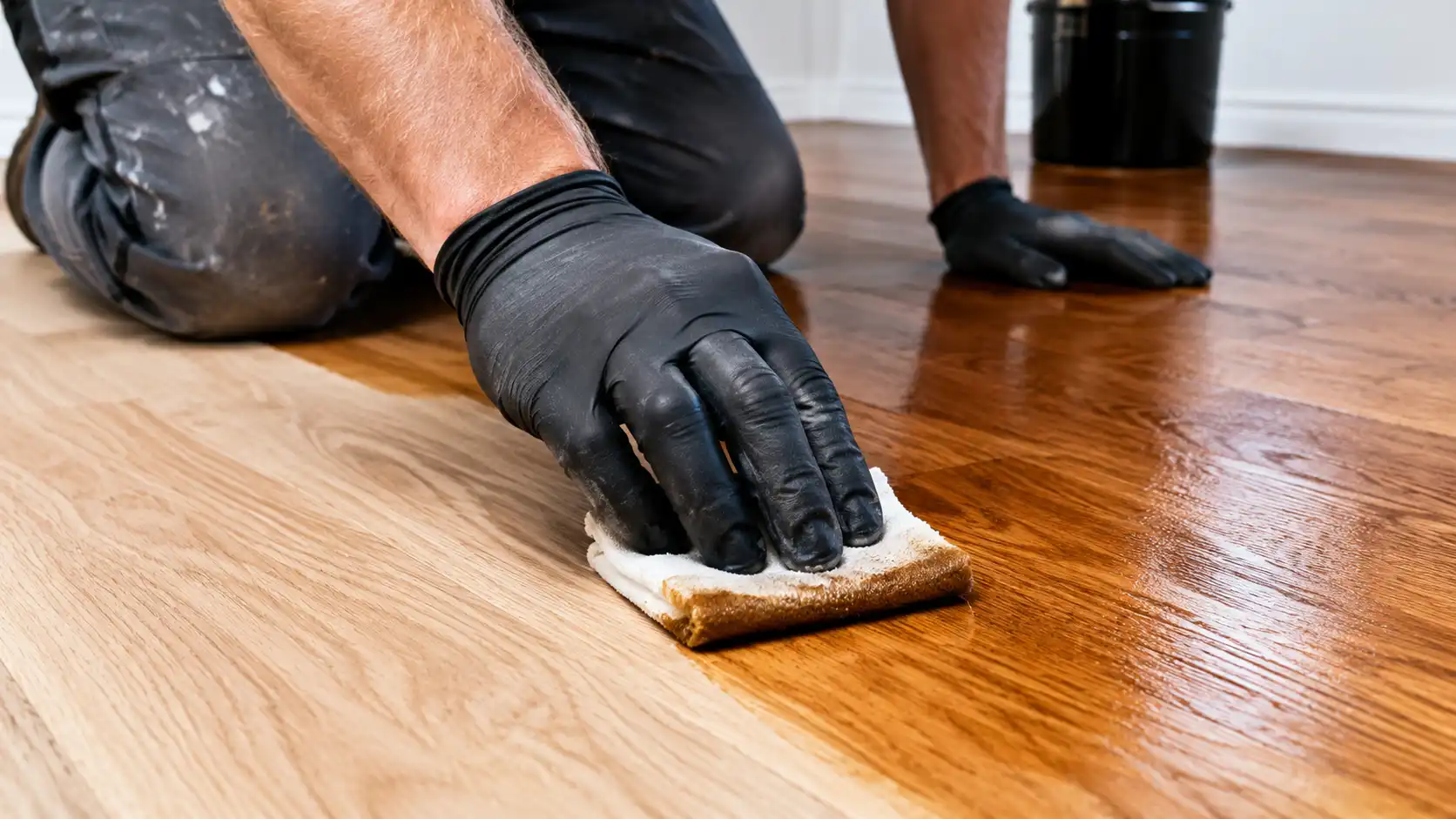
Wood stain is a pigmented or dye-based liquid applied to bare or prepared wood to alter its color. Unlike paint, which sits on the surface as an opaque film, most stains penetrate into the wood fibers and become part of the material. The result shows the natural grain and texture of the wood while taking on the color you have chosen.
Stain creates color. It does not provide significant protection on its own. On interior floors, stain is followed by a protective topcoat such as polyurethane or hardwax oil. On exterior surfaces, penetrating stains combine both color and protection by saturating wood fibers with oil-based carriers that repel moisture.
Stain vs finish — the key distinction: Stain is the color layer. Finish is the protective layer. On interior floors, stain first, finish second. On exterior decking and fencing, penetrating stains combine both in one product.
The five types of wood stain
1. Oil-based penetrating stain
The traditional choice for interior hardwood floors and the most widely used formula among professional flooring contractors. Oil carriers penetrate deep into wood fibers, producing rich, warm color with excellent grain definition and a 15–20 minute working time before the stain starts to set.
California rule: High-VOC oil-based stains above 250 g/L cannot legally be sold or used in California. Choose low-VOC compliant formulas. National Hardwood stocks only California-compliant products.
2. Water-based penetrating stain
The required choice for gray, white, and cool-toned colors that are difficult or impossible to achieve with oil-based formulas. Dries faster, emits significantly less VOC, and cleans up with soap and water. Shorter working time requires more precise application technique.
3. Gel stain
Thick, pudding-like consistency that sits on the surface rather than penetrating. Produces more consistent color on problem woods such as pine, maple, poplar, and fiberglass that absorb liquid stain unevenly. Best for cabinets, doors, trim, and furniture.
4. Penetrating oil and hardwax oil
Products such as Rubio Monocoat and Osmo Polyx-Oil combine staining and finishing in a single product. They bond with the top layer of wood fibers for a matte, natural look that appears and feels like raw wood with color. Spot-repairable without refinishing the entire floor.
5. Exterior penetrating stain
A category of its own. Exterior stains provide color and weathering protection in a single product, formulated with UV inhibitors, mildewcides, and water-repellent carriers for outdoor exposure.
| Opacity Level | What It Does | Best For |
|---|---|---|
| Transparent | Shows full grain, adds minimal color | New wood, exotic hardwoods like Ipe or Teak |
| Semi-transparent | Shows grain, adds significant color | Most residential decks, fences, cedar siding |
| Semi-solid | Shows texture, covers grain, more uniform | Older or weathered wood |
| Solid color stain | Full color coverage, no grain visible | Heavily weathered or damaged wood |
Oil-based vs water-based: the decision framework
Choose oil-based when:
- You want warm browns, dark walnuts, rich amber tones
- Working with red oak, walnut, cherry, or hickory
- Timeline is flexible and rich color is the priority
- Using oil-based polyurethane as topcoat
- You are outside California’s 250 g/L VOC cap
Choose water-based when:
- You want gray, white, or cool neutral tones
- Working with maple or other problem absorbers
- Fast turnaround is required (dries in 2–4 hours)
- Using water-based polyurethane as topcoat
- Buying in California — always compliant
Never mix without checking: Do not apply water-based polyurethane over oil-based stain before full cure. Applying too soon causes adhesion failure. Minimum cure time before water-based topcoat: 24–48 hours in warm conditions.
How the topcoat changes your stain color
This surprises most homeowners. The stain color you see on bare wood is not the color you get after the finish goes on.
- Oil-based polyurethane adds a warm amber tone that deepens and warms any color. This effect continues developing as the finish cures over months.
- Water-based polyurethane dries crystal clear and does not alter the stain color. Keeps color as close to the wet sample as possible.
- Gray, white, or cool stain colors always require water-based topcoat. Oil-based polyurethane will fight these colors and add unwanted warmth.
California VOC rules: what Southern California buyers must know
California has the strictest VOC regulations in the United States, enforced by CARB and the South Coast AQMD covering Los Angeles, Orange, Riverside, and San Bernardino counties.
CARB compliance vs FloorScore
CARB compliance covers VOC emissions during application. FloorScore is a separate certification testing the finished, cured floor surface for ongoing VOC off-gassing. Both matter for indoor air quality. We recommend FloorScore-certified finish products for interior floor applications — especially in homes with children, elderly residents, or anyone with respiratory sensitivities.
Wood stain colors trending in 2026
Southern California designers and homeowners are shifting away from the gray and very dark floors that dominated 2014–2022.
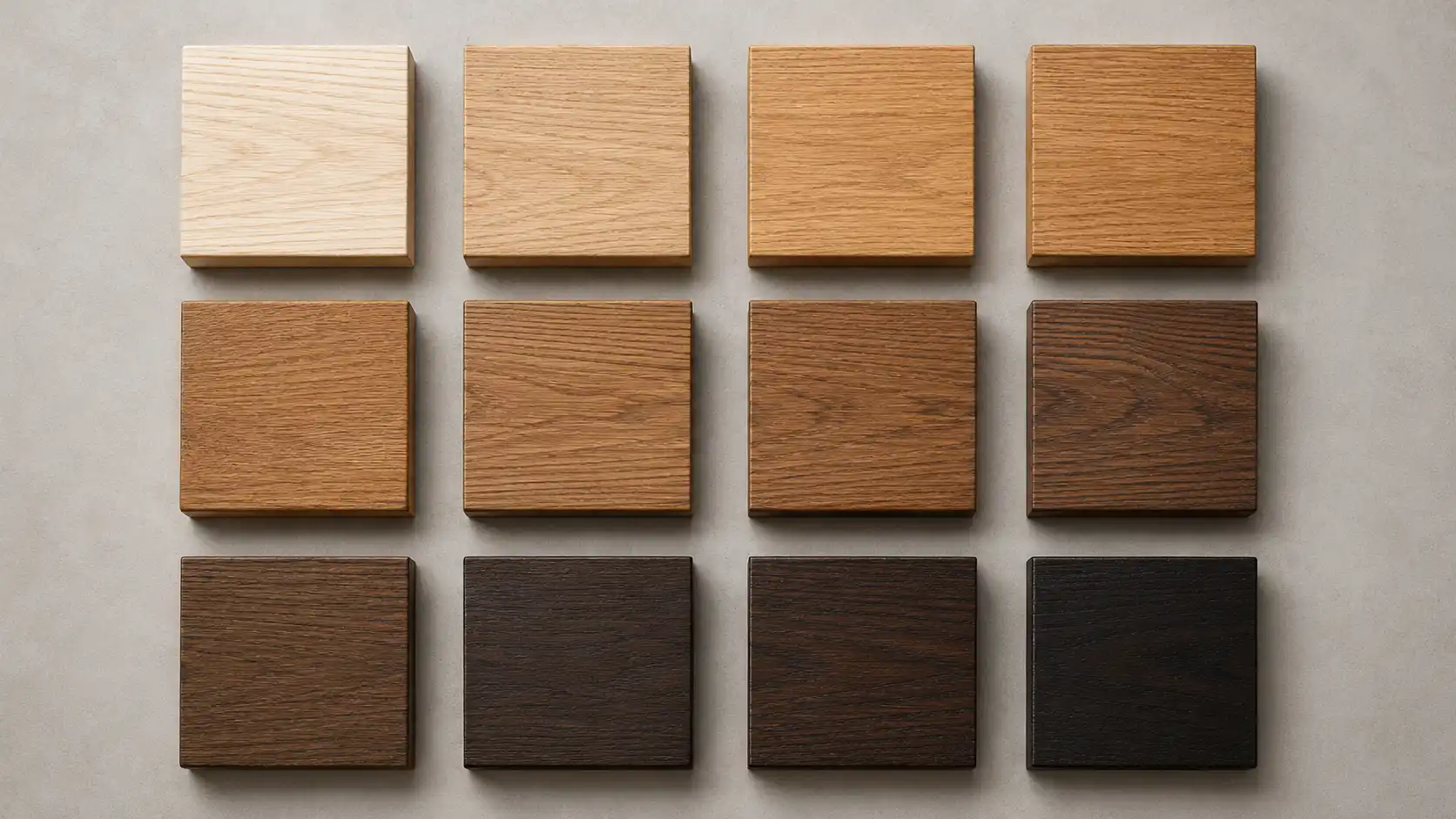
Never commit to a stain color from a store chip or website photo. Test your selected stain on a sanded section of your actual floor, let dry completely overnight, then apply your planned topcoat over the test patch. This is the only way to see the true final color.
Staining different wood species
Different species absorb stain at completely different rates and patterns. What looks perfect on oak can look blotchy and uneven on maple.
| Species | Stain Absorption | Common Issues | Professional Notes |
|---|---|---|---|
| Red oak | Very good | Reddish undertone fights cool stains | Most forgiving species for oil-based stain |
| White oak | Excellent, consistent | Subtle green undertone raw | Most popular species for staining in 2026 |
| Maple | Poor, closed grain | Notorious for blotching | Gel stain or pre-conditioner required |
| Pine | Very poor, uneven | Dramatic blotching | Gel stain for furniture; oil for exterior only |
| Walnut | Good but already dark | Limits lighter stain options | Often best left natural with clear finish |
| Hickory | Good absorption | Natural contrast between heartwood/sapwood | Staining reduces but does not eliminate contrast |
| Cherry | Good, darkens naturally | Darkens significantly with sun exposure | Light stains work well; darkens regardless of stain |
How to apply wood stain: interior floors step-by-step
Common wood stain mistakes
- Staining over existing finish. Stain must be applied to bare wood. Sanding is not optional — there is no shortcut that produces professional results.
- Skipping the test patch. Every professional tests stain in an inconspicuous area. Wood species, sanding grit, and topcoat choice all affect final color in ways that cannot be predicted from a chip.
- Using oil-based stain for gray or white colors. Oil-based stain has inherent warm amber undertones that fight cool colors. Applying oil-based gray stain to red oak often produces a green-gray result nothing like the sample chip.
- Over-applying exterior stain. Excess stain that cannot penetrate the wood stays on the surface and dries into a peeling, sticky film. Apply thin coats and remove all excess within 60 minutes.
- Ignoring California VOC rules. Purchasing high-VOC oil-based stains from out-of-state online suppliers and using them in California is illegal under South Coast AQMD rules.
