
The newel post sets the tone for your entire staircase.
Turned or box? Wrong choice makes the whole staircase look off. This complete guide covers every type, size, wood species, how to match your hardwood floors, fastener systems, and installation steps – with California building code requirements included.
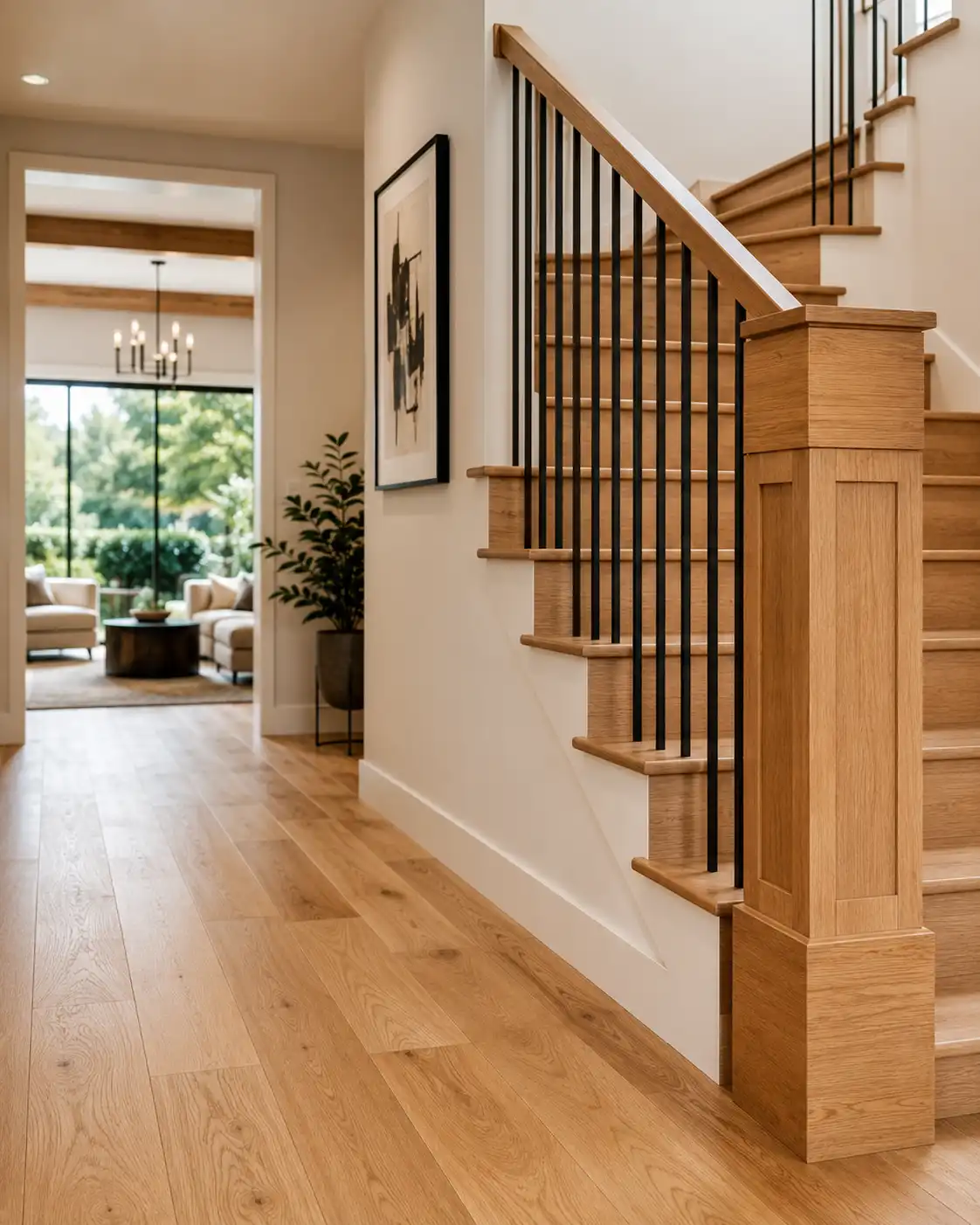
What is a newel post?
A newel post is the large vertical post that anchors the railing system at the bottom, top, and any direction-change points of a staircase. It is the primary structural element of the balustrade – the complete railing assembly – providing the fixed point into which the handrail terminates and from which the entire railing derives its stability. Without a properly secured newel post, the railing has nothing solid to anchor into, which is both a structural and a safety failure.
Beyond structure, the newel post is the most architecturally expressive element of any staircase. Its profile, height, material, and proportion communicate the design language of the home more immediately than any other stair component. A tall, ornately turned newel post reads Victorian. A wide flat-panel box newel reads Craftsman or Colonial. A slender square post reads modern or contemporary.
Newel post vs baluster: These terms are frequently confused. The newel post is the large structural post at the bottom, top, and turns of the staircase. Balusters (also called spindles or pickets) are the smaller vertical elements installed between newel posts along the railing. The newel post anchors the system. The balusters fill it.
At National Hardwood, we supply newel posts in multiple hardwood species from our Van Nuys showroom, and our in-house mill can produce custom profiles for replacement or renovation projects. We also stock stair treads and nosing so your entire staircase can be matched in species and finish from one source.
Where newel posts are installed
| Position | Also Called | Typical Finished Height | Notes |
|---|---|---|---|
| Bottom newel | Starting newel, base newel | 42 in to 60 in | The most visible post in the home – the most decorative. Floor-mounted into structural framing. |
| Top newel | Finishing newel, landing newel | 36 in to 42 in | Slightly shorter than the bottom post because it sits at an elevated position. Must match the bottom post in species and profile. |
| Landing newel | Transition newel, turn post | Matches adjacent posts | Critical structural post at direction changes. Must be secured into landing framing – not just the tread surface. |
| Half newel | Wall newel | Matches adjacent posts | Used where the railing terminates into a wall rather than a free-standing post. Fastened directly to wall studs. |
Turned vs box newel posts: the fundamental choice
The fundamental choice in newel post selection is between a turned post and a box newel. Everything else – species, size, finish – is secondary to getting this choice right for your home’s architectural style.
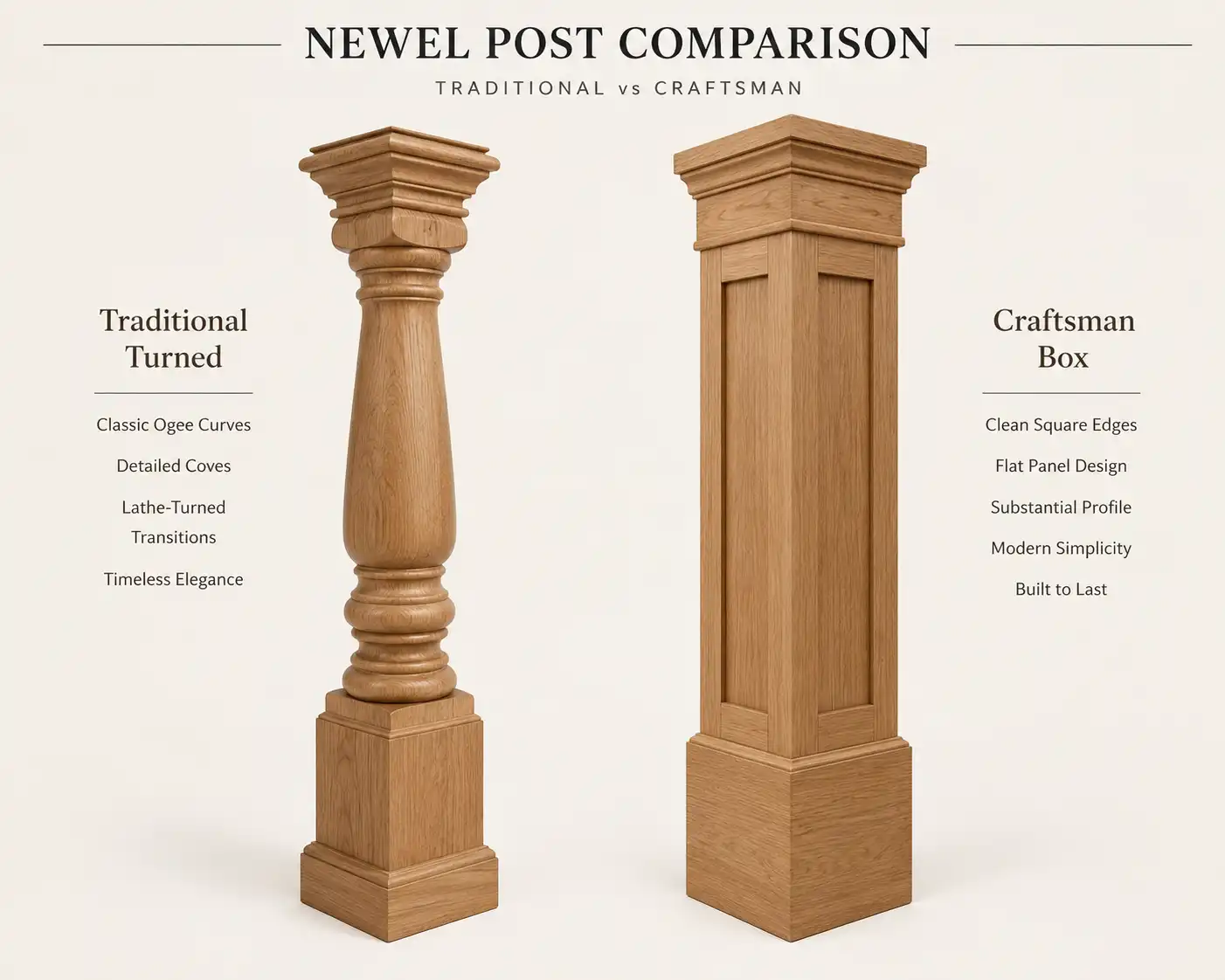
A turned newel post is a solid piece of wood shaped on a lathe, producing a rounded profile with decorative curves, coves, and details along the shaft. The shaft transitions between a rounded turned section in the middle and square sections at the top and bottom for mounting. The profile communicates the design period of the home immediately.
| Style | Profile Character | Best Architecture | Shaft Size |
|---|---|---|---|
| Traditional turned | Ogee curves, coves, classical details | Victorian, Colonial, Federal, pre-1950 homes | 3 to 4 in diameter |
| Craftsman turned | Squared-off turnings, simpler transitions | Craftsman bungalows, 1910 to 1940 LA homes | 3.5 to 5 in square sections |
| Colonial turned | Moderate detailing, balanced | Colonial revival, traditional builder-grade homes | 3 to 3.5 in diameter |
| Contemporary turned | Minimal turning, mostly round shaft | Transitional homes, updated traditional interiors | 2.5 to 3.5 in diameter |
A box newel post is a square or rectangular hollow post built around a structural core. The exterior faces are clad with flat panels, applied moulding, and decorative caps that create the appearance of a solid carved post while being lighter and allowing for much larger finished dimensions than a solid turned post.
Construction: The typical box newel is built around a 4 by 4 or 4 by 6 structural post that handles the load. Around this core, a box frame is constructed from 1-inch lumber. The exterior faces are then clad with flat or raised panels. Applied moulding bands, cap moulding, and base moulding create the decorative profile. A solid cap block sits on top.
| Style | Finished Size | Best Architecture |
|---|---|---|
| Plain box newel | 6 to 8 in square | Modern farmhouse, Craftsman, contemporary transitional |
| Raised panel box newel | 7 to 10 in square | Colonial, traditional, formal interiors |
| Column box newel | 8 to 12 in square | Grand entryways, Victorian, tall-ceiling foyers |
| Craftsman box newel | 6 to 8 in square | Craftsman bungalows, mission style, arts and crafts |
Box newels allow for significantly larger finished dimensions than turned posts. A 10-inch square box newel makes a bold architectural statement in a grand entry that a turned post simply cannot match at the same scale without being prohibitively expensive in solid wood.
Newel post sizing: proportion determines whether it looks right
The most common newel post mistake is choosing a post that is the wrong size for the room and staircase scale. A post that is too slender looks unstable. A post that is too short looks truncated. A post that is too wide overpowers the staircase.
The visual weight rule: The newel post must have appropriate visual weight for the other millwork in the room. If your home has heavy baseboards (4 inches or taller), thick crown moulding, and deep casing profiles, choose a substantial newel post. A slender 3-inch turned post looks lost in a room with 5-inch baseboards and 6-inch crown moulding. See our hardwood moulding guide for matching trim proportions.
| Ceiling Height | Recommended Post Height | Turned Diameter | Box Width |
|---|---|---|---|
| 8 ft standard | 42 to 48 in | 3 to 4 in | 6 to 7 in |
| 9 ft | 48 to 54 in | 3.5 to 4.5 in | 7 to 8 in |
| 10 ft | 54 to 60 in | 4 to 5 in | 8 to 10 in |
| 12 ft plus | 60 to 72 in | 5 in plus | 10 to 14 in |
California Building Code requirement: Handrail height must be between 34 and 38 inches measured vertically from the stair nosing (CBC, adopting IRC Chapter 3). The newel post height is not regulated to a specific number but must be tall enough that the handrail terminates correctly within this range. The railing system must also resist a 200 lb concentrated load applied in any direction at the top of the post.
Wood species for newel posts
Wood species selection determines how the newel post looks when stained or painted, how durable it is in a high-traffic location, and whether it can be matched to your existing hardwood flooring and stair treads and nosing.
Matching newel post to hardwood floor and stair treads
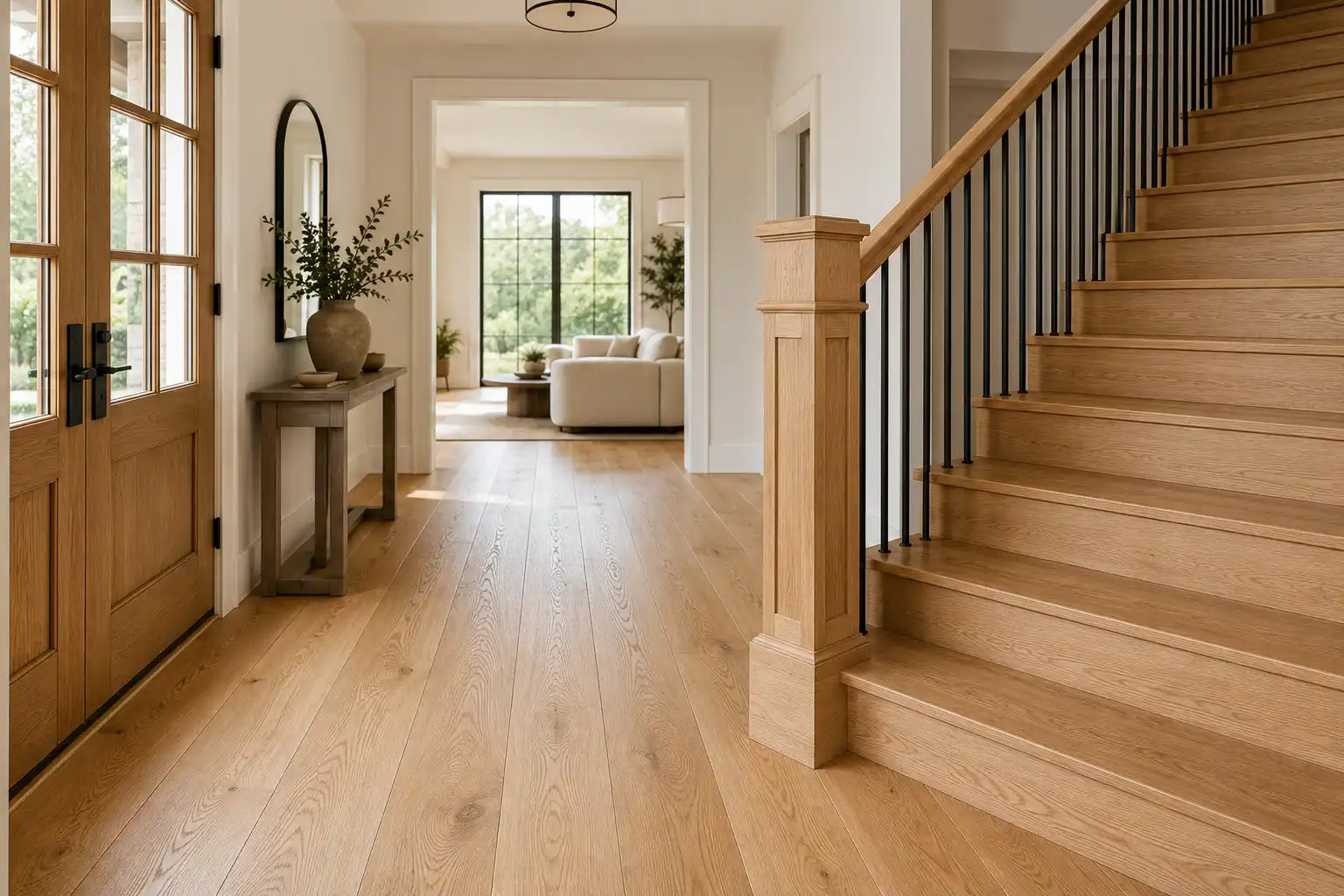
The most cohesive approach is to use the same wood species for the newel post as the stair treads and the hardwood floor. When all three match in species and stain, the staircase reads as a designed whole rather than a collection of components.
| Floor Species | Best Newel Match | Alternative | Avoid |
|---|---|---|---|
| White oak | White oak in matching stain or natural | Red oak in matching stain | Maple – grain contrast noticeable |
| Red oak | Red oak in matching stain | White oak in matching stain | Walnut – too dark unless contrast intended |
| Walnut | Walnut in matching tone | Cherry in dark stain | Maple – grain too different, visual clash |
| Engineered white oak | White oak solid or hemlock in matching stain | Hemlock in matching stain | MDF painted – cannot match stained floor |
| Natural unstained white oak | White oak or hemlock in clear coat | Maple in clear coat | Any painted post – breaks the natural wood concept |
If the original post profile in your LA home is discontinued – which is common in pre-1950 homes – bring a section of your existing newel or tread to our showroom and we will identify the profile or create a custom match from our in-house mill. We also stock engineered hardwood flooring and can match the face veneer species for your newel post.
Newel post caps and finials
The cap that sits on top of the newel post is a significant design element that is frequently overlooked. The cap must be appropriate for the post style and proportional to the post girth. The cap must be thicker in dimension than the post face by approximately 1/2 inch on each side to create a visible projection – a 6-inch box newel should carry a 7-inch cap.
| Cap Type | Profile | Best Match |
|---|---|---|
| Flat pyramid cap | Square base tapering to a flat top plateau | Craftsman, contemporary, farmhouse box newels – most popular in 2026 |
| Pyramid cap | Square base tapering to a point or acorn tip | Traditional turned posts, colonial box newels |
| Ball cap (finial) | Round ball or urn shape on a square collar | Victorian, ornate turned posts – common in pre-1940 California homes |
| Flat cap | Completely flat square block, no taper | Modern minimalist, contemporary square posts |
| Turned cap | Lathe-turned profile matching shaft details | Traditional turned posts for design continuity |
Newel post fastener and anchor systems
Newel post failure is almost always an installation problem rather than a material problem. A loose or wobbly newel post almost always results from inadequate anchoring at the base. There are three main fastener systems.
A threaded rod (typically 3/8 inch diameter) is installed through the floor and the center of the newel post base. The rod is secured to the floor framing below with a nut and washer, and the newel post is threaded down onto the rod and secured with a nut recessed into the post base and concealed by a decorative base cap.
Best for: Turned newel posts with a center bore hole. Requires access below the floor (basement or crawl space) to secure the bottom nut. Produces the most rigid connection and is the preferred method for any turned post installation.
A metal anchor bracket is surface-mounted to the floor or tread with lag screws driven into the framing below. The newel post base is then fastened to the bracket with screws driven through the bracket into the post base. Concealed by a decorative base trim applied around the post at floor level.
Best for: Box newel posts where access below the floor is not available. The bracket must be sized for the post and the lag screws must reach the subfloor framing – not just the finish floor or tread.
Lag bolts are driven horizontally through the newel post base directly into the adjacent framing – typically the stringer (the structural board running along the side of the staircase). Provides an extremely rigid connection when the stringer is solid framing lumber. Particularly effective for posts installed adjacent to a wall.
Critical: Regardless of method, lag bolts or threaded rod must reach structural framing – subfloor joists, stringers, or wall studs. Fasteners driven only into finish flooring, treads, or drywall will not provide adequate anchorage and the post will work loose. California code requires the railing system to resist a 200 lb concentrated load applied in any direction at the top of the post.
Exterior newel posts: different rules apply
Exterior newel posts used on decks, porches, and exterior stairs face conditions that interior posts never encounter. Material requirements and installation details are fundamentally different. Never use standard MDF or interior hardwood for exterior newel post applications.
| Material | Exterior Suitable | Lifespan | Maintenance |
|---|---|---|---|
| Ipe (Brazilian walnut) | Yes – best performer | 40 plus years | Annual penetrating oil to maintain color, or let weather to silver-gray |
| Cedar | Yes – naturally moisture resistant | 15 to 25 years | Stain or seal every 3 to 5 years |
| Pressure-treated pine | Yes – required for ground contact | 15 to 25 years | Stain or seal every 2 to 4 years |
| PVC composite | Yes – low maintenance | 25 to 40 years | Minimal – periodic cleaning |
| Standard interior hardwood | No – will deteriorate outdoors | 2 to 5 years | Not applicable – unsuitable |
| MDF | No – will fail in 1 season | Under 1 year | Not applicable – completely unsuitable |
Newel post installation: step-by-step
This process covers installation of a bottom newel post using the surface mount bracket method, which applies to most residential renovation situations. For prefinished floors and curved stair nosing coordination, see our dedicated guide.
Tools required
- Stud finder
- Drill and drill bits (pilot hole and lag bolt sizes)
- Level (2-foot or longer)
- Wrench and socket set for lag bolts
- Finish nailer for base trim
- Tape measure and pencil
- Wood shims for plumb adjustment
Newel post cost guide: Southern California 2026
| Product | Material | Cost Each | Notes |
|---|---|---|---|
| Standard turned newel – paint grade | Poplar or pine | $40 to $120 | For painted installations only. Most affordable option. |
| Standard turned newel – stain grade | Hemlock or oak | $80 to $200 | Good stain acceptance. Most commonly stocked at NHW. |
| Standard turned newel – hardwood | Oak, maple, or walnut | $120 to $350 | Premium species. Takes stain beautifully. Matches hardwood floors. |
| Box newel – paint grade | Poplar or pine construction | $150 to $400 | Built-up construction. Painted finish standard. |
| Box newel – hardwood faced | Oak or maple face panels | $250 to $600 | Structural core with hardwood faces for stained finish. |
| Custom turned newel | Any hardwood species to order | $300 to $800 plus | Milled to match existing profile or custom design. 2 to 4 week lead time. |
| Custom box newel | Any hardwood species to order | $400 to $1,200 plus | Custom panel profile matched to existing millwork. 2 to 4 week lead time. |
Installation labor in Southern California runs $150 to $350 per post depending on method and access. A complete staircase balustrade including newel posts, balusters, and handrail typically runs $2,500 to $8,000 in labor alone for a standard single-flight residential stair. Trade and contractor accounts receive volume pricing at National Hardwood.
