
Eco-friendly flooring that does not compromise on beauty or durability.
FSC certified hardwood, reclaimed wood, bamboo, and cork – the sustainable flooring options that actually perform in Southern California homes. CARB compliant, low VOC, and genuinely sourced responsibly. This guide covers what each certification means, which products deliver on their eco claims, and what California-specific regulations require.
- 1Is hardwood flooring actually eco-friendly?
- 2What the certifications actually mean: FSC, CARB, PEFC, Lacey Act
- 34 genuinely sustainable flooring options for Southern California
- 4California eco-flooring requirements: what the law mandates
- 5Sustainable flooring full comparison table
- 6Flooring for LEED and green building projects in Los Angeles
- 7Frequently asked questions
Is hardwood flooring actually eco-friendly?
The short answer is: it depends entirely on where the wood comes from and what certification backs that claim. Hardwood flooring can be one of the most environmentally responsible flooring choices available, or one of the most destructive, depending on the sourcing practices of the manufacturer.
The case for hardwood as a sustainable material is legitimate. Trees sequester carbon during their growth cycle. When a tree is harvested and turned into a floor, that carbon remains locked in the wood for the life of the floor – decades or even centuries. Hardwood floors do not require replacement as frequently as carpet, vinyl, or laminate, reducing the total material consumption over a home’s lifetime. And unlike synthetic flooring products, hardwood is a biodegradable, renewable natural material.
The case against irresponsibly sourced hardwood is equally strong. Illegal logging, clear-cutting of old-growth forests, and exploitation of tropical hardwoods without replanting programs cause genuine and significant environmental harm. The flooring industry has a documented history of selling wood from illegal or unsustainable sources, sometimes without the knowledge of retailers or buyers.
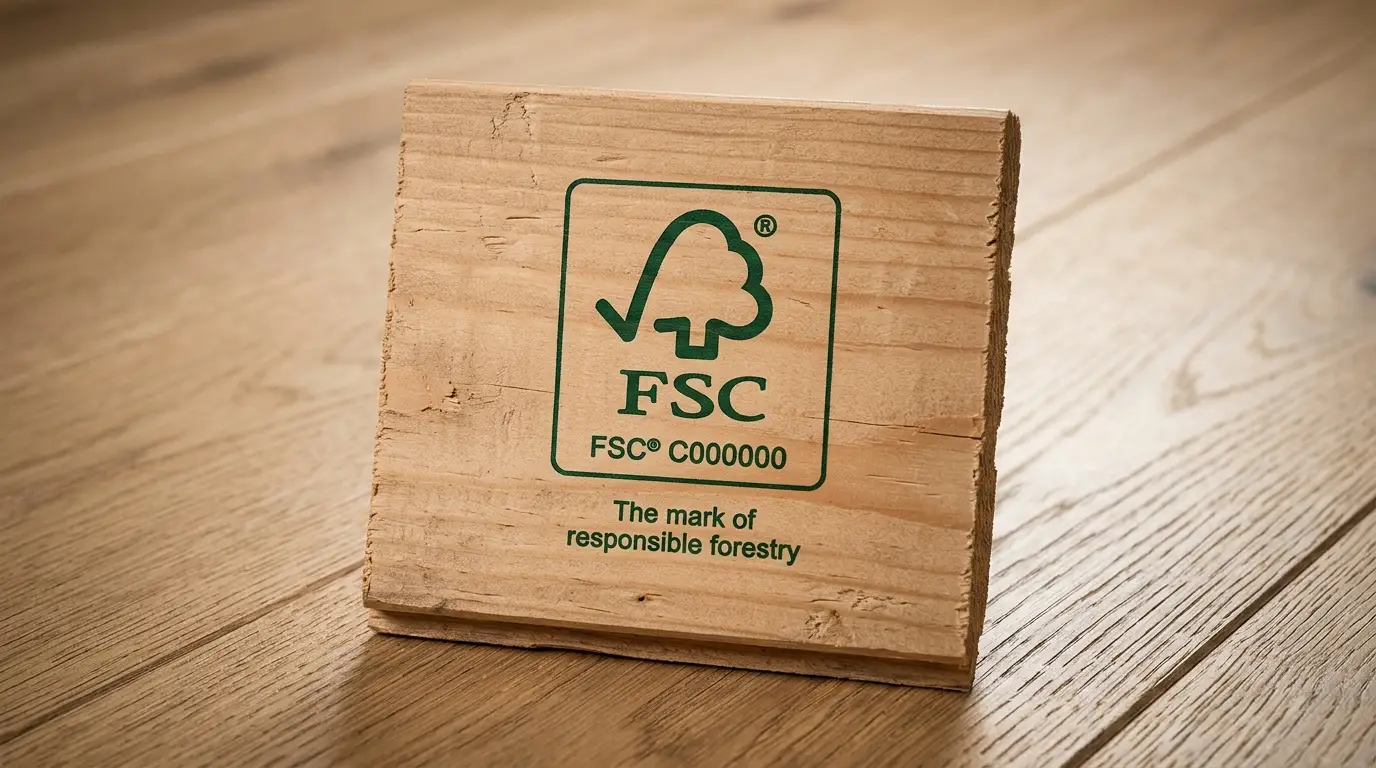
The answer: Buy certified wood. The Forest Stewardship Council (FSC) certification is the only internationally recognized standard that independently verifies responsible forestry practices from forest to finished product. CARB Phase 2 compliance ensures the wood composite products in the floor do not off-gas harmful formaldehyde indoors. These two requirements together – FSC certification and CARB compliance – are the minimum standard for genuinely eco-responsible hardwood flooring in California.
National Hardwood carries CARB Phase 2 compliant products across our entire flooring range. We can advise on FSC certified sourcing options for your specific species and project. Visit our Van Nuys showroom or call (818) 988-9663 to discuss eco-responsible specifications.
What the certifications actually mean: FSC, CARB, PEFC, and Lacey Act
Eco-flooring marketing is full of labels, badges, and claims. Understanding which certifications carry real independent verification and which are self-declared marketing terms is essential before making a purchasing decision.
4 genuinely sustainable flooring options for Southern California homes
Each of the four categories below offers a different combination of sustainability credentials, performance characteristics, and aesthetic options. The right choice depends on the room, the subfloor, the design brief, and the specific eco priorities of the homeowner.
FSC certified hardwood is the same species and quality as conventional hardwood flooring with the added assurance of verified responsible sourcing. White oak, red oak, walnut, maple, and hickory are all available in FSC certified versions from select manufacturers and distributors.
The certification adds a modest premium to the material cost – typically 5 to 15 percent over uncertified equivalents – but delivers the strongest environmental credentials available for new hardwood flooring. For LEED-certified building projects in Los Angeles, FSC certified wood earns credits under the Materials and Resources category.
What to verify: Request the FSC chain-of-custody certificate number from the supplier and verify it at info.fsc.org. Some products carry the FSC logo without a current valid certification. Independent verification takes two minutes and confirms the claim.
| Property | Detail |
|---|---|
| Species available | White oak, red oak, walnut, maple, hickory, and others – same as conventional |
| Cost premium over uncertified | 5 to 15 percent typical |
| LEED credits | Yes – Materials and Resources category |
| Performance difference | None – identical to conventional hardwood |
| CARB compliance | Verify separately – FSC and CARB are independent certifications |
Reclaimed hardwood flooring is sourced from old buildings, barns, factories, warehouses, and other structures being demolished or renovated. The wood is cleaned, remilled, and graded into flooring that carries the character of its previous life – nail holes, saw marks, weathered surfaces, and the dense tight grain of old-growth wood that is no longer legally harvested.
From a sustainability perspective, reclaimed wood is the most credible option: no new trees are harvested, no new forest is disturbed, and wood that would otherwise be landfilled is given a second useful life of decades or centuries. The embodied carbon in the wood was sequestered long ago and remains locked in the material.
The character trade-off: Reclaimed wood has visible history – nail holes, checking, color variation, and varying widths are normal characteristics, not defects. For buyers who want this character, it is a feature. For buyers who want uniform appearance, reclaimed is not the right choice. Reclaimed flooring is also more expensive than new hardwood due to the labor-intensive sourcing, cleaning, and remilling process.
National Hardwood stocks reclaimed hardwood options and can source reclaimed species on request for renovation projects. See our hardwood flooring page for current reclaimed availability.
Bamboo is technically a grass, not a wood, but it is processed and installed in the same way as hardwood flooring and performs similarly in residential use. The primary sustainability credential of bamboo is its growth rate – bamboo matures in 5 to 7 years compared to 40 to 80 years for most hardwood species. This makes it one of the most rapidly renewable flooring materials available.
Strand woven bamboo – the most common type in the US market – is extremely hard (up to 3,000 lbf Janka for some strand woven products, compared to 1,360 lbf for white oak). The manufacturing process compresses bamboo fibers under heat and pressure into dense planks that outperform many traditional hardwoods in scratch and dent resistance.
The CARB concern with bamboo: Many bamboo flooring products use urea-formaldehyde adhesive in their manufacturing process. This adhesive is a source of formaldehyde off-gassing that can affect indoor air quality. In California, all bamboo flooring must meet CARB Phase 2 limits. Always verify CARB compliance before purchasing bamboo flooring – some products sold online from non-California suppliers do not comply.
National Hardwood stocks bamboo flooring at our Van Nuys showroom. Browse our bamboo flooring selection for current available styles and species.
| Bamboo Type | Hardness | Appearance | Best For |
|---|---|---|---|
| Horizontal grain bamboo | 1,180 lbf Janka | Visible nodes, lighter look | Natural light bamboo aesthetic |
| Vertical grain bamboo | 1,180 lbf Janka | Linear grain, cleaner look | Modern interiors, less texture |
| Strand woven bamboo | 2,800 to 3,000 lbf | Dense, wood-like appearance | High traffic areas, families with pets |
| Engineered bamboo | Varies by face species | Bamboo face, plywood core | Slab installation, wide plank look |
Cork is harvested from the bark of the cork oak tree (Quercus suber) without cutting down the tree. The bark is stripped every 9 to 12 years and regenerates completely – the same tree can be harvested for over 200 years. This makes cork one of the most genuinely renewable flooring materials available, with no tree mortality involved in production.
Cork flooring has unique performance properties that no other material replicates: it is naturally thermal and acoustic insulating, naturally antimicrobial due to a compound called suberin, and naturally fire resistant. Underfoot, cork has a slight cushion that makes it comfortable for long periods of standing – a significant advantage in kitchens.
Cork underlayment: National Hardwood stocks Portuguese cork underlayment for use under hardwood, laminate, and LVP flooring. Portuguese cork is considered the highest quality cork produced, harvested from the Alentejo region of Portugal which produces approximately half the world’s cork supply. Cork underlayment improves thermal performance, acoustic dampening, and underfoot comfort for any floating floor installation.
| Property | Cork Performance |
|---|---|
| Janka hardness | Approximately 200 to 300 lbf – softer than hardwood, more durable than carpet |
| Thermal insulation | Naturally insulating – warm underfoot even over concrete slab |
| Sound absorption | Excellent – reduces impact and airborne sound significantly |
| Moisture resistance | Naturally moisture resistant due to suberin – suitable for kitchens and bathrooms with sealing |
| Renewal cycle | Bark regenerates every 9 to 12 years – same tree for 200 plus years |
California eco-flooring requirements: what the law actually mandates
California has the strictest indoor air quality standards for flooring products of any state in the US. Understanding what is legally required helps buyers separate genuine eco-credentials from marketing claims.
| Product Type | CARB Phase 2 Limit | What to Verify |
|---|---|---|
| Hardwood plywood (engineered hardwood core) | 0.05 ppm formaldehyde | Request CARB compliance certificate from supplier. Check product label for CARB Phase 2 notation. |
| Particleboard (used in some laminate cores) | 0.09 ppm formaldehyde | Laminate products must declare CARB compliance. Never buy laminate without verified CARB certification. |
| MDF (medium density fiberboard – trim and moulding cores) | 0.11 ppm formaldehyde | Check CARB certification on any MDF-core moulding or trim products. |
| Bamboo flooring | 0.05 ppm (hardwood plywood standard applies) | Many bamboo products fail this standard. Verify CARB certification before purchase. |
| Solid hardwood flooring | No CARB limit – no composite wood core | Solid hardwood is naturally low-formaldehyde. FSC certification addresses sourcing, not emissions. |
South Coast AQMD and California VOC limits for flooring finishes
Beyond the flooring material itself, California imposes VOC emission limits on the stains and finishes applied to hardwood floors. The South Coast Air Quality Management District (SCAQMD), which covers Los Angeles, Orange, Riverside, and San Bernardino counties, sets VOC limits that apply to professional flooring finishing work.
- Wood floor finishes: 250 grams per liter VOC limit in California
- Wood floor sealers: 200 grams per liter VOC limit
- Waterborne finishes are almost always below these limits and are the environmentally preferred specification
- Oil-based polyurethane finishes typically exceed California VOC limits for consumer use and require contractor application under specific conditions
- UV oil finishes and hardwax oil finishes from European manufacturers often have very low VOC content and meet California requirements
See our complete stains and finishes guide for California-compliant products for hardwood floor finishing. Every finish product we stock meets California VOC requirements.
California wildfire zone considerations for eco flooring
Southern California homes in wildfire-designated zones (WUI – Wildland Urban Interface) have additional considerations for flooring material selection. Hardwood flooring has a natural fire resistance advantage over synthetic flooring materials – wood chars and slows combustion rather than melting and spreading flame the way vinyl and synthetic carpet products can. This is a genuine but rarely discussed eco-advantage of natural wood flooring in Southern California’s high-risk fire environment.
For exterior applications in wildfire zones, Ipe wood has a Class A fire rating without chemical treatment – it is naturally fire resistant due to its extreme density. This is particularly relevant for Southern California deck and fencing applications where wildfire risk affects material selection.
Buying eco-flooring online for California installation: Products marketed as eco-friendly or sustainable that are sold by out-of-state online retailers may not meet California CARB Phase 2 requirements. California law requires compliance from all products sold or installed in the state, but enforcement at the retail level is inconsistent. Buying from a California-based retailer who verifies compliance is the safest approach.
Sustainable flooring comparison: which option is right for your home?
| Option | Eco Credential | Hardness | Refinishable | CA Slab | Cost Range Installed |
|---|---|---|---|---|---|
| FSC certified hardwood | Highest – verified sourcing | Species dependent – 950 to 1,820 lbf | Yes – multiple times | With moisture management | $12 to $25 per sq ft |
| Reclaimed hardwood | Highest – zero new harvest | Old-growth – often harder than new stock | Yes – thick boards allow refinishing | With moisture management | $15 to $35 per sq ft |
| Strand woven bamboo | Very good – 5-7 year renewal | 2,800 to 3,000 lbf – very hard | Limited – thin wear layer | Suitable – engineered core | $8 to $18 per sq ft |
| Cork flooring | Excellent – no tree mortality | 200 to 300 lbf – soft | No – replace when worn | Suitable – floating installation | $6 to $15 per sq ft |
| Cork underlayment | Excellent – under any floor | N/A – underlayment only | N/A | Yes – improves slab performance | $1 to $3 per sq ft material |
| Engineered hardwood (FSC) | Good – CARB + FSC face required | Face species dependent | 2 to 3 times with thick wear layer | Best option for wide plank on slab | $10 to $22 per sq ft |
| Laminate (CARB compliant) | Limited – HDF core not renewable | Surface only – AC3 to AC5 rated | No – replace when worn | With moisture mitigation | $4 to $10 per sq ft |
Flooring for LEED and green building projects in Los Angeles
Los Angeles has one of the most active LEED-certified residential and commercial construction markets in the US. Flooring material selection contributes to several LEED credit categories under LEED for Homes and LEED BD+C.
| LEED Credit Category | Flooring Contribution | Product Requirement |
|---|---|---|
| Materials and Resources – FSC | Credits for using FSC certified wood products | FSC chain-of-custody certified hardwood or engineered wood |
| Indoor Environmental Quality – Low VOC | Credits for low-emitting materials | CARB Phase 2 compliant flooring + California-compliant finishes |
| Indoor Environmental Quality – FloorScore | Credits for certified low-emission flooring | FloorScore or GreenGuard Gold certified products |
| Materials and Resources – Recycled Content | Credits for recycled or reclaimed materials | Reclaimed hardwood flooring qualifies as reclaimed material |
| Regional Materials | Credits for locally sourced materials | Materials harvested and manufactured within 500 miles of the project site |
For LEED-certified projects in the Los Angeles area, National Hardwood can provide the documentation required for LEED credit submissions: FSC chain-of-custody certificates, CARB compliance documentation, FloorScore certification numbers, and regional sourcing information. Contact us with your project specifications to discuss documentation requirements.
See the professionals and trade accounts section for our trade program and LEED documentation support.
Frequently asked questions
Eco-responsible flooring starts with the right conversation.
CARB compliant products, FSC sourcing documentation, and cork underlayment – all available at our Van Nuys showroom. Bring your project specifications and we will help you build the most sustainable floor system for your Southern California home.
